A Look at Holy Week

The ancient Hebrews used a lunar calendar, this means that the 1st of the month was during the New Moon phase and that would make the 15th of the month the Full Moon phase.  It was fun to connect the days of Holy Week with the lunar calendar; it just shows the orderliness of our God.

Day of our week Day of the  lunar calendar Passover Holy Week events
Sunday 10th Choosing and prepping the lamb The ride into Jerusalem, people prepared the way
Monday 11th Jesus cursed the fig tree and cleared the Temple courts,
Tuesday 12th Explained the dead tree and taught the people
Wednesday 13th He was prepared for his burial at the dinner
Thursday 14th Lamb is slaughtered and prepared at twilight Room prepared, Passover observed, prayed in the Garden
Friday 15th Burned any leftover lamb Trials and crucifixion
Saturday 16th Jesus preaching to the spirits in Hell
Sunday 17th He rose and showed himself to select people

The first Passover, when the Lord kept watch to bring the People out, they started for Succoth.  The starting point was Rameses; the distance is about 30 miles so that was a long walk on very short notice.  Pharaoh actually ordered them to leave.  The celebration observes seven days of bread with no yeast because that is what happened on the first Passover.

I have been writing for several years on numbers in the Bible.

  • Thirteen was about how new things started in association with that number.
  • Fourteen actually started events.
  • Fifteen is linked with cleaning things up to celebrate.
  • Sixteen was that God kept His eye on things

I found the connections between those studies and the days of the month for Holy Week interesting.

I have other studies on the days of the Holy Week – Thursday, and post labeled Easter 2015,

Moses’ Rod/Snake

A simple piece of wood, a tool of Moses’ occupation, but it would become part of miracles¸ signs, and wonders.  It became the symbol of spiritual authority for the Israelites and a bane to the gods of Egypt.

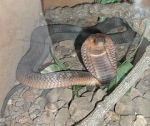
This piece of wood is introduced in Exodus 4 where God tells Moses to throw it on the ground and it becomes a nachash (from hiss) or snake.  Moses ran from it.  Since this was not in Egypt but in Midian, I am choosing the Black Desert Snake or Desert Cobra asSinai-Desert-Cobra the snake.  Since Moses was to go to Egypt with this “sign”, I don’t think it would have been an Egyptian Cobra.  No, I cannot prove that.  Either snake is poisonous, the Black Desert Snake has an LD50 or lethal dose that kills 50% of people bit with a 0.4 mg/kg; an Egyptian Cobra’s LD50 is 1.15 mg/kg but probably delivers more venom per bite. That would make the Black Desert Snake more poisonous.  I don’t really hold it against Moses for running, if it was a Black Desert Snake, he knew that they were deadly.  He did brave it up and grabbed the tail which is something that not many people would do.  Can you imagine carrying that rod around for the next several years?  I personally would have been very careful not to drop it on the ground, just in case.

In Exodus 4:3 and 7:15 it is just a snake, but in 7: 9, 10, 12 Moses does not use the word nachash but instead calls his rod and the magicians’ rods tanniym or monster.  (I would think the magicians’ rods were paralyzed Egyptian Cobras and Egyptian cobrathe throw brought them out of their trance.)   This word tanniym is translated in other passages as whale, dragon, and jackal.

Another thing I found was instead of saying that Aaron’s snake swallowed the other snakes; Scripture says his ROD swallowed the other rods.  The importance in that change of words says that Aaron’s spiritual authority, as the servant of God, defeated the authority of the magicians.

Pics from: https://en.wikipedia.org/wiki/Walterinnesia_aegyptia and

https://en.wikipedia.org/wiki/Egyptian_cobra

Midian – Enemy and Instrument

Midian – Enemy and Instrument

Midian was a son of Abraham by his third wife Keturah (Genesis 25).  His descendants played an important role in the Exodus story and into the Judges’ time period.   Some experts think that Midian was several groups of people and or a geographic area and not just a single nation.  They start their part in the story of Israel when Joseph’s brother sold him into Egypt (Genesis 37).  This is also where Moses fled when he ran away from Pharaoh; his wife, father-in-law, and children were Midianites.

In Numbers 22 the story of Moab and Midian working together to stop Israel by bringing in Balaam is told.  It seems that Balak, king of Moab, takes the lead and even in Numbers 25 it first mentions Moabite women as being the lure to get Israel to sin.  A Midianite woman is killed in verse 8 and it stops a plague; in verse 16 the Lord says to treat Midian as enemies and kill them because of the deception with the Baal of Peor.  In Numbers 31 Moses is to lead a campaign against them and then he will die.  It must have been quite an attack because many important people including kings and Balaam were killed.

A thought that should disturb the people of God is that sex was used as a weapon in the name of religion to defeat God’s people.  The devil crossed and confused the lines then and is still doing it today.

The other big reference to Midianites is with Gideon in Judges 6, 7, and 8.  This story also ends with the Midianites being beaten severely.    There are references in Psalm 83, Isaiah 9, and 10 that talk about how badly Midian was beaten.  They don’t say if it was Moses or Gideon but the context makes it sounds like the beatings were bad and that a similar beating was wished on the current enemy.

Living in the “now” of troubles and testing compared to analyzing them later will produce two very different views.  This is a “later” point of view; God used the Midianites to push Israel to a deeper walk and expose things that still they needed to deal with.  One example is the army killing the men and keeping the women who were the instrument that got them into trouble.  Even later the Israelites were still dealing with the troubles of Peor, possibly, the girl slaves and the children born from them.  Midianite DNA and mindset were spread into every tribe of Israel, including Levi.  Be careful what you choose to live with no matter how you got it.

The Wonders That Plagued Egypt

http://www.sofiatopia.org/maat/eyes.htm

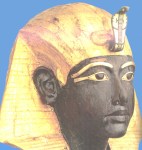
Before the Exodus of Israel God did eleven wonders against Pharaoh and Egypt.  I did not make a mistake Moses did eleven wonders, not ten.  The first wonder is in Exodus 7: 10 were Aaron threw down the “rod of God” and it became a snake, probably a cobra.  The court magicians threw down their staffs and they were/became snakes.  (The snakes were probably paralyzed so as to be walking sticks for the magicians.)  All eleven of these wonders/signs defeated an Egyptian god.  The cobra was a symbol of Pharaoh who considered himself a god.

The wonders of blood, frogs, and gnats happened to both the Egyptians and Israelites.  I think this had to happen because the People had gotten too much of Egypt in them and Father God had to get their attention.  These wonders are against water and land but also the attack of the frogs was wrapped up with beer and important food in Egypt.  The magicians could do the snake, blood, and frogs, but the gnats they proclaimed the “finger of God.”  (See Frogs in the Bible and Reflections on Judgments)

During ten of the wonders, Pharaoh hardened his heart and “would not listen” or “let the people go.”  This phrase is repeated many times and three different words are used for “hardened.”  I will look into these words in a separate post.

If you accept the snake as one of the wonders there is a pattern of 1, 3, 3, 3, 1 to the plagues (hard hits).  In the “second three” the stakes go up and only the Egyptians are affected (Exodus 8:22).  I know that people had to deal with dead fish and frogs but in this “three” livestock died, so a loss of food/income hits Egypt.  The plague of the livestock would also be the sixth wonder (six is the number of man) and it hits them in the pocketbook.

In the next three wonders (hail, locust, and darkness) God says he unleashes the “full force of the plagues” (9: 14, 16).  In the plague of hail, people die because some officials would not bring in their slaves and field workers.  This is the first time people died, before this, it has only been animals dying.  The hail would be the “eighth” wonder, eight is the number of new starts, and these last four plagues finally break Pharaoh and the Egyptians.  The People don’t get any of these plagues as God continues to show both sets of people that He is choosing one over the other.

The last “hard hit” of the firstborn is special in that it will purposely affect man and animals.  It also had the potential to affect the People of Israel and Egyptians alike.  If the firstborn of the People were not covered by the blood of the lamb they also would have died.

How about it?  Are you covered by the Blood?  If not please read the “Got Jesus” button at the top of the page.

PIC  http://www.sofiatopia.org/maat/eyes.htm

Moses – You Returned!?

Moses the most humble man in the world, the friend of God who ate with Him and saw His back, the doer of miracles, and leader of the people of Israel. You would think with all of those credentials Moses must have been willing to be moldable clay in the hand of the Master Potter. Wrong! He had issues and the big one was he had some serious history with Egypt and did not want to go back. He had made a mess of things when he left and did not want to face the court of Pharaoh or the people of Israel. This story starts in Exodus 3 and 4.

This concept of going back somewhere you left is on my mind because for the first time in my career I am returning to a school district that I left thirteen years ago. I had not left a mess like Moses, but I never thought I would be returning either. To say that I am not questioning why would be an understatement. Like Moses, it means leaving a comfort zone and going back to something that has changed while you were gone. His wife Zipporah and his sons had to leave family and friends for an uncertain future.

Father God had given him some glimpses of the road ahead but not the mistreating of the people by the Egyptians, the plagues, or being chased by a determined army. God had given him some pretty convincing signs to do but there was no mention of the people being stubborn and rebelling.

In looking at the big picture (that is all I can do for now) this is what I see happening:

  • Moses was retrained
  • Moses knew he was to go and he went
  • God sent him help, in the form of Aaron
  • Moses had command of supernatural powers to do the job
  • Not everyone was excited by his return or his mission
  • God walked with Moses through his mission