A Name Is Important

I recently had a comment that said I was not calling the children of Abraham by the correct terms. Basically I was misusing the words Israelite, Hebrew, and Jew. The reference source was the 1980 Jewish Almanac and it said, “Strictly speaking it is incorrect to call an Ancient Israelite a ‘Jew’ or to call a contemporary Jew an Israelite or a Hebrew.” The commenter, I feel, had another reason for informing me of my error (enough said).

In Sid Roth’s book They Thought For Themselves one testimony quoted a rabbis as saying, “You cannot understand the Bible without the Jewish Commentaries” (p 102). So staying in that line of thinking I found in http://judaism.about.com/library/3_askrabbi_o/bl_simmons_hebrews.htm that in the Book of Exodus they were called Israelites (1:1) and Hebrews (1:15). While in Jeremiah 32:12 they were referred to as Jews. Israelite comes from the words Bnei Yisroel or Children of Israel, Hebrew is from Ivri, and Jew is Yehudim because the kings of Israel were from the Tribe of Judah.

A Look at the Biblical Calendar

A Look at the Biblical Calendar

In Mark 14: 5 some disciples were complaining about Jesus being anointed with a “bottle” of pure nard.  The complaint was it could be sold for a year’s wage or three hundred denarii.  According to Matthew 20, a denarius was a day’s wage.  The year in the Bible was twelve months or lunar cycles (29 ½ days). (Some years had thirteen months to make up the eleven-day difference and that would keep the season in line with the calendar.)  So why only 300 denarii?

They were to rest on the Sabbath, so there are forty-eight days (four weeks times 12 months).  For the missing days, we need to look to the feast days, I will use Leviticus 23.  These had a “no work” or “no regular work” day associated with them, which means they would not be paid on these days.

  • Unleavened Bread – one at the beginning and the end
  • Pentecost – one day
  • Feast of Trumpets – one day
  • Day of Atonement – one day
  • Feast of Tabernacles – one at the beginning and the end
  • This is seven no work days.

That totals to 299 days – I guess we can round off one day or it is more than a year’s worth of wages.

The Number Fifteen in the Bible – Cleaning Up to Celebrate

The number Fifteen -15 in the Bible.

FYI – Depending on the translation and the concordance you use some of these numbers may appear different.  For this study, I just wanted the number fifteen (15).  The NIV and KJV handle numbers differently.  The KJV will spell them out like eight hundred and fifteen while the NIV will write 815 (Genesis 5:10).  Also, the NIV translates some numbers in standard units (what Americans will understand) like 15 feet while the KJV would say 10 cubits (Zechariah 5:2).

  • The first number fifteen (cubits – this is twenty feet) is in Genesis 7:20 and is the depth of water covering the mountains with the Flood.
  • The second usage is with the walls of the courtyard of the Tabernacle.  There were two fifteen cubit walls forming the east side leaving a twenty cubit gap that had an offset hanging acting as the gate (Exodus 27:14).
  • The third usage is in Exodus 16:1 (see 10 Test and Timeline).  This marked the second month of the Israelites marching out of slavery.
  • The most references are with Feasts (Leviticus 23).

As I thought about the fifteen cubits in Genesis I realized it was not the depth of water but the fifteen.  God used the water to “clean” the earth of corrupt humanity.  Several source listed below will tell you that if you added the letter yod (10) and the letter hey (5) you would get 15 which happens to spell out a name of God.  In Hebrew, however, it is written with the 9th (teth) letter and the 6th (waw) letter out of respect for God. (Sorry, Hebrew letters are also used as numbers.)

The total width of the courtyard for the Tabernacle was 50 cubits, that was the west and east side (the one that faces the sun).  So as you entered on the east side to worship there was a 15 cubit wall on your left and your right. (See Camp and Marching Order) The bases holding up the curtains/walls also had a fifteen associated with them. (Think about that for a minute!)

The most references with fifteen belong to 15th of the month because several Feasts (celebrations) start on that day – Unleavened Bread, Booths/Tabernacles, Purim, and several you may not find in a Christian Bible.  Passover is on the 14th of the first month and the 15th is the start of Feast of Unleavened Bread, which is also when Pharaoh let Israel go because the firstborn all died (another cleaning/judgment).  The Feast of Tabernacles celebrates the exodus when Israel lived in booths waiting for everyone over twenty to die.  A “silent/hidden” fifteen is associated with the Feast of Pentecost (Leviticus 23: 17 – 21) it is the number of offerings:

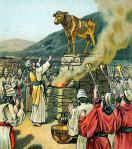
Why the fifteenth of the month?  If you do not know it the Hebrew calendar is set on a 30-day month (lunar cycle) with the month being the actual unit of time.  The first day is the new moon so the fifteenth day would be the full moon of each month.  Here are some thoughts about this: the Feast was a reminder of the “best” of Egypt dying and them leaving; full moon is a reflection of sunlight at its best; it still could add up to be a name of God. (Something to think about.)  To be fair to one source I read which said 15 represented “rest.”  The Feast do start (and end) with a day of rest but the first one, the day after the first Passover, was them leaving in a hurry. These Feasts (Day of Atonement/Yom Kippur and Feast of Tabernacle) were so important that Jeroboam set up a false holiday on the 15th of the 8th month to act as a distractor for the Ten Tribes (1 Kings 12:33).  In Ezekiel 31:17 it is talking about Egypt, the time frame the 15th day of the first month (Passover/ Unleavened Bread).  Purim is the holiday from the Book of Esther and is still celebrated today (enemies got cleaned out).

Another notable story that has fifteen wrapped in it is the healing of Hezekiah where God added fifteen years to his life (2 Kings 20:6, Isaiah 38:5).  One resource concluded that fifteen must deal with “addition” because fifteen years were added to his life.  His reign was twenty-nine years long so this extra fifteen years started in the fifteenth year of his reign.

Some other non-holiday references with fifteen being a part of the story are (You will find these scriptures in a King James Version.):

  • Hosea 3:2 where the prophet bought his wife back for fifteen pieces of money (a picture of Jesus redeeming His Bride)
  • Solomon had columns in rows of fifteen holding his house up (1 Kings 7)
  • Ziba in 2 Samuel 9 had fifteen sons
  • 2 Kings Amaziah king of Judah lived 15 years then he was killed (cleaned out)
  • Asa king of Judah threw a party in the 15 years of his reign to renew the seeking of God – 2 Chronicles 15:10
  • Bethany was fifteen furlongs from Jerusalem
  • Paul spent fifteen days with Peter (Galatians 1:18)
  • Acts 27:28 finds Paul in a boat over fifteen fathoms of water.  Chronologically this would be the last listing of fifteen in the Bible.  The first reference (Genesis 7:20) had fifteen units of water and a boat also. (Just saying.)
  • Luke 3:1 is where John the Baptist starts to preach and that was the 15th year of Tiberius.  (Another party was starting.)

God “cleaning things” and “parties starting” seem to happen, a lot when the number fifteen is involved.  The feast were times to enjoy God and His goodness by drawing close to Him so they are cathartic in themselves.

Screen Shot 2014-05-17 at 8.07.29 PMThe fifteenth letter in the Hebrew alphabet is Samech.  I will list some things associated with it but follow the links to the various sources for a better study (Please note that some are Messianic Jew/Christian and others are strictly Jewish).

  • Numerically it represents the number sixty.
  • The priestly blessing has fifteen words and sixty letters.
  • It means “to support” or “to protect.”  This is all forms of support: spiritual, financial, physical, moral, etc.
  • Samech (15) and Mem (13) surround/support Nun (14).  Samech and Mem are the only fully enclosed Hebrew letters. (See studies on Thirteen and Fourteen).  Nun may represent someone who is “bent down.”
  • Because it is circular it represents the wedding ring.

There are still other references with the number fifteen (15) in the Bible but I hope you will continue to study as this number/letter has a lot associated with it.

References/Resources

Faith, Hope, Love

Faith, Hope, Love

1 Corinthians 13:13 And now these three remain faithhope, and love. But the greatest of these is love.

Colossians 1:5 the faith and love that spring from the hope stored up for you in heaven and about which you have already heard in the true message of the gospel

1 Thessalonians 1:3 We remember before our God and Father your work produced by faith, your labor prompted by love, and your endurance inspired by hope in our Lord Jesus Christ.

1 Thessalonians 5:8 But since we belong to the day, let us be sober, putting on faith and love as a breastplate, and the hope of salvation as a helmet.

  • Faith has its definition and examples in Hebrews 11.
  • Love has its descriptors in 1 Corinthians 13.
  • Does Hope have a chapter or verse?
  • Hope as defined in the 1828 Webster’s Dictionary is:

HOPEnoun [Latin cupio.]

  1.  A desire of some good, accompanied with at least a slight expectation of obtaining it, or a belief that it is obtainable. hope differs from wish and desire in this, that it implies some expectation of obtaining the good desired or the possibility of possessing it. hope therefore always gives pleasure or joy; whereas wish and desire may produce or be accompanied with pain and anxiety.
  2.  Confidence in a future event; the highest degree of well-founded expectation of good; as a hope founded on God’s gracious promises; a scriptural sense.

HOPEverb intransitive  To place confidence in; to trust in with the confident expectation of good.

A chapter or verse just for Hope – no.  It’s not even a fruit of the Spirit (Galatians 5:22).  Well, maybe there is one place but it is a stretch – 2 Peter 1:5-7(NIV) For this very reason, make every effort to add to your

  • faith
  • goodness; and to goodness,
  • knowledge;and to knowledge,
  • self-control; and to self-control,
  • perseverance; and to perseverance,
  • godliness;and to godliness,
  • mutual affection; and to mutual affection, (early editions have brotherly kindness)
  • love.

 In defense of my thinking.  No, those six things are not really in the definition of hope but you are not going to have hope if you do not have those qualities.

For more on the word HOPE (Just click, it is a previous post.)

http://webstersdictionary1828.com/Home?word=Hope

Verses were retrieved from https://www.biblegateway.com/quicksearch/?quicksearch=faith+hope+love&qs_version=NIV

All verses used are New International Version (NIV) Holy Bible, New International Version®, NIV® Copyright © 1973, 1978, 1984, 2011 by Biblica, Inc.®


Eliashib “Why is the house of God neglected?”

Who is Eliashib?  Well, definitely not a top 40 Bible character!  Can’t find him then go to Nehemiah 13.

Eliashib is a priest; well not just a priest he is the High Priest (v. 28) after the 70-year (Sabbath) rest of the land that Jeremiah predicted.  This was because Israel had forgotten about Jubilee and that the land was to get a rest also.

The quick storyline of Nehemiah – Nehemiah, an official of King Artaxerxes, petitions to go to Jerusalem and rebuild the town wall.  He does it in record time but he has opposition Tobiah and Sanballat who hate Israel and Jerusalem.  Nehemiah sets things right and is called back to Artaxerxes.  (We will assume Ezra the priest has died.)

Eliashib who apparently has not read the Book of Moses (or did not care) cleared out the room reserved for the grain offering for the Levites and let Tobiah move in.  This set several things into motion.  The Levites had to go back to their fields because of no more grain offerings.  No Levites, no one to stop merchandise from coming into Jerusalem on the Sabbath. Then Nehemiah found that men were marrying foreign women.  These were some of the sins that lead to the destruction of Jerusalem and here they were doing it again.  Who was leading this destructive behavior, the High Priest?  It was so bad the Eliashib had allowed his grandson to marry into Sanballat’s family.  So the boy would have been in line to be the High Priest.

What happened, the people read the Bible and put an end to it and then the man of God shows up and changes the High Priest because he ran Eliashib and his family off.

Point is READ your Bible and Know the Word.

Last point – The people had read Deuteronomy 23:3 that no Moabite should be allowedDavid052 into the assembly of God.  What about David and Solomon?  Their grandmother was Ruth the Moabite.  Did God just overlook His Word?  Look at Ruth 4:9 Boaz as kinsmen-redeemer got Ruth as a wife.  He redeemed Ruth!  I image it was just like Jesus redeeming us, we became new people in the sight of the Law and anything in the past cannot be counted against us.

http://clipart.christiansunite.com/1379673661/Bible_Characters_Clipart/David_Clipart