Psalm 103 – Benefits

Benefits:

  1. Forgives
  2. Heals
  3. Redeems
  4. Crowns
  5. Satisfies
  6. Works for the oppressed

His Ways and Deeds:

  1. Compassionate
  2. Gracious
  3. Slow to anger
  4. Abounding in love
  5. Removed our transgression
  6. Has compassion
  7. He knows us
  8. His love is with those who fear Him

I am going to deal with the word “righteousness”, as it appears with the “Benefits” and “His Ways and Deeds.” It is in verse 6 and 17 and both times it is used it is the feminine form – tsdaqah.   The Strong’s Concordance states that it is used 157 in the Old Testament but is not found in Exodus, Leviticus, 2 Kings, Eccl, Lamentations, Habakkuk, and Zephaniah. Tsedeq is the masculine form and is used 119 times mainly in poetic literature. Both of these words have a figurative usage of “prosperity.” The conclusion of many exegetes is that the terms have a relational and legal significance.

In verse 6 He is working for the oppressed while in verse 17 it is with those who fear the Lord and their children. At least in these verses, the relationship is the stronger with the weaker thus reflecting the Bridegroom/Bride relationship Jesus has with His Church.

See Psalm103 – Praise and Moses

I used the 1990 NIV for this study.

Psalm 103 – Moses

Psalm 103:6 He (the Lord) made known His ways to Moses and His deeds to the people Moses_Pleading_with_Israelof Israel. (NIV)

My study note on this verse was – Why not Abraham or Jacob/Israel? That was several years ago but as I began to study Psalm 103 that question nagged me again. Why did God wait to show “His ways” to a man? Why Moses and not the Father of Faith – Abraham or Jacob, Joseph, or Judah?

Why did David single out Moses as having been shown the “ways of God?” I mean Abraham had gotten a promise and a covenant from God and had been shown favor so why Moses? I am going to digress here a moment and think about the relations these men had with God. In Exodus 6: 2- 5 God said that Abraham, Isaac, and Jacob knew Him as El-Shaddai (the God who pours out His riches because of His grace) thinking about these men they were blessed. Yes, they were tested, had trials and even messed-up but they were blessed because of God’s grace. However, in the same verses, God said He had not shown them the Jehovah (the One Who promised them deliverance because of His divine control) side of His nature. This part was for Moses and the children of Israel to experience.

Both Abraham and Moses experienced visits with God. In Genesis 12:7, 17:1, and 18:1 God “appeared” to Abraham; at first, I thought of a vision like he had in chapter 15:1. But according to Strong’s Concordance “appear” carries the context of something literally seen. Moses also had “visits” in the burning bush (Exodus 3), the heavenly dinner party (Exodus 24), and the times in the cloud on the mountain.

Both men had conversions with God, but it seems that Moses wrote things down while Abraham passed things on orally. Before the event that is talked about in Psalm 103, which is Exodus 33:13, Moses had written a Book of the Covenant (Exodus 24: 7).

So now to the question as to why God’s ways were revealed to Moses – Moses asked! Exodus 33:13 records the conversation Moses had with God. The NIV states it this way, The Path“If you are pleased with me, teach me your ways so I may know You.” The context here is important because in verse 12 Moses is talking about leading the people. “Ways” means a highway or well-traveled path so with a little play on words Moses is asking for two things in this passage – physical direction and spiritual knowledge. (See study on Paths and Ways). A lesson here for leaders, you need to ask to know God’s ways.

Psalm 103 – Barak the Lord

I know I have read this Psalm (103) many times, in my Bible it has highlights and underlines I even imaged a place and time that David would have written it but that apparently did not mean I studied it. Well, for the place and time I could see David having penned this awesome song in 2 Samuel 12:16. This is where David is pleading for the life of the first child he had with Bathsheba. For seven days David is pleading with the Eternal God of Israel; I am sure he was stating why he would follow such a great God. David would also be reminding God of His awesome deeds and righteous ways, part of this would be comparing things David can see to the Father’s bigger realities. But what pulled me into this study was the phrase – “Praise the Lord, O my soul.”

KJV vs. NIV and Hebrew vs. English has always been a reason for me to study and Psalm 103 continues this tradition. The NIV translators rendered barak to mean, “praise” while in Hebrew it is “bless.” Vine’s Dictionary adds it is – to kneel, bless, be blessed, or curse.

I liked that it started and ended with “Bless the Lord, O my soul.” Taking that thought a step farther I only found two psalms that begin and end with that phrase, 103 and 104. There are several that begin and end with “hãlal” or Hallelu Yah or as we say in English – Hallelujah! I believe those Psalm are 135, 146 – 150.  Verses 1, 2, 20, 21, and 22 a, b begin with barak and verse 1, 2, and 22b add the phrase “O my soul.” So six times (man’s number) it is said to “bless” the Lord, actually the three that add “O my soul” are for David (men) while the other three are directed at other creations.

Verses 19 – 22 are a “verse” or thought within this psalm. They deal with God’s kingdom and who should barak. David notes that angels, heavenly host, all His works, and my soul are to bârak. At first I was puzzled by angels, heavenly host and all works, I thought for sure David was repeating himself but a check of the Hebrew definitions added to the depth of this Psalm. The “angels” or messengers seem to be a specific group of created beings while the “heavenly host” is the rest of God’s army. This is consistent with the rest of Scripture because different “classes” of angels are mentioned in the prophets and Revelation. “All His works” is just that, everything thing else: plants, animals, the waves, and the heavens.

Psalm 103 ends as it began, a personal call for the individual to barak his God with everything that is within him.

Top 20 Song or Musical Sunday School Lesson?

A look at Psalms 60 and 108

Previously, I wrote a blog entitled Where and When the Psalms Were Written. In that blog, I matched the verse in the Bible that may have been the inspiration for writing the Psalm. Psalm 60 and 108 were two of those psalms but I want to compare them because they have a large similar portion used in two very different psalms.

I believe Psalm 60 was one of the reasons I started doing the matching. Its timestamp was easy to find in 2 Samuel 8:13 and 1 Chronicles 18:12 which tells of the 12,000 Edomites and the Valley of Salt. The introduction and the verses don’t really match and if you do a “search” on the Valley of Salt there are several reasonable explanations as to why there may be differences. (The Valley of Salt is also a topic of disagreement because we are not sure where it is/was.)

Psalm 108 I originally put with 2 Samuel 6:5 when David was bringing the Ark to Jerusalem. David the Writer uses rhetorical devices in many psalms by repeating phrases but in these two Psalms, a large portion is used in apparently two different occasions much like Psalms 14 and 53. These “re-purposed” psalms are also in different “Books” within Psalms. I compared Psalms 135 to 136 because of similar content but they really are presented in very different styles.

Not all Bible translations have chapter “headings.” I like them because they can allow your imagination to soar as to the “when what, and why” they were written and used. Psalm 108’s heading is not a repeat, as most people will say all psalms were sung. “Song” and “psalm” here are two completely different words. I can imagine that it was a favorite that you might hear someone humming in the marketplace or while they were working.

Psalm 60, on the other hand, has all the markings of a formal arrangement that was used at special gatherings. Asaph may have been the “director” but we don’t know for sure. Miktam like maskil is thought to be a musical term whose exact meaning has been lost to us, what a shame. It also has a Selah in verse 4 which may signal a pause to give time to reflect. The fact that David set it to the tune of another well-liked song just shows that we have not changed all that much, my example is the hymn, “Amazing Grace” (it was set to a popular tune of the day). But the “for teaching” is what catches my eye. David knew the power of music to help with learning and remembering!

box 1

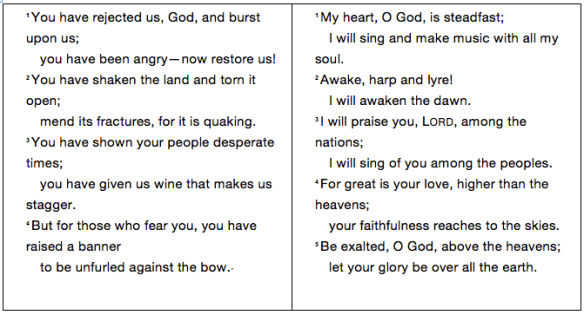
Psalm 60 shows great distress and turmoil and the unspoken “where are You, God.” The term “banner” in verse 4 is a very “visible signal” that pulls the learner back to the Father. The start of Psalm 108 could not be more different with phrases like “make music with my soul” and “your faithfulness reaches to the skies.” Well maybe not. Love and faithfulness reaching to the skies and a banner do sound like the same thing.
box 2

The shepherd, the ridiculed little brother, the youngest son, and the overachieving young man who feared little are all descriptions of David. As complex as David may be the last two lines in this shared portion would only come from the heart of someone who has been in God’s presence and has valued that experience – “human help is worthless” and “with God, we win.”  The box below – on the left is the shared portion, and the right side is my notes.

Reuben, Gad, Manasseh, Judah, Edom, Moab, Shechem, Genesis 49box 3New International Version (NIV) Holy Bible, New International Version®, NIV® Copyright © 1973, 1978, 1984, 2011 by Biblica, Inc.®  Used by permission. All rights reserved worldwide.
Psalm 84:5-7

Psalm 84: 5-7 – New American Standard (NASB)

How blessed (happy) is the man whose strength (oz – force, security, majesty, praise) is in You, in whose heart (lebab – heart, mind, understanding) path 4a for blogare the highways (mesillaw – “lifestyle”, main road, pilgrimage) to Zion!

Monument Valley-Dry Wash-01Passing through the valley of Baca (weeping, balsam, mulberry) they make it aspring (pools, blessings, fountain); the early rain (Autumn) also covers it with blessings (pools).mill_run_spring_small

They go from strength to strength (chayil – “force” an army, wealth, virtue, valor, strength), every one of them appears before God (Elohim) in Zion.

There is no definable place called the Valley of Baca; one Bible atlas did ID a city by that name but it is not by Jerusalem.

All of the words in blue are added into the NASB translation and these come from a variety of sources that include several translations and concordances.

New American Standard Bible (NASB) Copyright © 1960, 1962, 1963, 1968, 1971, 1972, 1973, 1975, 1977, 1995 by The Lockman Foundation

Dry Valley pic is from http://www.hsipro.com/Picture%20Album.htm 

Mill Run Spring http://www.deq.state.va.us/Programs/Water/WaterSupplyWaterQuantity/GroundwaterCharacterization/SpringDatabase.aspx