Psalm 103 – Barak the Lord

I know I have read this Psalm (103) many times, in my Bible it has highlights and underlines I even imaged a place and time that David would have written it but that apparently did not mean I studied it. Well, for the place and time I could see David having penned this awesome song in 2 Samuel 12:16. This is where David is pleading for the life of the first child he had with Bathsheba. For seven days David is pleading with the Eternal God of Israel; I am sure he was stating why he would follow such a great God. David would also be reminding God of His awesome deeds and righteous ways, part of this would be comparing things David can see to the Father’s bigger realities. But what pulled me into this study was the phrase – “Praise the Lord, O my soul.”

KJV vs. NIV and Hebrew vs. English has always been a reason for me to study and Psalm 103 continues this tradition. The NIV translators rendered barak to mean, “praise” while in Hebrew it is “bless.” Vine’s Dictionary adds it is – to kneel, bless, be blessed, or curse.

I liked that it started and ended with “Bless the Lord, O my soul.” Taking that thought a step farther I only found two psalms that begin and end with that phrase, 103 and 104. There are several that begin and end with “hãlal” or Hallelu Yah or as we say in English – Hallelujah! I believe those Psalm are 135, 146 – 150.  Verses 1, 2, 20, 21, and 22 a, b begin with barak and verse 1, 2, and 22b add the phrase “O my soul.” So six times (man’s number) it is said to “bless” the Lord, actually the three that add “O my soul” are for David (men) while the other three are directed at other creations.

Verses 19 – 22 are a “verse” or thought within this psalm. They deal with God’s kingdom and who should barak. David notes that angels, heavenly host, all His works, and my soul are to bârak. At first I was puzzled by angels, heavenly host and all works, I thought for sure David was repeating himself but a check of the Hebrew definitions added to the depth of this Psalm. The “angels” or messengers seem to be a specific group of created beings while the “heavenly host” is the rest of God’s army. This is consistent with the rest of Scripture because different “classes” of angels are mentioned in the prophets and Revelation. “All His works” is just that, everything thing else: plants, animals, the waves, and the heavens.

Psalm 103 ends as it began, a personal call for the individual to barak his God with everything that is within him.

Top 20 Song or Musical Sunday School Lesson?

A look at Psalms 60 and 108

Previously, I wrote a blog entitled Where and When the Psalms Were Written. In that blog, I matched the verse in the Bible that may have been the inspiration for writing the Psalm. Psalm 60 and 108 were two of those psalms but I want to compare them because they have a large similar portion used in two very different psalms.

I believe Psalm 60 was one of the reasons I started doing the matching. Its timestamp was easy to find in 2 Samuel 8:13 and 1 Chronicles 18:12 which tells of the 12,000 Edomites and the Valley of Salt. The introduction and the verses don’t really match and if you do a “search” on the Valley of Salt there are several reasonable explanations as to why there may be differences. (The Valley of Salt is also a topic of disagreement because we are not sure where it is/was.)

Psalm 108 I originally put with 2 Samuel 6:5 when David was bringing the Ark to Jerusalem. David the Writer uses rhetorical devices in many psalms by repeating phrases but in these two Psalms, a large portion is used in apparently two different occasions much like Psalms 14 and 53. These “re-purposed” psalms are also in different “Books” within Psalms. I compared Psalms 135 to 136 because of similar content but they really are presented in very different styles.

Not all Bible translations have chapter “headings.” I like them because they can allow your imagination to soar as to the “when what, and why” they were written and used. Psalm 108’s heading is not a repeat, as most people will say all psalms were sung. “Song” and “psalm” here are two completely different words. I can imagine that it was a favorite that you might hear someone humming in the marketplace or while they were working.

Psalm 60, on the other hand, has all the markings of a formal arrangement that was used at special gatherings. Asaph may have been the “director” but we don’t know for sure. Miktam like maskil is thought to be a musical term whose exact meaning has been lost to us, what a shame. It also has a Selah in verse 4 which may signal a pause to give time to reflect. The fact that David set it to the tune of another well-liked song just shows that we have not changed all that much, my example is the hymn, “Amazing Grace” (it was set to a popular tune of the day). But the “for teaching” is what catches my eye. David knew the power of music to help with learning and remembering!

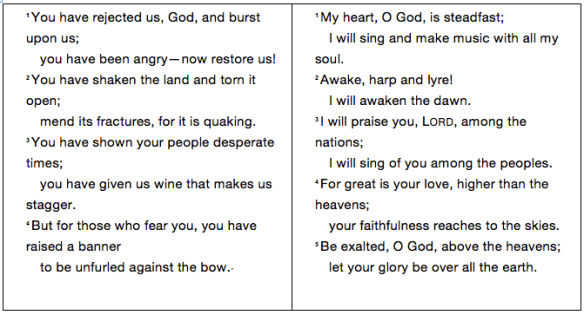
box 1

Psalm 60 shows great distress and turmoil and the unspoken “where are You, God.” The term “banner” in verse 4 is a very “visible signal” that pulls the learner back to the Father. The start of Psalm 108 could not be more different with phrases like “make music with my soul” and “your faithfulness reaches to the skies.” Well maybe not. Love and faithfulness reaching to the skies and a banner do sound like the same thing.

box 2

The shepherd, the ridiculed little brother, the youngest son, and the overachieving young man who feared little are all descriptions of David. As complex as David may be the last two lines in this shared portion would only come from the heart of someone who has been in God’s presence and has valued that experience – “human help is worthless” and “with God, we win.”  The box below – on the left is the shared portion, and the right side is my notes.

Reuben, Gad, Manasseh, Judah, Edom, Moab, Shechem, Genesis 49box 3New International Version (NIV) Holy Bible, New International Version®, NIV® Copyright © 1973, 1978, 1984, 2011 by Biblica, Inc.®  Used by permission. All rights reserved worldwide.

Psalm 84:5-7

Psalm 84: 5-7 – New American Standard (NASB)

How blessed (happy) is the man whose strength (oz – force, security, majesty, praise) is in You, in whose heart (lebab – heart, mind, understanding) path 4a for blogare the highways (mesillaw – “lifestyle”, main road, pilgrimage) to Zion!

Monument Valley-Dry Wash-01Passing through the valley of Baca (weeping, balsam, mulberry) they make it aspring (pools, blessings, fountain); the early rain (Autumn) also covers it with blessings (pools).mill_run_spring_small

They go from strength to strength (chayil – “force” an army, wealth, virtue, valor, strength), every one of them appears before God (Elohim) in Zion.

There is no definable place called the Valley of Baca; one Bible atlas did ID a city by that name but it is not by Jerusalem.

All of the words in blue are added into the NASB translation and these come from a variety of sources that include several translations and concordances.

New American Standard Bible (NASB) Copyright © 1960, 1962, 1963, 1968, 1971, 1972, 1973, 1975, 1977, 1995 by The Lockman Foundation

Dry Valley pic is from http://www.hsipro.com/Picture%20Album.htm 

Mill Run Spring http://www.deq.state.va.us/Programs/Water/WaterSupplyWaterQuantity/GroundwaterCharacterization/SpringDatabase.aspx

The Jesus Psalm

I refer to Psalm 22 as the Jesus Psalm just because so much of it refers to the Easter story. I know there are other New Testament verses that will fit with Psalm 22 but this is a good start. I will encourage you to do one of these; there are several places in the New Testament that I will be doing during Holy Week and beyond.

Psalm 22

New Testament Verse

My God, my God, why have you forsaken me?
Why are you so far from saving me, so far from my cries of anguish?
My God, I cry out by day, but you do not answer, by night, but I find no rest. .Yet you are enthroned as the Holy One; you are the one Israel praises.
In you our ancestors put their trust; they trusted and you delivered them.
To you they cried out and were saved; in you they trusted and were not put to shame.But I am a worm and not a man, scorned by everyone, despised by the people.All who see me mock me; they hurl insults, shaking their heads.


“He trusts in the Lord,” they say, “let the Lord rescue him. Let him deliver him, since he delights in him.”

Yet you brought me out of the womb; you made me trust in you, even at my mother’s breast.
10 From birth I was cast on you; from my mother’s womb you have been my God.

11 Do not be far from me, for trouble is near
and there is no one to help.

 12 Many bulls surround me; strong bulls of Bashan encircle me.

13 Roaring lions that tear their prey open their mouths wide against me.

14 I am poured out like water, and all my bones are out of joint.
My heart has turned to wax; it has melted within me.

15 My mouth is dried up like a potsherd, and my tongue sticks to the roof of my mouth; you lay me in the dust of death.

.

 16 Dogs surround me, a pack of villains encircles me; they pierce my hands and my feet.

17 All my bones are on display; people stare and gloat over me.

18 They divide my clothes among them and cast lots for my garment.

 .

 19 But you, Lord, do not be far from me. You are my strength; come quickly to help me.

20 Deliver me from the sword, my precious life from the power of the dogs.
21 Rescue me from the mouth of the lions; save me from the horns of the wild oxen.

 22 I will declare your name to my people; in the assembly I will praise you.

23 You who fear the Lord, praise him! All you descendants of Jacob, honor him! Revere him, all you descendants of Israel!
24 For he has not despised or scorned the suffering of the afflicted one;
he has not hidden his face from him but has listened to his cry for help.

.

25 From you comes the theme of my praise in the great assembly; before those who fear you I will fulfill my vows.

.

.

 26 The poor will eat and be satisfied; those who seek the Lord will praise him— may your hearts live forever!

27 All the ends of the earth will remember and turn to the Lord, and all the families of the nations will bow down before him,

28 for dominion belongs to the Lord and he rules over the nations.

29 All the rich of the earth will feast and worship;
all who go down to the dust will kneel before him— those who cannot keep themselves alive.
30 Posterity will serve him; future generations will be told about the Lord.
31 They will proclaim his righteousness, declaring to a people yet unborn: He has done it!

Matthew 27: 46 About three in the afternoon Jesus cried out in a loud voice, “Eli, Eli, lemasabachthani?” (Which means “My God, my God, why have you forsaken me?”)..John 8: 54 Jesus replied, “If I glorify myself, my glory means nothing. My Father, whom you claim as your God, is the one who glorifies me. 55 Though you do not know him, I know him. If I said I did not, I would be a liar like you, but I do know him and obey his word. 56 Your father Abraham rejoiced at the thought of seeing my day; he saw it and was glad.”.

Matthew 27: 39 Those who passed by hurled insults at him, shaking their heads 40 and saying, “You who are going to destroy the temple and build it in three days, save yourself! Come down from the cross, if you are the Son of God!”

Matthew 27: 41 In the same way the chief priests, the teachers of the law and the elders mocked him. 42 “He saved others,” they said, “but he can’t save himself! He’s the king of Israel! Let him come down now from the cross, and we will believe in him. 43 He trusts in God. Let God rescue him now if he wants him, for he said, ‘I am the Son of God.’”

.

.

.

Luke 22: 63 The men who were guarding Jesus began mocking and beating him.

Luke 14: 64 “You have heard the blasphemy. What do you think?” They all condemned him as worthy of death. 65 Then some began to spit at him; they blindfolded him, struck him with their fists, and said, “Prophesy!” And the guards took him and beat him.

John 19: 28 Later, knowing that everything had now been finished, and so that Scripture would be fulfilled, Jesus said, “I am thirsty.”

.

John 20: 25 So the other disciples told him, “We have seen the Lord!” But he said to them, “Unless I see the nail marks in his hands and put my finger where the nails were, and put my hand into his side, I will not believe.”

.

Luke 23: 34 And they divided up his clothes by casting lots. (John 19:23)

.

Luke 22: 42 “Father, if you are willing, take this cup from me; yet not my will, but yours be done.”

.

.

.Luke 4: 43 But he said, “I must proclaim the good news of the kingdom of God to the other towns also, because that is why I was sent.” 44 And he kept on preaching in the synagogues of Judea.

.

.

Matthew 21: The crowds that went ahead of him and those that followed shouted, “Hosanna to the Son of David!”

.

Mark 8: The people ate and were satisfied. Afterward the disciples picked up seven basketfuls of broken pieces that were left over.


Holy Bible, New International Version®, NIV® Copyright © 1973, 1978, 1984, 2011 by Biblica, Inc.® Used by permission. All rights reserved worldwide.

Comparison of Psalm 14 and 53

Is there a deep spiritual significance to having two nearly identical Psalms in the Bible?  – No, not that I could find but I think it is kind of neat. They appear in two different parts or books within Psalms. The first “book” goes from #1 to # 41 and the second “book” is #42 to #72. The books end with “Amen and Amen” and #72 announces, “This concludes the prayers of David son of Jesse.”

Psalm 14For the director of music. Of David. The fool says in his heart,  “There is no God.”They are corrupt, their deeds are vile;
there is no one who does good.

The Lord looks down from heaven
on all mankind
to see if there are any who understand,
any who seek God.
All have turned away, all have become corrupt;
there is no one who does good,
not even one.

Do all these evildoers know nothing?

They devour my people as though eating bread;
they never call on the Lord.
But there they are, overwhelmed with dread,
 for God is present in the company of the righteous.
You evildoers frustrate the plans of the poor,
    but the Lord is their refuge.

Oh, that salvation for Israel would come out of Zion!
When the Lord restores his people,
let Jacob rejoice and Israel be glad!

Psalm 53

For the director of music. According to mahalath. Amaskil of David.

The fool says in his heart,
“There is no God.”
They are corrupt, and their ways are vile;
there is no one who does good.

God looks down from heaven
on all mankind
to see if there are any who understand,
any who seek God.
Everyone has turned away, all have become corrupt; there is no one who does good,
not even one.

Do all these evildoers know nothing?

They devour my people as though eating bread;
they never call on God.
But there they are, overwhelmed with dread,
where there was nothing to dread.
God scattered the bones of those who attacked you; you put them to shame, for God despised them.

Oh, that salvation for Israel would come out of Zion!
When God restores his people,
let Jacob rejoice and Israel be glad!

You have to wonder if David changed the music with #53?  Did the change from Jehovah (Lord) in #14 to Elohim (God) change how it was sung or were they for different types of worship services or a special occasion? Jehovah means “The Eternal” and Elohim means “Supreme God” of the two I would think that Psalm 14 might be the more formal one.

I am guessing Psalm 52 and 53 were written after 1 Samuel 22 when Doeg the Edomite killed the priest. I think that time period would have given David a lot of inspiration to write several psalms. (Please see the blogs on David, LORDWhen Psalms Were Written and Jacob/Israel )  There is also a study on Psalm 60 and 108.

New International Version (NIV) Holy Bible, New International Version®, NIV® Copyright © 1973, 1978, 1984, 2011 by Biblica, Inc.® Used by permission. All rights reserved worldwide.