Tribes of Israel – Manasseh

Manasseh was the first-born child of Joseph who was put as a “second son” by Jacob. Joseph in naming Manasseh and Ephraim demonstrates that he was perfectly happy with his new life and had no intention of going back. (Genesis 41:51+52) He had the power to send a message back to his family but he did not.

I wonder how these two acted around the rest of the family? They were children of the ruler of the country they lived in and because of being Egyptian possibly had more privileges. From Genesis 48:1 I would wonder if Joseph even allowed them to live around his brothers? Joseph may have had them marry within the family but Manasseh definitely owned slaves and even had a foreign concubine.

1 Chronicles 7:14+15 talks about Manasseh’s two notable descendents: Gilead and Zelophehad.  In Numbers 36 Zelophehad dies in the exodus and leaves only daughters, these girls stand up for themselves and their father’s lineage. The daughters go to Moses and plead their case before God; this leads to a new decree to acknowledge women as heirs. It may not sound like much but that was groundbreaking territory when women were viewed much of the time as second-class people or property.   The other descendent was Gilead who was to lend his name to the area of the east bank of the Jordan River that wasTwelveTribesofIsraelebible the inheritance of the tribes of Manasseh, Rueben and Gad. This is a contrast to Zelophehad’s daughters; Gilead comes from an Aramean concubine and a group of people who were not Israelites (Huppites and Shuppites). Just like Bilhah and Zilpah this concubine was a slave that Manasseh used and was so elevated to a slightly better status in the household. You get the feeling that the children were valued but not the mother (Sarah and Hagar).

In 1 Chronicles 5: 18 -26 it gives two contrasting stories; one of faith and trust in God and the other of unfaithfulness to Him. In verse 20 the East Bank tribes cry out to God for help in the middle of a battle and are helped and overcome their enemies. In verse 25 it tells of the unfaithfulness that gets them taken away by Tiglath-Pileser.habor_river

Actually, Manasseh’s descendents were on par with the other tribes; they did their part in taking the Promise Land and showed up at all the right times and were active during the life time of Saul and David. Lo Debar is in the allotment of land given to Manasseh and it was this area that David went to when he ran from Absalom.

Map from http://www.biblestudytools.com/resources/maps/twelve-tribes-of-israel-map.html and eBibleTeacher.com.

http://bibleatlas.org/full/habor_river.htm  large map,

Tribes of Israel – Dan and Naphtali

Bilhah and Her Boys

Bilhah is Rachel’s servant; her other claim to fame is that she was unfaithful with Rueben. The other time she is mentioned is in 1 Chronicles 7:13 where the children of Naphtali are identified as her descendents; Dan is mentioned but his descendents are listed. (see List)

I have to think about this a little more but Dan is the first of four “slave children.” Even though the customs mentioned here in Paddan Aram are not stated again in the Bible (first-born daughter marrying first and raising a family by a slave), “slave” children are not treated as equals at other times in Scripture (ex. Jephthah, in Judges). I don’t see these four boys being treated differently by the other brothers but it should be noted that they are on the “Mount of Curses” after they enter the Promise Land and Jacob put her and Zilpah with their children at the head of the column when he was about to meet Esau (first killed/captured).

Dan is Jacob’s fifth child and Bilhah’s first. The name Dan sounds like “vindicated or judged” and was given by Rachel (she also named Naphtali).

Deuteronomy 33: 22 About Dan he said: “Dan is a lion’s cub, springing out of Bashan.”

Genesis 49: 16 “Dan will provide justice for his people as one of the tribes of Israel.
17 Dan will be a serpent by the roadside, a viper along the path, that bites the horse’s heels so that its rider tumbles backward. 18 “I look for your deliverance, O Lord. (NIV) Several sources consider this a play on words with the meaning of his name.

Dan’s big story is in Judges 17 &18, unfortunately it is not a good one. Even though they were a large tribe they could not take their inheritance and move their allotment to the north. As a tribe they “steal” a priest and idols, kill a peaceful village and take their land. They make most of other highlights of tribal list including an allotment in Ezekiel but they are not listed in 1 Chronicles or Revelations. I have often thought that had to do with the idol worship that continued to the Exile of the Northern Kingdom but other “brothers” messed up just as bad and still made the list. Dan shown here is where he was suppose to be according to Joshua.TwelveTribesofIsraelebible

Naphtali is Jacob’s sixth child and Bilhah’s second; his name means “wrestling.”

Deuteronomy 33: 23 About Naphtali he said: “Naphtali is abounding with the favor of the Lord and is full of his blessing; he will inherit southward to the lake.”

Genesis 49:21 “Naphtali is a doe set free that bears beautiful fawns. (NIV)

Not much is known of Naphtali as a person and the tribe does show-up at important times but was not a major player. The tribe can be noted for supplying warriors for both Deborah and Gideon. With Zebulun their territory included Nazareth where Jesus grew up.

Map from http://www.biblestudytools.com/resources/maps/twelve-tribes-of-israel-map.html and eBibleTeacher.com.

Tribes of Israel – Issachar

Issachar is the fifth son of Leah and the ninth child of Jacob.

Deuteronomy 33: 18 About Zebulun he said: “Rejoice, Zebulun, in your going out,
and you, Issachar, in your tents.
Genesis 49:14 “Issachar is a rawboned (strong) donkey lying down among the sheep pens. 15 When he sees how good is his resting place and how pleasant is his land,
he will bend his shoulder to the burden and submit to forced labor. (NIV)

Like most of the other sons Issachar does not have a lot documented about his life. We know that he was involved in looting Shechem, selling Joseph and the trips to Egypt but that is about it for the story of his life. His family is also pretty quiet but he does have a few standouts in his linage and they are mentioned when all the tribes come together or are being assigned things to do by David or Solomon. They are included in some of the revivals in the latter part of Chronicles.

Tola, a judge mentioned in Judges 10:1+2 is from Issachar and Deborah includes them in her song in Judges 5:15.

Baasha, a king of the Northern Tribes (Israel) is found in 1 Kings 15:27 – 16:7; the NIV mentions that the name may mean “bad” and he lived down to the meaning as he killed the previous king and his entire family. (That seemed to be standard practice for the day.)

Issachar with Zebulun and Judah formed the leading edge of the Camp during the Exodus; in fact those three appear together many times. I feel it is because they are the three “blessed” sons of Leah. Reuben, Simeon and Levi all incurred Jacob’s wrath during his lifetime. I also feel that they were the “true” children of a wife instead of a concubine. (Judah was not a poster child for good as he starts the selling of Joseph and had the trouble with his daughter-in-law.)

He and Zebulun are often mentioned together and were allotted land next to each other after the conquest. But like most of the Northern Tribes they go into Exile under the Assyrians and you loose track of them after that.

Another Issachar connection has to do with Gideon.  He was in Ophrah that was actually in the land of Issachar.  Several sources I have read refer to Manasseh mingling with both Issachar and Zebulun; a map in my Holman Bible puts much of his story in those lands.

Map from http://www.biblestudytools.com/resources/maps/twelve-tribes-of-israel-map.html and eBibleTeacher.com.

Tribes of Israel – Levi

Levi is the third son of Jacob and Leah. His name sounds like the Hebrew word for attached because Leah hoped that Jacob would be attached (love) to her.

Genesis 49:“Simeon and Levi are brothers— their swords are weapons of violence.
Let me not enter their council,
let me not join their assembly, for they have killed men in their anger and hamstrung oxen as they pleased.
Cursed be their anger, so fierce,
and their fury, so cruel! I will scatter them in Jacob and disperse them in Israel. (NIV)

This prophecy was fulfilled because the Levities had the “Lord as their inheritance” thus they received only cities within other tribes and Simeon was “scattered” into Judah. After the incident at Shechem, they really did not do anything else outstanding and just slip into history.

Deuteronomy 33:8 About Levi he said: “Your Thummim and Urim belong to the man you favored. You tested him at Massah; you contended with him at the waters of Meribah.
He said of his father and mother, ‘I have no regard for them.’ He did not recognize his brothers or acknowledge his own children, but he watched over your word
and guarded your covenant.
10 He teaches your precepts to Jacob and your law to Israel. He offers incense before you and whole burnt offerings on your altar.
11 Bless all his skills, O Lord, and be pleased with the work of his hands. Smite the loins of those who rise up against him; strike his foes till they rise no more.” (NIV)

The Thummim and Urim were how the Israelites could receive instruction (Ezra 2:63) from the Lord. I have read that the breastplate (Exodus 28:30) the High Priest wore had stones with the names of the tribes inscribed on them and they may have been removable; then they would “roll” them and pick who the Lord’s choice was from the casting of these lots. An example of this may be in Judges 1:1+2 when Judah was picked to lead Israel against the Canaanites. (If you Google this subject, you will find a lot of non-Christian/Biblical info)

Massah and Meribah was the name given to the campsite of Rephidim (Exodus 17) or the “spring and rock” where the Israelites argued and tested the Lord about drinking water. Rephidim is also where the Amalekites come into the Exodus story as enemies.

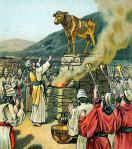
Exodus 32 is an interesting chapter featuring the Levities. Moses is up on a mountain seeking God and receiving the Commandments, Aaron is making a golden calf and the family collectively is killing people who are out of control because of the calf. And once again God shows His mercy by making Aaron the priest even after he “fibs” about the golden calf in vs.24.  It is interesting to note that a specific genetic marker has been found that allows them to specifically trace Aaron’s family line. See http://en.wikipedia.org/wiki/Y-chromosomal_Aaron

Other notable descendants of Levi and Aaron are David’s Praise Team: Heman, Asaph, and Ethan (1 Chronicles 15: 19), Benaiah the captain of David’s guard was a priest-1 Chronicles 27:5. Jeremiah was from the priestly family of Hilkiah.

clipart.christiansunite.com/1352029261/Old_Testament_Clipart/Old_Testament009.jpg 

The Tribes of Israel and Shechem

Shechem in Genesis 33 and 34 is a family and a town. In my tribe series, its importance is that it is the places where Simeon and Levi incur their father’s wrath by killing all the men of Shechem. It is also where Jacob built an altar and bought a piece of land that he later gave to Joseph.

After Joshua brought the children into the Promised Land they were instructed in Deuteronomy 27 to have some tribes stand on Mount Gerizim and pronounce blessings for Israel and the other tribes to stand on Mount Ebal to pronounce curses.

The land went to Ephraim in the allotment and Shechem became a city of refuge as stated in Joshua 17:17.

We see it again in Judges 9 being associated with Abimelech.

When the Northern Kingdom went into exile the Samaritans were brought in to occupy the land.  They accepted some of the beliefs of Israel; one thing they did was to build a shrine on Mt. Gerizim to offer sacrifices. Years later in John 4 Jesus meet the women at the well in a town of Sychar, which is believed to be Shechem. If you remember this meeting was at Jacob’s well.

http://bibleatlas.org/shechem.htm