Reflections on the Judgments in Exodus

When God purposed to remove His children from Egypt He had to show Himself and His power to Israel. Since they had been in Egypt several hundred years they knew Egyptian gods very well. His “attack” on the polytheistic belief system started on the human connection with the gods – Pharaoh. He was the mediator between the gods

and the people and the cobra was his protection. It was sculpted into a uraeus (the hood flared cobra) which pharaoh wore on his head. This all deals with one of their creation stories. Pharaoh set the tone for the beliefs of the nation and the swallowing of his symbol and that of the magicians set the tone for the rest of the Exodus.

Many documentaries have been made tying all of the Plagues together but I noticed an interesting connection between the first three (see Start to Out of Egypt). The Nile River was not only their source of water but also the major trade route. Several gods/goddess served as water deities so this judgment was also a major sign for the children of Israel. The third plague was on the land and again several deities are recognized as soil/sand/desert gods. It is interesting that plague number two was frogs/toads as they are amphibians and live in or on both water and land. The frog/toad binds the first and third plague together. There was an animal (besides man) that was affected with each of the first three plagues (1st fish, 2nd frogs, 3rd gnats/mosquitoes with the livestock). The Hebrew word associated with plague three could have been fleas, gnats, mosquitoes, or lice. There are logical connections for Plagues One through Four because bad water and dead fish would have contributed to frogs then mosquitoes african toadand the piles of dead frogs would have supplied meat for the flies.   As I said in my post Frogs, beer was important to Egyptians and a favorite type of beer was “red as human blood.”
Plague Three the magicians could not reproduce the plague and finally had to admit that God was stronger than they were. I did find it notable that they only attributed this plague as being the “finger of God” and not the hand or arm. Maybe they at least realized that it could get a lot worse.

In studying this I have wondered how long the Nile stayed polluted? Was it just seven days? It does not say but if God were also teaching Israel about the weakness of Egyptian gods making them work to get their water would have been major! So the first three plagues “defeated” the gods of Pharaoh, water, fish, frogs (beer/bread), and land.

Frogs in the Bible

Frogs

In the Bible frogs are mentioned in two contexts: in Exodus 8 as the second plague and in Revelation 16 where evil spirits look like frogs. In Exodus, the Lord is freeing His people from Egypt. Pharaoh and his country have been selected to show the glory of God and the plagues are Jehovah showing His power over the gods of Egypt. His “miraculous signs and wonders” start in chapter 7 with Aaron’s rod/snake swallowing the magician’s rods/snakes. (Reflections on these later; so, back to the frogs.)

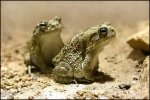
Chapter 7 ends with a timestamp of “seven days.” Chapter 8 begins with Moses asking for the release of the people or frogs will invade the land. I believe in the supernatural, but I also think that God uses His natural laws. I don’t see where the Nile was changed back so did seven days allow for clearing of the water? Since Father God had been planning this, it seems reasonable that the tadpoles were in place so they would have been breathing air by this time. I looked for the life cycle of Egyptian toads/frogs and couldfrogs_210648african toad not find times for the growth of the animals. Their predators (fish, another god) had been killed in the polluted water so more would have been available for the invasion.

A frog goddess Heqet (Heket) was revered and connected with fertility and childbirth. Her depictions were either a frog or a woman with a frog’s head. She symbolized new life and/or fruitfulness, and it is possible that her priestesses were midwives. The frog became the symbol for 100,000 or “immense number.” The “hefnu” (symbol) was because of their fertility and the association with water (another god) made them a positive and potent symbol. Because they were held as sacred the Egyptians would not have killed the invaders. In researching Egyptian toads/frogs some of the species have a mildly toxic secretion, which could have caused some people to scratch the area where they were touched. So, contact with the animals would have been very unpleasant. They also would have been active during the day or night and the toads could have traveled away from canals. Part of the judgment was that they would come upon the people and into ovens and bread kneading troughs. At first, you think this is just so the people would have a hard time making food but beer in ancient Egypt was made in conjunction with bread making. Beer was a very important commodity in Egypt and was actually a payment for labor. In God’s sense of humor shutting down beer making actually shut done all work in Egypt. Oh, one Egyptian word for beer is heqet or heket the name of the frog goddess. (Father God shut down another Egyptian god in the beer/yeast cult.) (See yeast) One complaint against the children of Israel was that they were very abundant, so this judgment on Heket is even more ironic since frogs were the symbol for abundance. 10_Eqyptian_gods_10_Plagues.pdf (rice.edu)

This plague and the actions of Pharaoh and his magicians are interesting in their own right. In Exodus 8:22 God makes a distinction between Israel and Egypt but with the frogs, everything is “you and your people” so it makes you wonder exactly who was plagued. Because “bedroom and bed” are mentioned it leaves to wonder if the plague started at night. With the blood and frogs, it seems that all the magicians could do was add to the misery of the people by calling more of the plague upon them. It seems that Pharaoh would have told the magicians to rid the land of the frogs but it is Moses and God who is finally left with ridding the land of the frogs so they could make them but not get rid of them. My question is why did Pharaoh wait to get rid of the frogs? The piling up of the frogs instead of burying or throwing them back into the Nile probably stems from the fact that they were sacred. One commentary mentioned that they may have died of anthrax or of dehydration while others suggest lack of food.

The other mention of frogs in the Bible is the Seven Bowls of Wrath that are poured out in Revelation 16. These Bowls closely resemble the judgments of Egypt’s gods but the frogs here are evil spirits that come out of the mouth of the dragon, beast, and false prophet. They are released after the Euphrates River is dried up. Their mission is to perform miraculous signs thus bringing the kings of the earth to Armageddon. Going back to the first appearance you have to think that those signs will be abundant and probably deal with the economy and may have a religious overtone.

(See Reflections on First Four Judgments)

A Look at the Biblical Calendar

A Look at the Biblical Calendar

In Mark 14: 5 some disciples were complaining about Jesus being anointed with a “bottle” of pure nard.  The complaint was it could be sold for a year’s wage or three hundred denarii.  According to Matthew 20, a denarius was a day’s wage.  The year in the Bible was twelve months or lunar cycles (29 ½ days). (Some years had thirteen months to make up the eleven-day difference and that would keep the season in line with the calendar.)  So why only 300 denarii?

They were to rest on the Sabbath, so there are forty-eight days (four weeks times 12 months).  For the missing days, we need to look to the feast days, I will use Leviticus 23.  These had a “no work” or “no regular work” day associated with them, which means they would not be paid on these days.

  • Unleavened Bread – one at the beginning and the end
  • Pentecost – one day
  • Feast of Trumpets – one day
  • Day of Atonement – one day
  • Feast of Tabernacles – one at the beginning and the end
  • This is seven no work days.

That totals to 299 days – I guess we can round off one day or it is more than a year’s worth of wages.

Zelophehad’s Daugthers

The story of Zelophehad’s daughters is a story of family, love for a father, and a lasting legacy.  With only fifty words they had their wish come true, their father’s name did not “disappear” just because he had no sons (Numbers 27:1-11).  Now, this did not happen without conditions (Numbers 36) and a little reminder to Joshua and the elders (Joshua 17:4), twelve more words.  Their story is recorded in three books of the Bible-Numbers, Joshua, and 1 Chronicles.  If you timeline this, Numbers 27 occurs and then the elders of Manasseh in Numbers 36 are worried about land that has not even been won yet but God agrees and sets conditions for inherited land and how it should be passed on if no son was born to a father.  After Numbers 27 + 36 Moses is called to go up the mountain, view the land and die so this may have been the last set of rules he sought God on.

The girls loved their father and he had brought them up to be obedient and independent.  They had a strong sense of justice and knew that just because there was no male descendant that they should not exclude them from their rights in the Promised Land.  So they looked to God and the authorities to do the right thing.

Zelophehad’s daughters were very conscious of politics in the camp and were aware that their father had made some wrong choices. So they start their petition for the inheritance with the fact that he died for his own sins, not Korah’s.  Korah wanted to be a priest (Numbers 16) and lead a rebellion against Moses and Aaron (see Jude 11).  The daughters were very aware that he was not a perfect man when they said he died for his own sins, which would have been grumbling, complaining, and wanting to go back to Egypt.

Names are important in the Bible and it is always interesting to see what the names of people mean.  (I know that sometimes I make too much of the meaning.)  I always assume that the name we see was the one given them at birth but it is always possible that it could have been changed as they grew or that they were nicknames.  With that said here are the meaning for the daughters’ names from my Strong’s/Vines Concordance for the KJV.

  • Mahlah – 4244 – weak one
  • Noah – 5270 – movement (not exactly the same of Noah of the Ark)
  • Hoglah – 2295 – partridge
  • Milcah – 4435 – queen
  • Tirzah – 8656 – delightsomeness

Zelophehad’s name is used 11x in KJV and 9x in the NIV.  In the Strong’s Concordance it is not given a meaning but in the NIV Concordance, it listed as – shadow of dread, terror or protection from dread.  He is also the son of Hepher (pit or shame).  Maybe the Dead Sea Scroll’s shed new light on the root words that made up his name.

As part of Manasseh, the girls received land on the west side of the Jordan not in Gilead that was for the shepherds of the family.

The last mention of them is in 1 Chronicles 7:15. Where again it is pointed out that God had done something special for Zelophehad and his daughters. The land was the inheritance and it was important but his daughters gave him the gift of being remembered because they were brave enough to stand up for their family name and their father.

Noah and Moses

Trivia question!  What do Noah and Moses have in common?

A tebah, it is pronounced tay-baw.  It means, “box” and it is # 8392 in the Hebrew and Aramaic Dictionary in the Strong’s Concordance. The King James translates this word into ark.  Noah and Moses are the only two people in the Bible to have a tebah.

Moses’ mother, Jochebed (Exodus 6:20), used slime, you gotta love King James, Moses036(chemar, #2564 – bitumen) in Exodus 2:3 to coat his ark (tebah.)  Chemar is used in two other scriptures: Genesis 11:3 (Tower of Babel) and Genesis 14:10 (Valley of Sodom).  Jochebed also used pitch (zepheth, #2203 – asphalt because it softens or liquifies in the sun).  The other two uses of zepheth are in Isaiah 34:9 where it foretells that Edom’s streams will be burning zepheth.

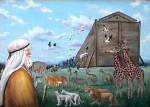
Noah had pitch (kopher, # 3724) to coat his ark, both inside and out (Genesis 6:14).  Noah's arkThis is the only place where kopher is used as that type of covering; the majority of its translations are our word ransom.  In Exodus 30:12 every Israelite in the census who “crosses over” is to redeem himself with a “half-shekel” or about 6 grams of money (It does not say if it was gold, silver, or copper.)  It was collected to service the Tent of Meeting.  In Isaiah 43:3 it is also used as the word ransom but here the “Savior of Israel” says He gave Egypt as your kopher.

I know what you are about to say, “What about the ark of the covenant?”  It is aron and it also means box and is translated ark, chest, and coffin (#727 in Strong’s).  ark of the covenantThe origin of this word carries the idea of “gathering.” Joseph was buried in an aron (Genesis 50:26) and Jehoiada the High Priest with Joash (2 Kings 12:9) made an aron to collect money to rebuild the Temple.

Final Thoughts:

  • I am sure that Noah and Moses’ tebah were rather plain and very functional whereas the aron’s were very fancy and well decorated.
  • It is a beautiful picture that Noah’s ark was coated in redemption, inside and out.
  • I am not sure what to think about the fact that the coating on Moses’ basket is associated with a sinful place (Sodom), judgment (Edom), and a structure built to glorify man over God (Babel).

The clipart is from http://clipart.christiansunite.com