Zelophehad’s Daugthers

The story of Zelophehad’s daughters is a story of family, love for a father, and a lasting legacy.  With only fifty words they had their wish come true, their father’s name did not “disappear” just because he had no sons (Numbers 27:1-11).  Now, this did not happen without conditions (Numbers 36) and a little reminder to Joshua and the elders (Joshua 17:4), twelve more words.  Their story is recorded in three books of the Bible-Numbers, Joshua, and 1 Chronicles.  If you timeline this, Numbers 27 occurs and then the elders of Manasseh in Numbers 36 are worried about land that has not even been won yet but God agrees and sets conditions for inherited land and how it should be passed on if no son was born to a father.  After Numbers 27 + 36 Moses is called to go up the mountain, view the land and die so this may have been the last set of rules he sought God on.

The girls loved their father and he had brought them up to be obedient and independent.  They had a strong sense of justice and knew that just because there was no male descendant that they should not exclude them from their rights in the Promised Land.  So they looked to God and the authorities to do the right thing.

Zelophehad’s daughters were very conscious of politics in the camp and were aware that their father had made some wrong choices. So they start their petition for the inheritance with the fact that he died for his own sins, not Korah’s.  Korah wanted to be a priest (Numbers 16) and lead a rebellion against Moses and Aaron (see Jude 11).  The daughters were very aware that he was not a perfect man when they said he died for his own sins, which would have been grumbling, complaining, and wanting to go back to Egypt.

Names are important in the Bible and it is always interesting to see what the names of people mean.  (I know that sometimes I make too much of the meaning.)  I always assume that the name we see was the one given them at birth but it is always possible that it could have been changed as they grew or that they were nicknames.  With that said here are the meaning for the daughters’ names from my Strong’s/Vines Concordance for the KJV.

  • Mahlah – 4244 – weak one
  • Noah – 5270 – movement (not exactly the same of Noah of the Ark)
  • Hoglah – 2295 – partridge
  • Milcah – 4435 – queen
  • Tirzah – 8656 – delightsomeness

Zelophehad’s name is used 11x in KJV and 9x in the NIV.  In the Strong’s Concordance it is not given a meaning but in the NIV Concordance, it listed as – shadow of dread, terror or protection from dread.  He is also the son of Hepher (pit or shame).  Maybe the Dead Sea Scroll’s shed new light on the root words that made up his name.

As part of Manasseh, the girls received land on the west side of the Jordan not in Gilead that was for the shepherds of the family.

The last mention of them is in 1 Chronicles 7:15. Where again it is pointed out that God had done something special for Zelophehad and his daughters. The land was the inheritance and it was important but his daughters gave him the gift of being remembered because they were brave enough to stand up for their family name and their father.

Noah and Moses

Trivia question!  What do Noah and Moses have in common?

A tebah, it is pronounced tay-baw.  It means, “box” and it is # 8392 in the Hebrew and Aramaic Dictionary in the Strong’s Concordance. The King James translates this word into ark.  Noah and Moses are the only two people in the Bible to have a tebah.

Moses’ mother, Jochebed (Exodus 6:20), used slime, you gotta love King James, Moses036(chemar, #2564 – bitumen) in Exodus 2:3 to coat his ark (tebah.)  Chemar is used in two other scriptures: Genesis 11:3 (Tower of Babel) and Genesis 14:10 (Valley of Sodom).  Jochebed also used pitch (zepheth, #2203 – asphalt because it softens or liquifies in the sun).  The other two uses of zepheth are in Isaiah 34:9 where it foretells that Edom’s streams will be burning zepheth.

Noah had pitch (kopher, # 3724) to coat his ark, both inside and out (Genesis 6:14).  Noah's arkThis is the only place where kopher is used as that type of covering; the majority of its translations are our word ransom.  In Exodus 30:12 every Israelite in the census who “crosses over” is to redeem himself with a “half-shekel” or about 6 grams of money (It does not say if it was gold, silver, or copper.)  It was collected to service the Tent of Meeting.  In Isaiah 43:3 it is also used as the word ransom but here the “Savior of Israel” says He gave Egypt as your kopher.

I know what you are about to say, “What about the ark of the covenant?”  It is aron and it also means box and is translated ark, chest, and coffin (#727 in Strong’s).  ark of the covenantThe origin of this word carries the idea of “gathering.” Joseph was buried in an aron (Genesis 50:26) and Jehoiada the High Priest with Joash (2 Kings 12:9) made an aron to collect money to rebuild the Temple.

Final Thoughts:

  • I am sure that Noah and Moses’ tebah were rather plain and very functional whereas the aron’s were very fancy and well decorated.
  • It is a beautiful picture that Noah’s ark was coated in redemption, inside and out.
  • I am not sure what to think about the fact that the coating on Moses’ basket is associated with a sinful place (Sodom), judgment (Edom), and a structure built to glorify man over God (Babel).

The clipart is from http://clipart.christiansunite.com

Nehushtan – Numbers 21:4-9

The old generation has passed away and it is now time for the “children” to enter the Promised Land. (See Timeline) Miriam and Aaron have died so it is now Moses, Joshua and Eleazar (Aaron’s son) are leading the people. Israel, not Moses, has cried out about Arad, a Canaanite king, has come out against them and Israel has completely destroyed them. They now must go around their cousins, Edom, because God will not let them have their land. (See Edom) So what do they do?

  1. Grow impatient
  2. Speak against God
  3. Speak against Moses
  4. Bring out the ubiquitous complaints no water, bad food, no bread and are we to die in the desert.

I know this cycle is old and you think they would have learned but they have not; makes you think about our complaining. In verse 6 God sends venomous snakes; these are Saw_Scaled_Viper_Echis_carinatusprobably the Carpet or Saw-scaled Viper. People start to die so they once again confess their sins to Moses and he prays for them and God gives them a way out. The thing that really stands out here is God did not remove the snakes; He requires an act of faith before they can be healed. They must look at a brass snake (See copper) on a pole.

In John 3:14-15 this act of faith is explained as a type and shadow of Jesus and the salvation He would bring because of the cross. And just as John 3:16 is next, so the people went on to get water and defeat Sihon and Og.

But the story of the brass/bronze serpent apparently does not end when they moved on and camped at Oboth. They kept it and it became an object of worship because in 2 Kings 18:4 Hezekiah breaks it up because they were burning incense to it. It seems to be human nature to get stuck on something that works; God used that for a time but He moved on and did other great things and used other things to deliver the people. They seemed to miss the point – Worship God and not things. (See Superstitious)

http://en.wikipedia.org/wiki/File:Saw_Scaled_Viper_Echis_carinatus.jpg

Holy Week – Friday

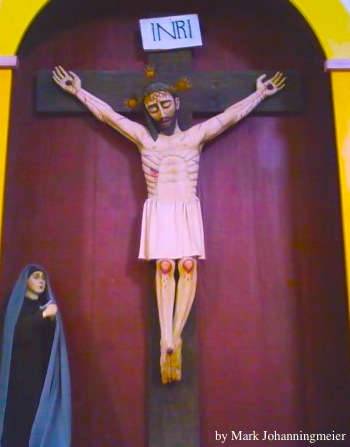
Crucifix from Misson Espiritu in Goliad,TX

Matthew 27:1-61, Mark 15:1-47, Luke 22:66 – 23:56, John 18:28 – 19:42

See Holy Week 2014 – Friday – Jesus Asked For a Drink

Exodus 12:3-6 is the story of the Passover. The Israelites were to pick a one-year-old sheep or goat on the 10th day and take care of it until the 14th day when it was to be killed at twilight. (God started a “new month” for them; so there was a civil calendar and a religious calendar.) This shadows the last five days. The “darkness over the land” now makes sense because His time before Pilate and the trip with the cross was done in the morning. There needed to be “twilight.”

Moses as a type of Jesus ate the Passover lamb and then led the people to freedom; so Jesus ate the lamb and then led us out of sin to freedom. The Gospel of John makes so many connections between Jesus and the lamb – His silence during the trials and no breaking of His bones. The only questions Jesus answered were ones that directly dealt with His kingship and His relation to the Father.

Jesus trials are even shadowed when Moses had his meetings with Pharaoh. Pilate, however, was at least making an attempt to let Him go (it was a weak attempt). As I read John I wondered how the Gospel writers got conversations between Jesus and Pilate; another question that has to wait until Heaven.

I wish I could remember whose sermon this came from but here is something to hold on too – It maybe Friday but Sunday is coming!

Happy or Blessed

Screen Shot 2013-02-09 at 12.27.47 PM

What I love about Bible studies is you start on one thing and find yourself somewhere else and it is a great study too. This one started out as a study on light and ended looking at the word Esher, that means happy. (It will explain itself when I do the blog about light.)  In my Strong’s Concordance for the King James Version that has definitions from W.E. Vine adapted into the entries I found this and thought it was to good to pass up. (Strong’s #835)

Esher and the name Asher (son of Jacob) both come from the same root word and it can be translated blessed or happy. Most of the occurrences of Esher in scripture are in poems such as Psalms or Proverbs. Vine observes that the “prosperity” or “happiness” comes when a superior, usually God, has bestowed His favor on you such as in Deuteronomy 33:29. But he notes that according to Eliphaz Job was blessed and should have been happy not because everything was going good but because God favored Job (Job 5: 17-18). OUCH that runs against the modern thought process.

Vine’s final thought is that it is appropriate to translate Esher as “happy” but for modern readers it “does not always convey its emphasis” to us. Many modern translations do use blessed more than happy.

For a good example of the usage of this word please see http://www.craigladams.com/blog/files/Psalm-1-1.html for Psalm 1.

A good reference- http://biblesuite.com/hebrew/835.htm