Passover to Pentecost – Passover Number Two

Passover to Pentecost – Passover Number Two        Week 2 Day 4

Then the cloud covered the Tent of Meeting, and the glory of the Lord filled the tabernacle.  Exodus 40: 34 (NIV)

This may help with the timetable of events if you remember that Exodus, Leviticus, and Numbers are really one long story.  The first part of Numbers is out of sequence because it starts with the second month of the second year and then in Chapter 7 it goes back to the first month. (This was done to determine marching order and camp placement so that the offerings for the Tabernacle would make sense.)  If the legend is correct and Israel made it to Mount Sinai in fifty days, Moses spent forty days with God before the golden calf episode in Exodus 32 and then another forty days after that.  That puts them at more than 130 days out of Egypt.  Exodus 40 is the first day of the first month of the second year; that gives an idea of how long it took to make everything God showed Moses.

Leviticus has a lot of action in it, but it is set between the laws and rules that have been given.  The ordination of Aaron and his sons is an important part of the Book and is a little hard to place timewise.  It probably happened between Exodus 40 and Numbers 7, in which case that was a busy fourteen day period leading up to the second Passover.  There had to be seven days for the ordination of Aaron’s family and twelve days to dedicate the Tabernacle.  The tent that Moses and Joshua used to meet with God, which was set up outside the camp, was also called the “tent of meeting.”  The context of the scriptures really does point to a very busy fourteen days.  God may have been doing a little cleaning out the “yeast” in Aaron’s family before Passover.

After Passover, during the time of the Counting of the Omer Moses took a census (Numbers 1) and by the 20th day of the second month, they were moving again towards the Promise Land.  Like the first time, there was a three day journey and the people started complaining (Numbers 10: 33 to 11:3).  Timestamps are missing but in Numbers 11:24 is a perfect place to put the Day of Pentecost because the Lord poured His Spirit out on the seventy elders.  The next real-time stamp is Numbers 20 and the death of Miriam; this is the first month of the 40th year.

An important date was set in Numbers 9: 9 and that is the “Second Passover.”  God does want certain things to remembered and celebrated.  He made an allowance for people who were unclean to have time to rejoice and remember His mighty works.  (More on this on May 10th.)
Passover to Pentecost – What Is Important

Passover to Pentecost – What Is Important        Week 2 Day 3

Genesis 15: 13 “Know for certain that your descendants will be strangers in a country not their own….they will come out with great possessions. (NIV)

Abraham and Moses both lead groups of people out of Egypt.  When they left they were given riches, and had other people added to their groups.  The focus today is those things that you take with you when you leave Egypt.  Face it, I have not met anyone who has “left Egypt” that has not had some kind of “baggage” with them.

People

It is significant that Abraham and Moses both had family with them when they left.  Moses’ wife and kids must have been sent to Jethro because he returned them to Moses in Exodus 18.  It is the “other people”, non-family that we need to look at. Hagar and the other slaves are the “shadow” (Genesis 12: 16).  We know that Abraham made a mistake and their child would spawn enemies for Israel for many centuries. (See Enemies Part 1)

Exodus 12: 38 states, “Many other people went up with them.”  These people may have been other slaves, etc. but they did cause Israel to stumble in Numbers 11: 4.  There are many references to how God expected aliens or foreigners to be treated.  No, special rules against them, but they did have to follow the laws of the land (Israel).  Leviticus 24: 10 is the story of an Egyptian and Israelite son who blasphemed and was stoned.  God made it possible for aliens to participate in Passover, they just needed to be circumcised (Exodus 12: 48).

Water

It seems they had enough to make it three days into the desert before they ran out.  Remember, this was the length of time for the original trip to worship God (Exodus 15: 22).  I have heard creative preachers say that the piece of wood Moses threw in the water stuck upright and resembled a cross.  For sure this was a test and God reminded them that He was their healer (26 + 27).

Food

We know they brought their bread dough out of Egypt (no yeast), but Exodus 16 tells that the food lasted thirty days before it ran out.  This was another test and the people failed it.  God would have met the need, and He did, they just needed to learn to ask.

Riches

They asked for and received silver, gold, and clothing from the Egyptians.  They had more riches than ever had in their lives.  They could have bought anything they wanted.  It seems, however, all of the money that they now possessed was not all that important when they ran out of water and food.

All of the riches did come into play in Exodus 25 when they gave for the building of the Ark and all of the furnishings and tent of the Tabernacle.  It took a minute of reflection to realize that the Egyptians paid to make the items of worship for a God they did not believe in.

Skills

Exodus 35: 30 is the beginning of the story where they assembled the Tabernacle and the Ark.   As you read this and chapter 36 it repeatedly talks about skilled men, craftsmen, and designers.  Some of these people were doing other things than make bricks.

Yeast

They should not have had yeast because of Passover and the Feast of Unleavened Bread.  So they just let the bread dough “sour” and they were back in business!  The thought hit me though that yeast (connected to a goddess) was not usable once they started using the manna.  It would not have had time to rise well (or kept) before it had to be thrown away because they could not keep it overnight.  God did not want “yeast” in His miracle.

Passover to Pentecost -Out of Egypt – Things You Might Recognize

Passover to Pentecost -Out of Egypt – Things You Might Recognize        Week 2 Day 2

As someone who is coming “out of Egypt” and has watched many others make their way or at least try I found the Biblical narrative amazingly helpful.  Here are components of the trip that you might recognize:

  • Good Influence – God will send someone (Moses and Aaron) that you will identify with. The message will be simple “God hears you and He is concerned for you.
  • Bad Influence – A someone/thing will have a hold on you (Pharaoh). Frequently they are very demanding and possessive.  You may not be sure why they have a hold on you, but it can be strong.  It may be that in the beginning there was a good reason they were given that power over you. (Joseph and the famine)
  • Stuck – A feeling of being stuck in the situation, and that you cannot change it. There is possibly an aspect of where you are that you really enjoy.  You may have a feeling that you are needed; frequently you are being used to improve a situation. (Israel was building Pharaoh’s storage cities.)
  • What Lies Ahead – You may look ahead and imagine all kind of things that you will give up or have to do. God only gave Israel two things they were responsible for before they left Egypt – Celebrate Passover every year and consecrate your first born male child to the Lord.  The very thought of the journey may have been intimidating; they may have never been more than a mile or two from their houses.
  • From bad to “Are you kidding me!” – When you first hear the Gospel, hope will rise up inside you. Then Pharaoh hardens his heart, and things around you start to fall apart (plagues).  Three plagues happened to Israel and Egypt, but seven were only on Egypt.  This may seem strange but the plagues were to show that the Egyptian gods were no match for the Lord!  Those three plagues may have been the ones the Israelites had strong ties with.
  • Preparation – Jesus will take you as you are. I have seen these steps and components worked on later in the spiritual journey.  Passover was a preparation time for Israel; things had to be done and plans had to be made before they were freed.  I think it fair to say most people will count the cost (or some of them) before they go on the Jesus Journey.  Oh, they made the preparations for the meal and then the miracle(s) happened.
  • Finally on the journey – Reality will hit, but learn from what Israel did.
  1. It may take you a while to get to the next level of growth. It was fifty days to Mount Sinai and the Word.
  2. Expect new enemies, the Amalekites. They were a problem for Israel for centuries. (see the post on the Amalekites)
  3. Things will change. Israel ran out of the water and food they had brought with them. God showed up and showed off for them.
  4. Israel DID not ask God for supplies, instead, they complained and blamed. I want to believe if Israel would have sought the Lord instead of complaining this story may have been written differently.

Other thoughts:

  1. Abraham and Sarah was the foreshadowing of all of this “going out of Egypt.” The story is in Genesis 12: 10 – 20 and it sounds very much like the story in Exodus.
  2. Joseph and His Brothers – The brothers experienced some of these conditions while trying to take care of their families before they brought Jacob/Israel into Egypt.   (Genesis 42 – 44)
  3. Jacob did come out of Egypt but he was dead. (Think about that) Pharaoh did give him royal treatment and had him escorted to the burial cave.
  4. Two other people came out of Egypt. Jeroboam (1Kings 11: 26 – 40 and 12: 15 – 20) He was a stumbling block for Israel, but he chooses that course when God had promised him something better.  Jesus – Matthew 2: 19
  5. Moses left and came back. The first time he was a hunted man, the second time he left he was in charge of a million people.  As leader Moses had his own set of problems and learning experiences.  He also moaned and complained, but he learned and believed.  He had to have Aaron to speak for him.  Jethro’s visit was for Moses but it affected the people also.
  6. Israel did leave with things of Egypt, but that is tomorrows post.

IF YOU HAVE NOT STARTED THIS JOURNEY PLEASE SEE – FOLLOWING JESUS!

Passover to Pentecost – Out of Egypt/ End of Passover

Passover to Pentecost – Out of Egypt/ End of Passover        Week 2 Day 1

That day the Lord saved Israel from the hands of the Egyptians. Exodus 14: 30 NIV

I have used the metaphor “out of Egypt” for a key word many times in my blog.  When you are out of Egypt you are going in to the Promise Land.  Passover is compared to your salvation experience and “out of Egypt” is your journey afterwards.  With metaphors explained let me tell the Exodus story with my “story telling glasses” on.

“We are partying now; people are dancing around playing tambourines and singing songs.  But it has been a mess for a long time.  It really started when this guy, Moses, showed up; it seems he had been gone a long time.  He was all excited because God had done something great in his life.  He told everyone that God knew about their problems and wanted to help them.

He went straight to the source of the problems.  Our hope went sky high. Then things got horrible.  Our water became contaminated; critters showed up and made our lives miserable.  They died then gnats and flies were everywhere.  It got better for us.  But we watched as sickness and the weather went bad all around us.  The neighbors started trying to take our stuff.  Our friend kept working with all of these problems, but as the problems kept coming we were still not free.

Our friend told us we should plan a party and cleanup our houses and be ready to move.  We were enjoying ourselves when the neighbors started showing up.  They told us we need to leave and started paying us to go.  They gave us whatever we asked for as long as we were leaving.

We tried to leave the country, but the roads out of town were blocked.  After a couple of days all of the neighbors decided we had been the cause of all of the problems and we needed to be taught a lesson.  They also wanted all of their stuff back.  God stopped them and opened up a way out.  The neighbors will not follow us now and we are out of the country.  That is why we are celebrating!”  Joshua told us this story before he went and helped our friend.

Passover to Pentecost – Dividing the Red Sea

Passover to Pentecost – Dividing the Red Sea        Week 1 Day 7

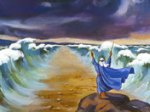
This is the day according to Jewish legend that the people of Israel went through the Red Sea.  This is still in the Feast of Unleavened Bread which was very practical because they were still in a hurry trying to get out of Egypt.  Then to add to the drama and to allow God to get more glory, Pharaoh was chasing them.   The additional glory would come when Pharaoh watched his army drown (I don’t think he leads his troops into the sea).

This post is not to debate if it could happen, or how it happened, but to see this as a shadow of baptism and part of the Great Commission.  Please see the post My Start to Out of Egypt for discussion and websites on the topic of going through the Red Sea.  I do believe this really happened.  My logic is simple – the Jewish people are an ancient and enduring people with a written history and the Red Sea and the Exodus is part of that history.  The Exodus story is recorded in many other books in the Bible (see the post Exodus in Other Books).  Since the Great Commission was given after Passover in the time of the Counting of the Omer we will talk more about it later.

Baptism

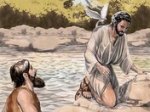
Baptism is a physical act of your free will that identifies you with the death, burial, and resurrection of Jesus.  We as disciples are to baptize other disciples as part of teaching them the commands of Jesus.  In the New Testament, John was baptizing people in the Jordan when Jesus met His cousin.  John wanted Jesus to baptize him but “all righteousness” had to be fulfilled (Matthew 3:15).  Jesus had His disciples baptize people (John 3: 22), and the Book of Acts has many examples of people being baptized.

The Jews of Jesus’ time regularly practiced a ceremonial washing, which is what John was doing.  The Qumran sect, who wrote the Dead Sea Scrolls, practiced this type of washing.  Jesus was “washed” by John, it was necessary; so they are related but not the same.

Shadows from the Old Testament

  • The Flood in Genesis with Noah in a pitch covered boat
  • Moses in the Nile in a pitch covered basket (see Noah and Moses)
  • Moses and Israel passing through the Red Sea
  • Joshua and Israel passing through the Jordan River
  • Naaman (2 Kings 5) dipping in the Jordan River

A Hand or Four Fingers and a Thumb

Pope Francis has noted that ISIS hates and kills Christians; they don’t seem to care how you are baptized.

Sprinkled or dunked, infant or by choice, Matthew 28: 19 or Acts 10: 48 I will respectfully say that Jesus is Lord of Baptism!  Jesus gave instructions to His disciples and they followed them, we tend to complicate things!

http://www.christianitytoday.com/history/2008/august/what-is-pre-christian-history-of-baptismal-ceremony.html