Lo Debar, I have a feeling that it has become a symbol of hope and that God can turn things around in as long as it takes to ask a question. Lo Debar holds the love of a true friendship and the strength of a promise kept but also has a darker side of greed, fear, and poor communication. The characters in this story have strong messages to teach us if we will listen. (see A Place Called Lo Debar)
David’s life before he killed the giant sets the stage for Lo Debar. The time he spent in the wilderness keeping sheep and singing praise to God allowed him to have a real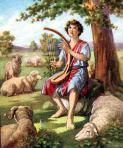 friendship. C. S. Lewis in Membership said, ”We live, in fact, in a world starved for solitude, silence, and privacy; and therefore starved for meditation and true friendship.” David had those so when Jonathan decided that they should be friends David was ready. David means “loving” and Jonathan means “Jehovah-given.”
The question of why did David even have to ask if Jonathan had a son puzzled me until I added ages and years together. The last time David saw  Jonathan alive was in 1 Samuel 23:16, while David is hiding at Horesh in the Desert of Ziph and Mephibosheth (probably), was not born yet. There was also the oath he gave to Saul in 1 Samuel 24: 22 not to kill off his family when he became king. So the question in 2 Samuel 9:1 is valid because he would not have known about Mephibosheth. But the lack of communication by Jonathan to the family about the covenant of friendship and the oath that Saul had with David caused a little five-year-old boy to be crippled as panic set in and the royal household flees in fear. (It seemed to be common practice to kill off everyone including servants of a royal family back in that age so I am sure the fear was real.) The poor communication or fear carried to other parts of the family because David had to find Ziba, a servant, instead of his wife, Michal, the aunt of Jonathan’s child, to tell him Mephibosheth existed and was alive.
I am not fussing at Jonathan because he was in a really bad spot. His crazy father wanted to kill his covenant friend and the family servants had already proven they could not be trusted, so speaking about David was probably not a good idea. But it would appear that he had a plan for his family in case something happened to him. I don’t think it was an accident that Mephibosheth was “found” living at Makir son of Ammiel’s house. Jonathan and possibly Saul must have trusted his man and his family to hide and protect the royal grandchild and eventually find a wife for Mephibosheth. Remember he also brought supplies to David as he ran from Absalom.
In studying Jonathan I found something that I have no idea what it means but it was interesting. As I said Jonathan means “Jehovah-given” and there are two forms of it used in the Bible they are number 3083 and 3129 in the Strong’s Concordance. 3083 is used when it deals with Jonathan and David plus two times in 1 Samuel 14: 6+8 where he was relying on God for direction to attack the Philistines. 3129 is used when it deals with Jonathan and his father Saul.
God has a sense of humor and likes to hide things in scripture like Makir son of Ammiel: Makir means “salesman or brought” and Ammiel means “people of God.” The Makir meaning shines out in the Absalom story because he brought a lot of goods to David almost as if he were a salesman. But he must have been important in Lo Debar because he hid Mephibosheth for at least twelve years, paid for his care, and picked his wife and no one turned them over to David. ( see Why Hide a Grandson There)
Ziba, Saul’s chief servant, is the dark side of this tale and may have worked for the family but with friends like him who needs enemies. You have to wonder if Ziba, which means, “stationed” is the servant with Saul in 1 Samuel 9? I took the “stationed” or “to be stationed” as he was the one assigned to Saul by God. He seems to have done fairly well for himself because he had 15 sons and 20 servants, which was a sign of wealth. I believe he was protecting his interest in telling David where Mephibosheth was living, he could have been hoping that David would kill Mephibosheth and the land of Saul would legally become his. So in 2 Samuel 16:1-4 when he was lying about Mephibosheth’s actions he was still trying to get the land and get rid of Mephibosheth. David seems to have seen this in 2 Samuel 19:24 when he orders the land split between them.
Saul, which means “asked”, is also part of this story. A lot of adjectives could be assigned to him because he is the poster boy for good going bad but the one that I settled on was selfish. His “self” pops up throughout his whole story and finally leads to a crippled child hiding in fear from the man who would be his best friend.
Mephibosheth, which means “dispeller of shame”, I am sure has been the center of many sermons and he should be because it is a beautiful story. Think about how he got to Lo Debar. The news comes that his father is dead; his nurse (not his mother) drops him breaking both feet as he is rushed many miles from home and left with someone he barely knows. He has no family, apparently, the only one who knows where he is, is a servant who wants his inheritance and all this five-year-old boy has to go on is stories and rumors about his father and grandfather. Then one day a military  unit takes him from the only house he remembers and brings him to the man he has been told to fear for at least twelve years. Once there he finds out he is rich and will eat at the king’s table for the rest of his life. Yeah, he should have a few sermons preached about him.
Did you notice that David did not answer Mephibosheth’s question of “why should you take notice of me?” Mephibosheth would have seen the end of David’s years and all of the trouble with his kids but he also would have seen the Temple built and Israel become a world power. You would take for granted that Solomon just continued David’s covenant of friendship and he ate at the king’s table for life.
The great thing that I found in finishing his story is that Mephibosheth’s tale did not end with him. In 1 Chronicles 8:34 – 40 and in 9:35 – 44 they list his family for several generations and record them as being warriors, so they fought for the kings of Judah for many years. This is for a grandchild of a disposed of a king who would have normally been killed; friendship is a great thing. In Chronicles, he is listed as Merib-Baal, which is a tribute to Gideon who also has connections to the Lo Debar/Manasseh area.
These final two connections are questionable so study them for yourself and you decide. Esther in Esther 2:5 is listed as being from the Tribe of Benjamin descended from Kish. There are two Kish’s in the tribe of Benjamin but none of the names line up with Mephibosheth. The other possible family member is Zimri who was king of Israel for seven days. There is a Zimri listed in Mephibosheth’s family line that would have been alive about that time but there is less proof for that than for Esther so let your imaginations go wild with the possibilities.
This “other” look at Lo Debar, Mephibosheth, David, and Jonathan has been a great study I hope you have enjoyed it.
The artwork is from http://clipart.christiansunite.com/1379673661/Bible_Characters_Clipart/David_Clipart




 Mark's Bible Study
