Ezrahite-Ethan and Heman

This study started with Psalms 88 + 89. The authors are Heman and Ethan the Ezrahites. I thought a quick look in Bible Gateway and Strong’s and it will be done quick-wrong. Please note that the names of Heman and Ethan are used many times in Scripture and they are not the same people. We normally associate those names with two descendants of Levi who led worship for David and probably Solomon in the First Temple. This took some time to sort out the Ezrahites appear to be from the tribe of Judah

Ezrahite—This name appears to originate with Zerah, the second son of Tamar and Judah (Genesis 38:27-30). Perez, the first twin out, is the one in David and Jesus’ lineage (Matthew 1, 1 Chronicles 2:10-12). Reference Strong’s #250 Hebrew. They must have been very intelligent because King Solomon in 1 Kings 4:31 is said to be wiser than them. 1 Chronicles 2:6 list the same names and calls them the sons of Zerah. Mahol could be an “unnamed father” who was not important in the family tree, they did things like that in making these lists. 1 Kings could give the idea that they were contemporaries of Solomon, while 1 Chronicles 2 gives the impression that they are much older, like Moses or before. To add to the possibilities, Heman was a seer for King David and Psalm 89 (Ethan) mentions David (more on this later). I will hold on to the older idea and offer some ideas why.

Heman (Psalm 88) – The “title” to this Psalm is imposing. It is a song. It is a psalm. (Yes, those are slightly different according to Strong’s.) It is for the music director. No one is sure what mahalath leannoth really is, and Heman wrote it. To me, that just seems like it had been around a while by the time it got to David. There are no timestamps in this psalm, as far as I could tell. So, trying to place it in history by the association with events or names is hard.

I think it has a somber tone, but many of the entries in Book Three are “dark”. I have felt that way in my life. If Heman wrote it during a period of struggle when nothing seems to be happening in his life, the tone is understandable. Verses 8-18 are very Messianic and show what Jesus endured starting in the Garden and going through the statements He made on the cross.

On a different note-Heman means faithful, and Ezrahite is cherished. It is the only psalm identified as belonging to Heman the Ezrahite, so he must have been special to have had it included in Scripture.   

Ethan – The meaning of Ethan is permanent, so is extended out to be the idea of a chieftain. According to Strong’s, the word is translated as strong or strength.

This Psalm seems to be in the time of David because it uses his name and the promises of God to David seem to be repeated in the psalm. Okay, I am stepping out on a limb here without a lot of proof. David, as a Hebrew word, is very special. If you convert the letters to numbers, it adds up to fourteen (see Matthew). It also means “beloved”. There are many websites, Jewish and Christian, that explore the meaning and etymology of this name. So, if you replace David with beloved and refer the passages to Israel/Judah, it still seems to make sense. Yes, that is weak at several levels, but it works. 

This psalm also has some negative parts and a section 26-37 that are Messianic and refer to the time Jesus was on the cross.

Well, studies may not always answer questions, but I learned many things doing this. So, my time was well spent and I hope you got something from reading this post of Heman and Ethan the Ezrahite.     
Psalm 23 Rearranged

This is Psalm 23 rearranged using all of the words. (Comments below.)

The KJV

KJV in a response format, imagine two groups of singers calling to each other.

KJV- just grouped differently.

The Lord is my shepherd; I shall not want.

He maketh me to lie down in green pastures: he leadeth me beside the still waters.

He restoreth my soul: he leadeth me in the paths of righteousness for his name’s sake.

Yea, though I walk through the valley of the shadow of death, I will fear no evil: for thou art with me; thy rod and thy staff they comfort me.

Thou preparest a table before me in the presence of mine enemies: thou anointest my head with oil; my cup runneth over.

Surely goodness and mercy shall follow me all the days of my life: and I will dwell in the house of the Lord for ever.

The Lord is my shepherd. 

I shall not want.

The Lord is my shepherd. 

He maketh me to lie down in green pastures: * he leadeth me beside the still waters.

The Lord is my shepherd. 

He restoreth my soul: he leadeth me in the paths of righteousness for his name’s sake. * 4 Yea, though I walk through the valley of the shadow of death.

The Lord is my shepherd. 

I will fear no evil: for thou art with me; * thy rod and thy staff they comfort me.

The Lord is my shepherd. 

Thou preparest a table before me in the presence of mine enemies: * thou anointest my head with oil; my cup runneth over.

The Lord is my shepherd. 

Surely goodness and mercy shall follow me all the days of my life: * and I will dwell in the house of the Lord for ever.

Each star * could be another repeat of the Lord is my shepherd, that might require changing words.

The Lord is my shepherd. 

Thou preparest a table before me in the presence of mine enemies: thou anointest my head with oil; my cup runneth over.

I shall not want.

He maketh me to lie down in green pastures: he leadeth me beside the still waters.

Yea, though I walk through the valley of the shadow of death, I will fear no evil: for thou art with me; thy rod and thy staff they comfort me.

He restoreth my soul: he leadeth me in the paths of righteousness for his name’s sake.

Surely goodness and mercy shall follow me all the days of my life: and I will dwell in the house of the Lord for ever.

David, like Moses and Miriam, composed, played, and sang songs. Some of his songs are identified as to where and when they were written. Following that thought, it was a fun study to place some of his other songs into context. No, I can not prove the circumstances that David composed his songs in.

I think that Psalm 23 was possibly his first song. I can see David watching his sheep and realizing that is how Father God took care of him. Many of David’s psalms carry and advance the lyrics of this song. To further the setting, it may have been written right before or shortly after his anointing by Samuel (16:1-13). Then the supernatural anointing took over and he excelled in his music. I think that David was a young shepherd, like his grandmother Rachel, about twelve years old when God and Samuel changed his life. Personally, I think that David did not go into Saul’s service for several more years, maybe seven or eight. In that time he excelled as a musician and killed his lion and bear. These are the things that brought him into Saul’s service.

To offer a reason for the variations of the words, I will sight Psalms 14 and 53 and how close Psalms 135 and 136 are worded.

Weeds or Standards

Church it is time!  As Pentecost approaches, I think it is time for a check-up.  This post has been stirring inside of me for a while but a verse in Psalm 74 finally put a voice to what I have been feeling.

This started with a “kingdom parable” in Matthew 13: 25.  Good seed was sown, but while we were asleep the enemy came in and sowed weeds. The master of the field had an unusual response – leave the weeds alone so you do not pull up the wheat!  And all of the gardeners said, “What!”  And all the church people said, “But that is not how I read the Bible, my doctrine must be correct.” 

Weeds – a plant that is not wanted were it is.  Unfortunately, that is a huge definition when it comes to plants.  I have cut down some huge weeds because I did not want that tree there.  But I quit fighting the false dandelions in my lawn just because they are pleasant to look at when in bloom.   Another example is penny and dollar wort, I don’t like them in my lawn and they are a pain in a garden/flower bed.  To get rid of them I can pull them up or poison them.  One method may work in a flower bed and the other may be okay in the lawn, but it is a decision that must be made carefully.  Oh, if those plants are in a sand dune they are wonderful at helping establish the stability of the dune along the beaches here in south Texas. 

The weeds the enemy has sown come in many shapes and sizes.  Throw in the human condition of pride and it can be war in the printing presses.  The “weed” that set me off is found in Genesis 1. The problem was not that God created the world, a Christian should agree to that, but how long it took and how it was done.  I have followed this argument for many years.  Some of this “weed pulling” comes from what Study Bible you use.  So, the Church of my Living God has battled itself for truth and let evolution take over the education system!

The verse in Psalm 74 that divided weeds from standards is #4.  “Your foes roared in the place where you met with us; they set up their standards as signs.” (NIV) Pick your favorite translation the meaning is clear!

Acts 2:36 needs to be a common point for all Christians – Jesus is Lord and Christ.  Unfortunately, weed seeds have been sprinkled into the rest of Peter’s sermon, that first birthday of the Church!  Verse 40 holds the last part of this post. “Save yourselves from this corrupt generation.” Church, they are in our meeting halls – roaring their standards.  New Age thought has been brought in, and we have let postmodernism change definitions in the Church.  Postmodernism works by changing (usually it is a slow change) the meaning of words!  Words they are changing or at least trying to change – Father God, Jesus, Christ, love, sin, family, and others!  The Great Commission has not changed and that needs to be the work of the Church.  Asaph is credited with writing Psalm 73 to 83; as I have read them recently, many sound like prayers against the foes of God and the Church of Jesus.           

Additional Thoughts – fellow Christians should not be an enemy, you may not agree with them on everything; the Seed is still good; Jesus has confidence in the Seed/Plants even with weeds trying to suck the life from the plants’ roots; Jesus still wins in the end! 

Psalm 59

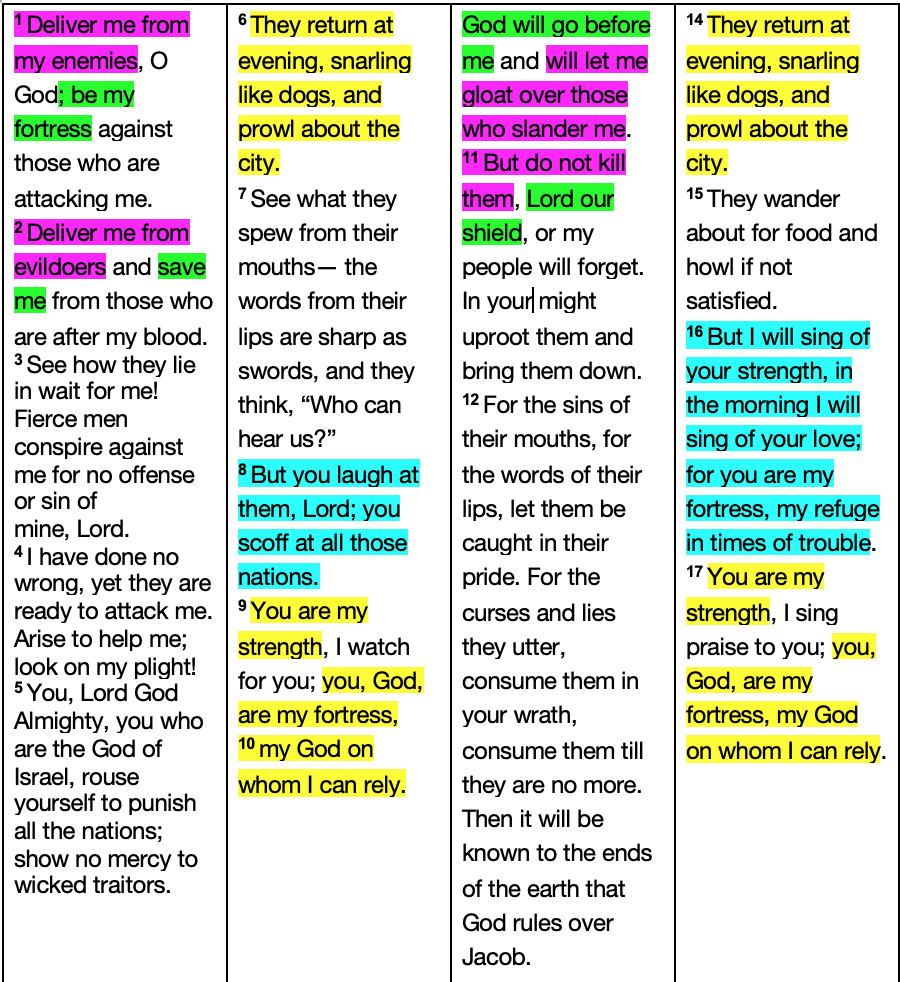
You have to love Psalms!  This is one of many that I have marked with repeated phrases.  The yellow and blue sections are great. The other highlighted sections are just similar thoughts. The shading was done by me for comparison.  

In my Bible, there is an introduction to this Psalm.  (This Psalm was copied from BibleGateway.com and is the New International Version.)  Apparently, at one time the introduction may have been the first verse.  It was written by David after the events of 1 Samuel 19: 11.  It would be fun to hear the actual tune that went with it when David wrote this song. Was it is up tempo or a slow mournful tune?

It is fair to say that David was not happy when he wrote it.  He was probably in his early twenties and not angry and fearful about what was being done to him!  Even in this very forceful wording, we find verse three, which is a shadow of the Pharisees and how they treated Jesus.  

New International Version (NIV) Holy Bible, New International Version®, NIV® Copyright ©1973, 1978, 1984, 2011 by Biblica, Inc.® Used by permission. All rights reserved worldwide.

Work of His Hands

The work of His hands.  cropped-flowers-1.jpg

A comforting idea that is in poems, sermons, and song is that we are “the works of God’s hands.”  Job and David both used this beautiful idea in their writings, but with two different perspectives. We will start with Job.

In Job 10:3 Job is answering one of his tormentors, Bildad, in his third discourse of his book.  Job’s bitterness is evident in this discourse; it is directed at Bildad and God.  (Job 9:33, part of the discourse, is a plea for the work of Jesus as being an arbitrator.)  The end of verse three is still directed at God and says, “While you (God) smile on the schemes of the wicked.(NIV)”  If we look at the original words we find the word “work” with slightly different meanings.  The word work in Job is ygiya it carries the idea of hard toiling/labor.  This fits in with the general tone of how Job is viewing himself and his relationship with God at that moment in his life. It is not pretty and Job is upset.

David uses the phrase in Psalm 138:8.  David uses a different word for work, his is maaseh and it still means work or labor but Vine’s Dictionary says it has to do with farming, artisans working, or the work of praising God.  It has a positive context as compared to ygiya. This fits very well with Psalm 138 and its overall upbeat message.

Even though the general tone of Psalm 138 is positive I can’t help but think it was written at a time when David needed to encourage himself. (ex. After Bathsheba, when he was on the run from Absalom, or when Ziklag was burned.)  It seems he is reminding himself and God of things that he has done and has happened. So the last line of verse eight with the word “abandon” in it puzzled me; it is the reason I think it was written during a time of duress.  It speaks to David’s plea not to be left alone at this time.

“The work of God’s hand.” Two men both referring to themselves as God’s handiwork, but I believe both from a different mindset.