Hezekiah Part 3

Hezekiah’s world, like ours, seems to have someone in the Middle East attacking people. For him, it was Assyria, Ahaz his father had made a treaty with them, who had captured and exported the Northern Kingdom of Israel. An interesting way they had of subjugating a conquered people was to export part or all of the population to a new location. Assyria did this in 1 Chronicles 5:26 and in 2 Kings 17:6, 18:11 to Israel; the promise was a nice location and prosperity. This promise was in 2 Kings 18:31 and included a vine (grape), fig tree, and their own water supply. Israel was sent to the Harbor River area.

Samaritans of the New Testament were and are the people that foreign kings brought into the area when the Northern Kingdom was conquered.  They had/have some of the customs of Jews but held onto their own gods. Their story starts in 2 Kings 17:24 and there is still a remnant of them in Israel today. Jesus uses the Good Samaritan and had a period of teaching in Samaria after meeting with the women by the well.

Isaiah the prophet, now an old man, had served four kings and Hezekiah would be his fifth. Isaiah 6, his commission, was with Uzziah (Azariah) who ruled 52 years, there was a co-regency with Jotham who ruled 16 years, Ahaz ruled 16 years and Hezekiah ruled 29 years so he had seen a lot by the time he started helping Hezekiah. The Northern Kingdom had been deported and Assyria had changed rulers at least once; Assyria is mentioned in Isaiah 8 and again in chapter 10 and 14. It comes in again in chapter 36 in Hezekiah’s 14th year. (see My Timeline) It is interesting that Hezekiah’s story ends in chapter 39. Someone pointed out that Isaiah has 66 chapters like the Bible has 66 books and chapter 40 compares to the beginning of the New Testament.  Like the hope that comes with the New Testament chapter 40 starts with “comfort, comfort my people” and ends with mounting on wings of eagles. (see Waiting on God post)

Egypt is still a power at this time and is in conflict with Assyria for who is going to control the world. Judah apparently has gone to them for help in the past and the Lord in several places condemns and warns about that practice through Isaiah in chapter 31.  Josiah in chapter 35 tries to block Egypt when they are going to fight Assyria and he pays for it with his life; Neco of Egypt punishes Judah and its kings for its interference. Egypt’s power is finally broken by Babylon and has never really risen to world power again.

Wikipedia says that the Habor and the Chobar in Ezekiel are the same while these two sources say no, the Chobar is a canal further south.

Fruit and Nuts – Figs and Nabal

Figs

Let us start our discussion of figs by talking about apples. In the Garden of Eden, there were two fruit trees that Adam and Eve did not eat from; according to Wikipedia, it is probable that they “became” apple trees during the Renaissance. I would like to make the case for them being fig trees; after all, what did they sew together to cover their shame, fig leaves. Most of this is a retake of a sermon I heard several years ago that used figs as a metaphor for the church/religion. The preacher made the point that where figs are mentioned just insert the idea of  “religion.”  I will not cover all of the references to figs and I am not sure all of them fit neatly into that box but let’s take a look at a few of them.

Genesis 3:7 Adam and Eve disobey and instead of trying to get back to God they cover themselves in fig leaves and people have been doing that ever since.

The phrase “under his own vine and fig tree” is found in several places in Scripture and can be a symbol of Israel being at peace but both of those plants are symbols for the church. Ex. 1 Kings4: 25, 2 Kings 18:31

Jeremiah 24: 1-10 is a vision where the prophet sees two baskets of figs in front of the Temple one good and one bad. This reminds me of Luke 6:43-46, which is the parable of the trees and the wise and foolish builder; this is where Jesus asks why do you say to Him Lord, Lord and do not do what He says.

John 1: 48 – Philip was under his fig tree and when he was called to come to meet Jesus.

Finally, the story of Jesus cursing the fig tree because it has no fruit and it dies.               Ex. Mark 11

Now in Israel, there is a sycamore-fig, it is not a true fig, but the analogy still works. And my final thought is something that is talked about in Scripture that I did not know; fig trees can bear two crops of figs, the first crop is called breba figs that grow from the old wood. The main crop follows on the ends of the branches- new wood. We can make all kinds of analogies here: natural vs spiritual Israel, former church latter church, new wineskins vs old wineskins, etc.

Please visit this blog to see more about figs.  http://ferrelljenkins.wordpress.com/2008/10/10/zaccheus-climbed-up-into-a-sycamore-tree/  The fig pic is from – http://www.raysfiginfo.com/graphics/sycamore04.jpg

Nabal

Proverbs 18:11 – The wealth of the rich is their fortified city; they imagine it an unscalable wall.             :23 – A poor man pleads for mercy, but a rich man answers harshly. (NIV)

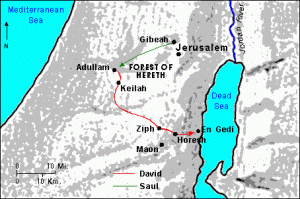
I think these two verses are examples of why I picked Nabal as my first “nut.” But we will get back to him, let us look at 1 Samuel 25 and get some background. Carmel means, “Planted orchard” and is in the area of En Gedi, which is south of Jerusalem (yes there is an Mt. Carmel that is in northern Israel).  Abigail (Nabal’s wife) means “a father’s cause of joy” and after she married David she had his second son, Daniel     (1 Chronicles 3:5).  The Desert of Maon, which means “dwelling”, is in the land of Judea and became a hiding place for David.

Nabal was a descendant of Caleb who was one of the two faithful spies in the book of Numbers; so he was loosely related to David. This leads us to why I think he was a “nut.” In verse 10 when Nabal harshly answers David’s men he knew exactly who David was and what he was capable of doing so verse 10 and 11 is really a high-level insult. David’s request for a gift was for protection that he and his men had given Nabal’s flocks.  So insulting a “warlord” with 600 men when a few sheep would have made him happy is a “nutty” thing to do. Now the problem actually started in verse 9 when the young men “waited.” This word is only translated twice as “wait” many of the times it is used it is “rest” and many of those references are inferring a LONG rest. So as it says in Proverbs 18 Nabal thinks his money is his fortress and so he answers people harshly and made the men wait a long time. (see Judas)

Fortunately for David and all the men around Nabal’s house, Abigail had good judgment. Note – part of the gift was pressed figs.

As I enjoy trying to place Psalms where they may have been written I would put Psalm 109 after verse 35.

Also, the Lord’s use of “tens” in this text is interesting; Nabal was in a coma ten days, which also was the number of men David sent for the gift.

Map of Carmel and Maon from http://home.comcast.net/~davebowser/bible/david/david15.html


Fruit and Nuts – Mark + Almonds

John Mark, the writer of the Gospel of Mark, is our first example of “fruit” from a ministry, that of Barnabas his cousin (Colossians 4:10). Barnabas “the encourager” took him under his wing when he and Paul had a falling out because of Mark (Acts 15:39). We really don’t hear a lot about Barnabas again but Paul tells Timothy to bring Mark along when he comes to see him (2Timothy 4:11). That is a real turn around for Paul and a line of thought is that change in Mark was because of Barnabas. He also helped Peter in his ministry (1 Peter 5:13).

Barnabas gets credit for the “fruit” but let’s look at where the “seeds” got planted. (Warning some of this comes from a very active imagination.)

Jesus himself, I believe, planted the seeds of Mark’s faith, because I think Mark was frequently with the disciples. Many scholars will say that there is a probability that Mark was the young man who “lost” his clothes in the Garden the night Jesus was arrested. Why would he have been with them? The upper room was at his house! Peter went back to Mary’s house (there were several) after the angel let him out of jail (Acts 12:12) this Mary is identified as Mark’s mother.  That would have also put him in the prayer meeting at Pentecost and possibly he was the one carrying the jug that the disciples followed to find the room (Mark 14:13).

Personally, I think that Peter and Andrew were his uncles and James and John were his cousins (Why not?). That would lead to this idea real easy; Mark was the little boy with the five biscuits and the two fish lunch. (I warned you.) I actually wrote a short story along that train of thought; he went along for the boat ride when Jesus needed the rest. But can you imagine getting a little boy’s attention for life with that miracle and what could his mother say when he comes home with twelve baskets of leftovers?

See this site for St. Mark http://www.americancatholic.org/Features/Saints/Saint.aspx?id=1364

Now for the nuts – almonds.

The two stories that always get my attention about almonds are the ones in Jeremiah 1: 11,12 I see a rod of almond; You have seen well, for I am watching over my word to perform it. And Numbers 17:8 where Aaron’s rod produced almonds in the Tent of Meetings.

The almond tree is the first tree to blossom in the spring so it became associated with watchers and the “first one”; the word almond comes from “shaqad” to be alert, sleepless, on the lookout for – hasten, remain, wake, watch. These scriptures are where it is used with these meanings: Watch– Jeremiah 31:28, 44:27, Proverbs 8:34; Wake-Psalm 127:1; Hasten– Jeremiah 1:12.  It is a play on words in Jeremiah 1:12 with the almonds and watching (footnote NIV and Strong’s).

The name Luz (the town that became Bethel) has a reference to almond trees.  This is where Jacob had his dream of the ladder to heaven.

The menorah or lamp had almond-shaped cups for the flames. The Maccabees received a miracle, the sign to continue the rebellion, with this type of lamp. The oil kept burning for a week instead of a day.

Over the years I have used several reference books to gather this material on almonds but this one had several interesting stories with it http://en.wikipedia.org/wiki/Almond

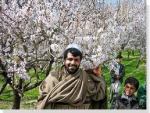
For almond pic http://www.rootsofpeace.org/press/press-2009/2009/11/big-buzz-with-afghan-farmers-1.html

For menorah pic  http://www.judaica-mall.com/16307.htm

The Man of the Gadarenes and Me

The Man of the Gadarenes and Me

by Mark

Among the tombs, lost from those who cared, lost from those who feared.

In the bars hiding from today.

—————————————————————————————–

Clothed in broken chains meant to bind him.

Never good enough, fear of rejection, tired of trying

—————————————————————————————–

Solitary among the dead, like them, only breathing.

Is this all there is?

—————————————————————————————-

You’re too close, the chains would warn.

Join this, try that, buy another beer

—————————————————————————————-

His shrieks and cries were calls of help; anger was heard.

Anger lashing out at those who love you

—————————————————————————————

When he saw the Master, the One that could save, his demons yelled.

I am ok, I was raised in church

————————————————————————————–

Though fear held on, he came to rest at His feet.

Jesus forgive me, thanks for never letting go

————————————————————————————–

Clothed and in his right mind, willing to follow Him anywhere.

Freed, not perfect but ready to try again

————————————————————————————–

His new Master said, “Go tell.”

Write your testimony on the blank lines.

Me and the Man

The man and I have crossed paths several times in my Christian walk.  The first time that I remember is a weekly meeting at a rehab unit in Charity Hospital of New Orleans.  I was the speaker and he was my sermon; I compared what he did to what I had been like before I was saved. I got right to the end of my sermon and had to let someone else give the altar call because I was crying so hard.

We meet again a few years later when a fellow teacher gave morning devotions and she focused on Mark 5:15.  He was “fully clothed and in his right mind” there were multiple points received from that message but it is not uncommon to get that as an answer in the morning if you ask me how I am doing.

I guess all of the fellowship over the years came together when I wrote the poem on the next page of this blog.  It is meant to be a witnessing tool as you write your testimony below ours.  It started as a writing contest entry, not sure it ever made it.

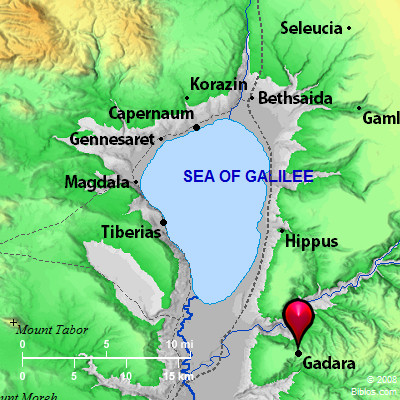
But this is a Bible study blog so if I may, I am going to give a few other things I have seen along the way. I will direct the study from Luke 8: 22 to 9:2 it is similar to Mark 5 and Matthew 8 but I like Luke because he had to “study to show himself approved” because he was “not around” like Matthew and Mark had been. Actually, Bible scholars will tell you that Mark wrote his book first and the other two followed and some argue that all three used a common undiscovered document. By the way, if you Google this topic be ready to be bombarded with all kind of things, the one that I found most amusing was the argument that Mark did not know his geography. Gee, he was alive at the time and had probably visited the region with his uncles when they were fishing. (Gerasenes is too far from the Sea of Galilee.)

The reason I start with Luke 8:22 is the phrase “one day.” It frames this as part of the story and the fact that they got hit with a storm as Jesus was about to do this great work is not surprising.  The thousands of whining demons, pigs near a kosher country and Jesus conversing with Legion I will leave those topics to your own Biblical beliefs and backgrounds; I want to focus on other things.

The people of the Gerasenes or the Decapolis were afraid and asked Jesus to leave which he did. I personally feel the reason that they wanted Him to go was that if He could do that miracle what He must be saying is real and they knew they would have to make a choice and a change.  They were probably not Jewish because it was a Roman area, like Lo Debar it was on the east side of the Jordan and perched on a hillside.  According to Wikipedia, it was a very secure place and one of importance.

Then there is Jesus’ reaction to the man’s request to go with Him; Jesus refused, yet in chapter 9 He sends out the Twelve. Jesus had a plan and it seemed that he could be useful for the Kingdom all on his own.

The map is from http://bibleatlas.org/gadara.htm or Biblos.com  if you have never used this website give it a look it is very interesting and useful.