Salem or Sodom – Bera, King of Sodom

Bera may be the most audacious person in the Bible! He is also a type and shadow of the devil. First, he is a king who allowed and possibly encouraged his people to sin. He then takes part in a rebellion against his overlord with the other rulers of the Valley of Siddium. They lose to the coalition lead by Kedorlaomer. The kings with the armies go hide in the hills while their families and towns are looted. The rout and panic of his army were so bad they were falling in tar pits. Then he expects to get his stuff/people given back to him! (Genesis 14)

Abram and his friends come in and save the day, and are traveling back toward Salem probably heading to his village. Out of the hills/hiding come Bera and meets Abram in the Valley of Shaveh or king’s valley, which is identified as the valley near Jerusalem. (The only other mention of a king’s valley in the Bible is in 2 Samuel 18:18 in a reference to Absalom.) I am sure there are a lot of ways to look at the goods Abram recovered, but it is possible that not all of it belonged to the Jordan River valley kings. So Abram could have made claim to everything he had just won and really who was going to take it from him, the kings who had just lost it! So Abram honors the Lord and gives a tithe to Melchizedek. I think the wicked king was getting nervous about losing so much stuff with no chance of getting it back. To curb the flow of goods Bera asks/claims the people, so Abram tells him what is going to happen and why. The nerve of that guy to be asking or claiming anything is unbelievable. But one thing is for sure, Salem brought the party and Sodom brought nothing.

Bera, just like the devil, knows people are more valuable than goods. The riches could have been a distraction for Abram because once you have all of that stuff you have to fight to keep it and Bera would have had more people.

The lesson to be learned here is what Bera/the devil does to a Christian in a fight. Abram had gotten a victory and probably was just hoping for some quiet time. But out comes someone to congratulate you on the victory. Many times that person will be a distraction from what you need, which is what Melchizedek brought, something to refresh and strengthen you. We Christians usually equate the bread and wine with communion but the truth is Melchizedek was throwing a party (feeding) for the victor because they were tired. Abram wisely discerned that Bera and the goods were not the reason he went to battle, that was to get his family back and that mission was accomplished. Bera lost everything, hid while someone else got the job done, and still claimed he was owed something.
https://www.biblicaltraining.org/library/valley-shaveh

Salem or Sodom – Abraham

Well, actually at this time he still was called Abram his name change is not for another three chapters. He would have been in his 80’s and had lived in Canaan less than ten years (16:3). He had made alliances with some of the locals and seemed to well established. He has had the foresight to train his men into a working army and claimed 318 who had been born in his house. That could have made his camp 1000 people strong and would have been a good-sized village. The importance of them having been born into his house speaks not only of loyalty but also the quality and intensity of their training. If his three allies also had similar camps that truly would have been a serious coalition. Josephus records this in Book 1 Chapter 10 and makes it sound like it was just the three brothers who went with Abram and not additional forces. If Aner, Esheol, and Mamre had brought troops the fighting force could have been up to 1,200 troops. Abram trusted these men enough to make a treaty with them so that speaks volumes about their character and abilities.

In musing over Genesis 14 I realized Abram went after Lot not after Sodom. So in verse 22 when he is talking to the king of Sodom, besides being a witness to a very heathen king, Abram is making it very clear he wanted nothing except what God would supply in his life. Given the fact that he had already decided his course of action before hand shows his intelligence and character.

We also need to look at the symbolism of this battle; Abram had victory over his past. The Euphrates River valley was his birthplace so his victory sealed his “new life” and showed his faith in the “Lord, God Most High, Creator of heaven and earth.”

Other facts:

  1. God will keep you in the know (vs. 13).
  2. Someone did some editing because it was not “Dan” yet (vs. 14).
  3. Ancient Elam and Shinar equate to modern Iran and Iraq it seems they have been bullies for a long time.

Christmas – Have You Been to Bethlehem

Christmas – Have You Been to Bethlehem

Angels007

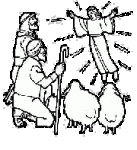
Shepherds, simple shepherds, out doing their job by camping in a field so they could guard sheep; sheep that would be used for sacrifice in the Temple to worship God. Working at night outside Bethlehem (House of Bread) so they could take care of their families. Sounds like a lot of people today who are doing everything they can just to earn a living. Then a “that night” happened in their lives. The Good News was told to them and they were told exactly what they had to do. Granted they had an angelic concert with a lot of praise but how many people after getting the Good News have a concert of witnesses The_Shepherds004praising God for things done in their life. But these guys did something bold and very life changing. They went and saw for themselves and in doing so they found Jesus and the first thing they did was to tell other people. You don’t think that was a big deal! Look in Nativity_Scenes002Luke 2:17 – 20 as they told people, they praised God and glorified Him but the people that heard were just “amazed” but not moved enough to go find Jesus for themselves.

What about you? Have you heard the Good News? If you have, have you purposefully gone to “Bethlehem” to find Jesus? Have you praised God and told people of the things you have seen? If not, make God’s day and give yourself as a present to Jesus.

http://clipart.christiansunite.com/

Top 20 Song or Musical Sunday School Lesson?

A look at Psalms 60 and 108

Previously, I wrote a blog entitled Where and When the Psalms Were Written. In that blog, I matched the verse in the Bible that may have been the inspiration for writing the Psalm. Psalm 60 and 108 were two of those psalms but I want to compare them because they have a large similar portion used in two very different psalms.

I believe Psalm 60 was one of the reasons I started doing the matching. Its timestamp was easy to find in 2 Samuel 8:13 and 1 Chronicles 18:12 which tells of the 12,000 Edomites and the Valley of Salt. The introduction and the verses don’t really match and if you do a “search” on the Valley of Salt there are several reasonable explanations as to why there may be differences. (The Valley of Salt is also a topic of disagreement because we are not sure where it is/was.)

Psalm 108 I originally put with 2 Samuel 6:5 when David was bringing the Ark to Jerusalem. David the Writer uses rhetorical devices in many psalms by repeating phrases but in these two Psalms, a large portion is used in apparently two different occasions much like Psalms 14 and 53. These “re-purposed” psalms are also in different “Books” within Psalms. I compared Psalms 135 to 136 because of similar content but they really are presented in very different styles.

Not all Bible translations have chapter “headings.” I like them because they can allow your imagination to soar as to the “when what, and why” they were written and used. Psalm 108’s heading is not a repeat, as most people will say all psalms were sung. “Song” and “psalm” here are two completely different words. I can imagine that it was a favorite that you might hear someone humming in the marketplace or while they were working.

Psalm 60, on the other hand, has all the markings of a formal arrangement that was used at special gatherings. Asaph may have been the “director” but we don’t know for sure. Miktam like maskil is thought to be a musical term whose exact meaning has been lost to us, what a shame. It also has a Selah in verse 4 which may signal a pause to give time to reflect. The fact that David set it to the tune of another well-liked song just shows that we have not changed all that much, my example is the hymn, “Amazing Grace” (it was set to a popular tune of the day). But the “for teaching” is what catches my eye. David knew the power of music to help with learning and remembering!

box 1

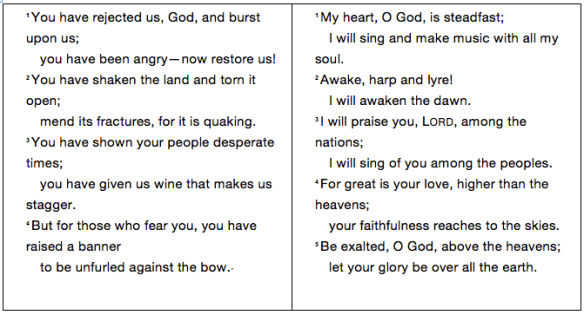
Psalm 60 shows great distress and turmoil and the unspoken “where are You, God.” The term “banner” in verse 4 is a very “visible signal” that pulls the learner back to the Father. The start of Psalm 108 could not be more different with phrases like “make music with my soul” and “your faithfulness reaches to the skies.” Well maybe not. Love and faithfulness reaching to the skies and a banner do sound like the same thing.

box 2

The shepherd, the ridiculed little brother, the youngest son, and the overachieving young man who feared little are all descriptions of David. As complex as David may be the last two lines in this shared portion would only come from the heart of someone who has been in God’s presence and has valued that experience – “human help is worthless” and “with God, we win.”  The box below – on the left is the shared portion, and the right side is my notes.

Reuben, Gad, Manasseh, Judah, Edom, Moab, Shechem, Genesis 49box 3New International Version (NIV) Holy Bible, New International Version®, NIV® Copyright © 1973, 1978, 1984, 2011 by Biblica, Inc.®  Used by permission. All rights reserved worldwide.

The Places of Rehoboam and Jeroboam

The Places of Rehoboam and Jeroboam

Israel and Judah

Shechem – (see the post The Tribes of Israel and Shechem) Why or if Rehoboam choose this place for his coronation is not mentioned in Scriptures but its history links it to Jacob (Genesis 34). It is also important in the start of the nation with Joshua because this is where the “Blessings and Curses” were recited (Deuteronomy 27:12 and Joshua 8:30). Shechem was also a city of refuge where people could find sanctuary if they were accused of murder and had not yet been tried (Numbers 35:9). It was also in Manasseh so for Rehoboam to pick this city would have had major unifying step to start his reign. But his poor judgment in accepting bad advice divided the kingdom. This is where Judah was elevated over his three older brothers and where his descendent split the nation of Israel.

Peniel or Penuel– This is the second city that Jeroboam “built up” or fortified in 1 Kings 12:25. The name means “face of God” and it is first mentioned with Jacob and his wrestling matching with the angel (Genesis 32: 30). This is when he was renamed Israel and met his brother the next day. The landmark that is mentioned is the Jabbok River on the east side of the Jordan in the Land of Gad. The area is also part of the story of Gideon and the city was punished for not helping him in a time of need. The Reader’s Digest Atlas of the Bible adds a twist to the why this city question. It is near the King’s Highway trade route and they hypothesize it was to control the trade (money). It is also in the Valley of Succoth and is more or less in a line with Shechem so it would form the southern boundary of the new nation. I can’t help but think that Jeroboam son of Nebat was still making a connection to Israel’s past and identifying with Jacob thus furthering his gods of gold as legitimate.

Shiloh – The name means tranquil. It was the first meeting place for the Israelites (Joshua 18) and is where the Ark of the Covenant was housed before the Temple was built so it was the major place of worship (Judges 18 and 1 Samuel 1). The prophet Ahijah lived there and this is where the wife of Jeroboam came to seek answers about her sick son (1 Kings 14). But this place was rejected by God because of Israel’s unfaithfulness and was desolate by the time of Jeremiah (chapter 26).

Bethel – The name means House of God and this is the place where Jacob saw the staircase to Heaven and God spoke with him (Genesis 12). It was part of the circuit that Samuel traveled when he judged Israel (1 Samuel 7). Jeroboam probably picked this because of how close it was to Jerusalem, was in the land belonging to Benjamin, and the connection to Jacob. The sin was so bad that in the prophet Amos’ day Bethel was condemned. FYI – The problem started with the first Jeroboam and Amos’ prophecies came during the second Jeroboam’s reign, Jeroboam son of Jehoash (2 Kings 14: 21).

Dan – (see the post Dan) The city and the tribe was considered the northern most part of Israel. So the saying from Dan to Beersheba meant from the north to the south. This area started wrong and never stopped. From Joshua 19:47 we see that they did not take control of their inheritance but instead went to Laish or Leshem. They killed everyone and set up their own priest and ignored God’s order of priest (Judges18: 30). Their priests were from Moses’ family not from Aaron’s. Note – this really is what Jeroboam son of Nebat did maybe that is why Dan is “lost” on so many of the Family List, they simply rejected what God had for them and did things their own way.

Egypt – The land of false gods and slavery, an enemy that did not quit until Babylon destroyed them. Yet almost without exception (Jonah is the only one I can think of) Israelites run back to Egypt. I know it is a spiritual picture of what not to do and of the sin we are to leave behind us. Jeroboam is a good example; Shishak gave him a place to hide but history indicates that when he invade Judah he kept going and subjected the Northern Kingdom also. The lesson here is RUN TO GOD NOT YOUR PAST.

Jerusalem/City of David – This is a name-dropper situation. Saying the City of David just made everything “look” better.

Built-up towns -2 Chronicles 11:6 -10.   Reader’s Digest Atlas of the Bible helps make sense of why these towns were picked by Rehoboam. This blocked the mountain passes from the south (Egypt) and set a defensive perimeter to the east and west of Judah. Looking at these marked off on a map this was a well thought out course of action the only place really not defended was to the north.

Map from:  http://www.bible-history.com/maps/israel_judah_kings.html