Psalm 80

I have been looking at the names that describe God so as I read Psalm 80 its three repeating verses caught my eye. The verses are #3,7 and 19; the verses add a name of God each time it repeats, and part of my study was to look at body parts and it talks about the face of God.

The three names that are added are:

1. God – Elohim means great or mighty one

2. Almighty – Saba focuses on power to conquer or means commander of the army (host)

3. Lord – Yahweh implies a personal covenant relationship with the true God

Different translations handle these verses differently so checking several will be a good study. (I used the NIV.) I did a definition study of the other words in the verse and a loose translation without the names would be:  Physical bring us back O (different names) establish favorable circumstances as a sign of favor so that we can be rescued from earthly enemies.

If you now read the verse adding the definitions for the names, it really adds a new depth to the verse.

I like how Asaph added another name as the Psalm proceeded. Now there are three other sets of names in Psalm 80 the first is “Shepherd of Israel” and then in verses 4 and 14 and these are combinations of Lord, God, and Almighty; if numerology interests you that is six times the names of God are used and a total of twelve individual uses.

Asaph starts the Psalm by calling on the Shepherd of Israel who led Joseph.  I like that title – Shepherd of Israel.  I read several ideas about why he would start off with Joseph and then mention Ephraim, Benjamin and Manasseh so know that you will find many ideas. So here is mine; Joseph is actually the “firstborn heir” which was an important position in a Hebrew family.  Benjamin was his brother by the same mother and Ephraim and Manasseh are his children; that would make them Rachel’s (the “loved wife”) children. Jacob was making Joseph the “ruler” of the family when the brothers got rid of him. One sign of this was the coat of many colors. He actually was the first-born son just not the first-born son, but Reuben lost the birthright of the first-born (Genesis 35:22).

Here are a few other “nuggets” that I found in doing this study.

  1. “Restore” carries the idea of return or repent; it is different from the New Testament “repent” or metanoia. Metanoia is a mental change while shoob or restore usually refers to a physical return.
  2. The word for face is paneh which comes from panah; it means to turn or look. Another word is paniym and it refers to the “face bread” or shewbread that was put into the Tabernacle.  They did not have a physical image of God, but they had the bread. I am not an etymologist, so I do not know if they are related but the Spanish word for bread is pan.

  3. I read in my Bible Glow app; that the psalms in Book 1 (#1-41) more often use Yahweh (the Lord) and Book 2 (#42-72) uses Elohim (God) more often, there is no apparent reason for this grouping.
  4. A little background – this is in the Third Book of Psalms and most of these are attributed to Asaph (means gather or collector). He was a Levite and part of King David’s praise team.

I used my Strong’s Concordance with Vines Dictionary as a reference book. pic of bread from http://en.wikipedia.org/wiki/Challah

Judas in the Old Testament

Finding foreshadowing of the New Testament hidden in the Old Testament has been a study I always enjoy. This year I marked out months just for that in my study plan so here is the first. What I would attribute to Judas being like is found in several Psalms. I will mention the Psalm but also where I think the inspiration for that Psalm came from in scripture and who was the shadow of Judas.

Psalm 52David was writing this about Doeg the Edomite from 1 Samuel 22. He was the instrument of destruction for an entire branch of the priestly family; this was part of the sentence handed down from the Lord because of Eli and his wicked sons in 1 Samuel 2.  The final part of the story is found in 1 Kings 2:27.  Psalm 52:1 – 4 gives a look at what I think he was like: boasted of evil, practiced deceit, loved evil and spoke harmful words. Verses 5 -7 talks of his downfall and how he is remembered: in everlasting ruin, uprooted from the living, destroyed others.

Psalm 55 – Verses 12 – 14, 20 and 21 also talks about Judas’ character. “My companion, my close friend, with whom I once enjoyed sweet fellowship as we walked to the house of God”, Psalm 55:13,14 (NIV). And in verse 20 +21, “My companion attacks his friends; he violates his covenant.”  A possible point when this was birthed is 1 Samuel 22:3 when David is hiding his parents from King Saul.  But as I thought about it, it could be referring to his cousin Joab the commander of the army and a consistent problem for David or even his son Absalom.

Psalm 41:9 Even my close friend, whom I trusted, he who shared my bread, has lifted up his heel against me. This verse is quoted in John 13:18.

Psalm 109:1 – 20 – verse 8 is quoted in Acts 1:20 May his days be few; may another take his place of leadership. (Matthias) I think this Psalm was written because of Nabal in 1Samuel 25:35. The reason for this is in vs. 16 – 20 and describes both Nabal and Judas – never thought of doing a kindness, hounded the poor, needy and broken hearted, loved to pronounce curses and wore them like a garment.

Psalm 69:25 is also quoted in Acts 1:20 “let there be no one to dwell in their tents.”

Zechariah 11:12 – If you think it best, give me my pay; but if not keep it. So they paid me thirty pieces of silver. (Matt. 26:15)

So as expected Judas has some of the worst guys in the Bible providing his foreshadowing: Doeg the Edomite (priest killer), Nabal (the selfish fool) and possibly Joab (under minding cousin) and Absalom (son with ambition).

Follow Me – The 13th Disciple

Oh! You mean the guy in Acts. No, I mean the ones that were invited and never followed.

But let’s start with the one in Acts 1:20 – 26.  Matthias was the one picked over Joseph/Barsabbas/Justus; both had met certain requirements but God used the roll of the dice to pick him.  Ok, casting lots (rolling dice, modern counterpart), picking a stone from the Urim and Thummim (Numbers 27:21, 1 Samuel 28:6), flipping coins or drawing straws it was still God choosing and the disciples believing that He could direct the “lot.”  Nothing is recorded about him after this brief mention in Acts and the Catholic Encyclopedia has several possible stories of his life and times but nothing of any relibality. If you are triskaidekaphobia he can be the 2nd 12th disciple.

I am talking about a legitimate number 13 like the rich young ruler in Matthew 19:21, Mark 10:17 and Luke 18:18, who got a “come follow me” from Jesus OR the person in Luke 9:59 who had to bury his father first. We don’t even know if the man was dead, probably not because he “would have stinketh by then!” These three stories lead to a discourse about the cost of following Jesus and the promise that if you leave everything you will get that and more back.

Has it cost you something? Did you leave anything behind and not tried to replace it?

The phrase “follow me” carries the idea of choosing to be on a road with someone and going with them.  Paths and ways are another study but there are four things you can do on a road: 1. Stay on it and go with Him. 2. Turn and go the other direction. 3.Just get off. 4. Stand still.   Hot, cold or lukewarm.

I started to rethink this topic after looking at the Man of Gerasenes and his desire to follow Jesus and the Master’s redirecting him stay at home and witness there. Why?

Was he not ready? Had he already paid the price and this was his reward? Was he, because of his experience, in a different place in “the walk” than the twelve and Jesus knew they would not mix?

The picture of St. Matthias is from http://www.catholic-forum.com/saints/stm17001.jpg

The Man of the Gadarenes and Me

The Man of the Gadarenes and Me

by Mark

Among the tombs, lost from those who cared, lost from those who feared.

In the bars hiding from today.

—————————————————————————————–

Clothed in broken chains meant to bind him.

Never good enough, fear of rejection, tired of trying

—————————————————————————————–

Solitary among the dead, like them, only breathing.

Is this all there is?

—————————————————————————————-

You’re too close, the chains would warn.

Join this, try that, buy another beer

—————————————————————————————-

His shrieks and cries were calls of help; anger was heard.

Anger lashing out at those who love you

—————————————————————————————

When he saw the Master, the One that could save, his demons yelled.

I am ok, I was raised in church

————————————————————————————–

Though fear held on, he came to rest at His feet.

Jesus forgive me, thanks for never letting go

————————————————————————————–

Clothed and in his right mind, willing to follow Him anywhere.

Freed, not perfect but ready to try again

————————————————————————————–

His new Master said, “Go tell.”

Write your testimony on the blank lines.

Me and the Man

The man and I have crossed paths several times in my Christian walk.  The first time that I remember is a weekly meeting at a rehab unit in Charity Hospital of New Orleans.  I was the speaker and he was my sermon; I compared what he did to what I had been like before I was saved. I got right to the end of my sermon and had to let someone else give the altar call because I was crying so hard.

We meet again a few years later when a fellow teacher gave morning devotions and she focused on Mark 5:15.  He was “fully clothed and in his right mind” there were multiple points received from that message but it is not uncommon to get that as an answer in the morning if you ask me how I am doing.

I guess all of the fellowship over the years came together when I wrote the poem on the next page of this blog.  It is meant to be a witnessing tool as you write your testimony below ours.  It started as a writing contest entry, not sure it ever made it.

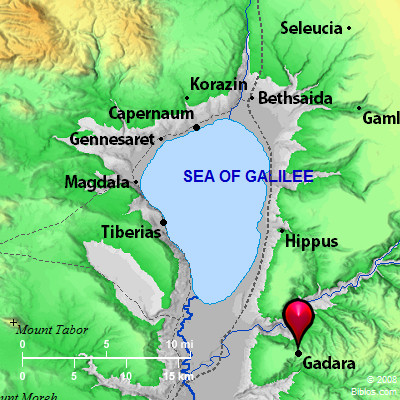
But this is a Bible study blog so if I may, I am going to give a few other things I have seen along the way. I will direct the study from Luke 8: 22 to 9:2 it is similar to Mark 5 and Matthew 8 but I like Luke because he had to “study to show himself approved” because he was “not around” like Matthew and Mark had been. Actually, Bible scholars will tell you that Mark wrote his book first and the other two followed and some argue that all three used a common undiscovered document. By the way, if you Google this topic be ready to be bombarded with all kind of things, the one that I found most amusing was the argument that Mark did not know his geography. Gee, he was alive at the time and had probably visited the region with his uncles when they were fishing. (Gerasenes is too far from the Sea of Galilee.)

The reason I start with Luke 8:22 is the phrase “one day.” It frames this as part of the story and the fact that they got hit with a storm as Jesus was about to do this great work is not surprising.  The thousands of whining demons, pigs near a kosher country and Jesus conversing with Legion I will leave those topics to your own Biblical beliefs and backgrounds; I want to focus on other things.

The people of the Gerasenes or the Decapolis were afraid and asked Jesus to leave which he did. I personally feel the reason that they wanted Him to go was that if He could do that miracle what He must be saying is real and they knew they would have to make a choice and a change.  They were probably not Jewish because it was a Roman area, like Lo Debar it was on the east side of the Jordan and perched on a hillside.  According to Wikipedia, it was a very secure place and one of importance.

Then there is Jesus’ reaction to the man’s request to go with Him; Jesus refused, yet in chapter 9 He sends out the Twelve. Jesus had a plan and it seemed that he could be useful for the Kingdom all on his own.

The map is from http://bibleatlas.org/gadara.htm or Biblos.com  if you have never used this website give it a look it is very interesting and useful.