Tribes of Israel – Reuben

The first-born son of Jacob by Leah was Reuben.

Genesis 29:32  Reuben sounds like the Hebrew for he has seen my misery; the name means see, a son. Like all of the sons you should not only look at them but what happened with their families. All of the boys have prophecy about them form Jacob and then one for them/their tribe from Moses.

Jacob’s statement before he died concerning Reuben was “Reuben, you are my firstborn, my might, the first sign of my strength, excelling in honor, excelling in power. Turbulent as the waters, you will no longer excel, for you went up onto your father’s bed, onto my couch and defiled it. Genesis 49:3  (NIV 1984)

Moses’ statement to the tribe of Reuben before he died was found in Deuteronomy 33:6 “Let Reuben live and not die, nor his men be few.” (NIV 1984) A footnote in the NIV says that the meaning of this phrase is uncertain.

As I mused about Reuben I knew he had been removed as family leader but he was still family and loved by God. God did not throw him away because of the mistake. Reuben did try to save Joseph from his brothers (Gen. 37:29) and he tried to take the lead in Genesis 42:37 for getting food for the family when Jacob was reluctant to risk another trip. His family fulfilled the agreement with Moses when they took the lead with their troops going first into the Promise Land 9 (Joshua 1:16). Men from the tribe supported David at a critical time when he needed help (1 Chronicles 12:37).

God still honored him/his family; in Ezekiel his allotment is between Ephraim (Joseph) and Judah on the north side of the City and in Revelation 7 he is second on the list under Judah. Again in Ezekiel 48 his gate is with Judah and Levi on the north side of the City.

Their gate on the north side is a interesting direction but I guess it is because north is where trouble comes from so the strongest families are facing that way. Sounds like another Bible study to me.

Tribes of Israel – Marching Order

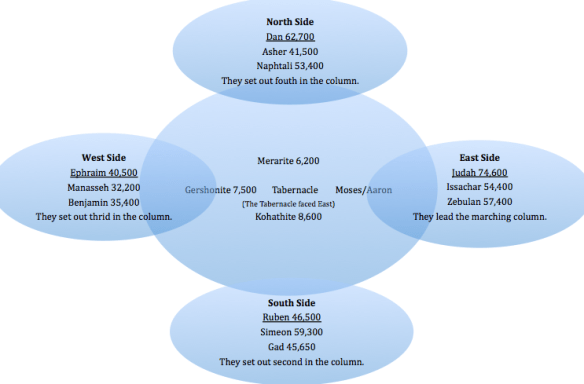
This is Israel’s camping arrangement and marching order as found in Numbers 2-4.

  • Click on the diagram to make it bigger.
  • The underlined family was the first to lead and also camped closest to the Tabernacle area.
  • Check the birth order of the lead families as to who were the “first-born” or family leaders.
  • The marching order was also the order they presented the offerings to dedicate the Tabernacle in Numbers 7.

Hezekiah Part 4

When you think of Hezekiah the first thing you think of is the tunnel for the water that his engineers dug to bring water into Jerusalem and the sun going backwards ten steps to confirm his healing. There is an urban legend that brings in NASA and extended space travel with the “lost day” of the Bible. I would love for this story to be true but after reading more on the topic I may let this one rest as NASA would have to confirm it and they are denying that the test ever took place.  The tunnel is still active and can be visited so that is an undeniable proof of Hezekiah and the truthfulness of the Bible.

Like other kings of Judah he “did right in the eyes of God” but he has an added statement in 2 Chronicles 29:10 that it was “in his heart” to make a covenant with God so that His fierce anger would turn away from them.  He did not follow in the footsteps of his physical father and in fact he undid and reversed many things his father had done in Jerusalem. I counted the kings who did “good” vs. those who “did not do right in the eyes of the Lord.”

Good Kings

David, Asa, Jehoshaphat, Joash*, Amaziah, Uzziah, Jotham, Hezekiah, Josiah,

Bad Kings

Saul, Solomon, Rehoboam, Abijah, Jehoram, Ahaziah, Joash*, Ahaz, Manasseh, Amon, Jehoiakim, Jehoiachin, Zedekiah

Joash started off good and then ended bad and some of the “bads” did have a change of heart towards the end of their life but they are still listed as bad. If you count Saul it is 13 “bads” to “8” goods.  A very telling verse is 2 Chronicles 27: 1,2 Jotham did what was right but the people continued their corrupt practices. So you cannot blame it just on the kings because the people’s hearts were not with the Lord.  If you read Mary’s genealogy you can see that Jesus did not come from this line of kings; He did come from David but through Nathan another one of his sons.

I guess the two important spiritual things that Hezekiah did was reopened the Temple with worship and praise and he held a Passover.

Tunnel Picture and a good informational websitehttp://www.generationword.com/Israel/jerusalem_sites/hezekiah_tunnel.html

Hezekiah Part 3

Hezekiah’s world, like ours, seems to have someone in the Middle East attacking people. For him, it was Assyria, Ahaz his father had made a treaty with them, who had captured and exported the Northern Kingdom of Israel. An interesting way they had of subjugating a conquered people was to export part or all of the population to a new location. Assyria did this in 1 Chronicles 5:26 and in 2 Kings 17:6, 18:11 to Israel; the promise was a nice location and prosperity. This promise was in 2 Kings 18:31 and included a vine (grape), fig tree, and their own water supply. Israel was sent to the Harbor River area.

Samaritans of the New Testament were and are the people that foreign kings brought into the area when the Northern Kingdom was conquered.  They had/have some of the customs of Jews but held onto their own gods. Their story starts in 2 Kings 17:24 and there is still a remnant of them in Israel today. Jesus uses the Good Samaritan and had a period of teaching in Samaria after meeting with the women by the well.

Isaiah the prophet, now an old man, had served four kings and Hezekiah would be his fifth. Isaiah 6, his commission, was with Uzziah (Azariah) who ruled 52 years, there was a co-regency with Jotham who ruled 16 years, Ahaz ruled 16 years and Hezekiah ruled 29 years so he had seen a lot by the time he started helping Hezekiah. The Northern Kingdom had been deported and Assyria had changed rulers at least once; Assyria is mentioned in Isaiah 8 and again in chapter 10 and 14. It comes in again in chapter 36 in Hezekiah’s 14th year. (see My Timeline) It is interesting that Hezekiah’s story ends in chapter 39. Someone pointed out that Isaiah has 66 chapters like the Bible has 66 books and chapter 40 compares to the beginning of the New Testament.  Like the hope that comes with the New Testament chapter 40 starts with “comfort, comfort my people” and ends with mounting on wings of eagles. (see Waiting on God post)

Egypt is still a power at this time and is in conflict with Assyria for who is going to control the world. Judah apparently has gone to them for help in the past and the Lord in several places condemns and warns about that practice through Isaiah in chapter 31.  Josiah in chapter 35 tries to block Egypt when they are going to fight Assyria and he pays for it with his life; Neco of Egypt punishes Judah and its kings for its interference. Egypt’s power is finally broken by Babylon and has never really risen to world power again.

Wikipedia says that the Habor and the Chobar in Ezekiel are the same while these two sources say no, the Chobar is a canal further south.

Hezekiah part 2

In part one I said to study Hezekiah start with Ahaz his father.  So I followed my own advice and did it again. Ahaz was a “bad” king and the nagging thought of “why” has been with me for several days. In 2 Chronicles it says he starts his reign at the age of twenty and ruled for sixteen years; that makes him 36 when he died. (see my timeline) Hezekiah started ruling when he was 25 so a little math tells us that Ahaz started his family at 11 years old. Maybe now we can start seeing why Ahaz was a mess. His great-grandsons at the end of 2 Chronicles were active very early also. This sort of answered my next question, why was Hezekiah so different? Probably he was not raised around his father instead he may have been raised by his mother’s parents.  Ahab, the king associated with Elijah, did this with his children; it was good business and at least kept part of the family safe in case of attack.

To add a few thoughts about Hezekiah and some things he did and may have done. In Proverbs 25 the heading in my NIV Bible says that these proverbs were copied by Hezekiah’s men but had been written by Solomon. So that adds to his “good” of cleaning and reopening the Temple and helping revival by holding Passover for the first time in over 250 years.

These, as always, are almost impossible to prove but because of the content I think he may have written Psalm 102 and 116 during or after his illness. I give him Psalm 119 just for the scholarly work that went into its writing and the phrase of verse 67, “before I was afflicted.” Psalm 119 is acrostic, which means that a verse or section was written using each letter in their alphabet. Each one of the sections also has eight verses in it, the number of “new beginning.” Something that I noticed several years ago was that if you lined them up and read all of the similar verses they made sense that way also. Example read verse 8, 16, 24, 32, 40, 48, 56, 64, 72, 80, 88, 96, 104, 112, 120, 128, 136, 144, 152, 160, 168 and 176 together they make a continuous thought. So you can read the 22 sections or you can read it as 8 sections with 22 verses each. (see Psalm 119 rewritten) See the other Psalms I try to connect with people.

The picture is from http://christianimagesource.com/king_hezekiah_g337-king_hezekiah__image_4_p2265.html