Tribes of Israel – Judah

Judah is the fourth son of Jacob and Leah and became the family leader. His name means “praise” because Leah decided to praise God at the birth of this son. The tension in this family that is reflected in the names of the sons is astonishing; the lesson here is don’t marry sisters:-)

His first recorded act after being tapped to be family leader was to sell Joseph to the Ishmaelites; so that they would profit from the loss of a brother. I read the story in chapter 38 as occurring quickly but Er, the first born, would have been only thirteen when Joseph became ruler of Egypt so the incident with Tamar must have been around the beginning of the famine. (a movie made an interesting point that he moved out to get away from a grieving Jacob) Remember Tamar is a grandmother of Jesus which is why this part is included in Scripture. He does seem to take a positive lead of the family in chapter 43 when he repeats the deal Reuben tried to make with Joseph. He is the main spokesman in chapter 44:16 and Jacob sent him for directions in 46:28.

Jacob at the end of Genesis leaves this blessing for Judah: Genesis 49:“Judah, your brothers will praise you; your hand will be on the neck of your enemies; your father’s sons will bow down to you.
You are a lion’s cub, O Judah; you return from the prey, my son. Like a lion he crouches and lies down, like a lioness—who dares to rouse him?
10 The scepter will not depart from Judah, nor the ruler’s staff from between his feet,
until he comes to whom it belongs and the obedience of the nations is his.
11 He will tether his donkey to a vine, his colt to the choicest branch; he will wash his garments in wine, his robes in the blood of grapes. 12 His eyes will be darker than wine, his teeth whiter than milk.

That blessing pretty well covers everything: family leadership, authority over his enemies, personal wealth and good looks.

The two main people from Judah in the Exodus story are Bezalel, the artist, found in Exodus 35:30 and Caleb, the faithful spy, first mentioned in Numbers 13:6. Both of these men are again mentioned in 1 Chronicles 2 where the clans of Judah and the family of Jesse, David’s father, and David’s sons are discussed. This family history goes to chapter 4:23 and covers Jabez and his pray. It also covers the rulers after the Exile. This family tree is repeated again in Matthew 1, which is Joseph’s line, and again in Luke 3:23, which is Mary’s family line.

Deuteronomy 33:And this he (Moses) said about Judah: “Hear, O Lord, the cry of Judah; bring him to his people. With his own hands he defends his cause.
Oh, be his help against his foes!”

Jesus is from Judah through David’s son Nathan, brother of Solomon. In one sense much of the Old Testament is about that family; 1 & 2 Samuel, much of 1 Chronicles and the books of the Kings and 2 Chronicles covers that family. While the prophets spend many of their words talking about Jesus and His coming.

Pictures are from http://www.freebibleimages.org/illustrations/http://www.biblepicturegallery.com/Pictures/David.htm

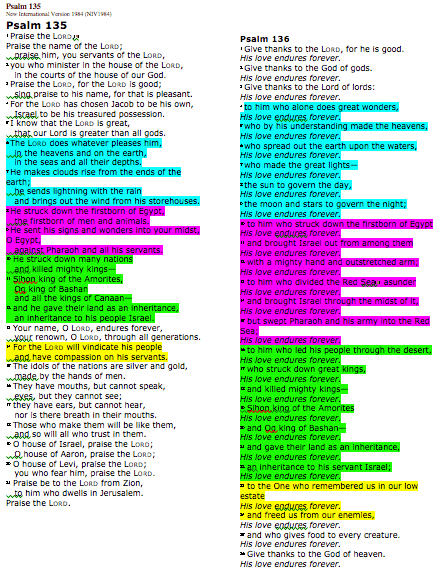
Comparing Psalm 135 and 136

Even though I do not think these were written by the same person or even in the same time period it is interesting that Psalm 135 and 136 have similar elements. Please image David in 1 Chronicles 15:11 instructing his Praise Team to sing Psalm 135 as they carry the Ark to Jerusalem. Then image Ezra in Chapter 3:11 separating the congregation into halves and having one group singing the first part of each verse while the other group responds with “His love endures forever.

These Psalms are included in the section of the “songs of ascents” which were traditionally sung as people went up to the Temple in Jerusalem. Psalm 115 and 118 share the idea of verse 19 and 20 of Psalm 135; the house of Israel, Aaron, Levi and those who fear Him. Psalm 135:4 talks about Jacob and Israel giving each a different emphasis. They also have a historical component remembering God’s great deliverance from Egypt and the defeat of Og and Sihon which marked the beginning of the conquest of the Promised Land. The blue sections highlight His control over nature and thus being in charge of their daily lives.

See the studies on Psalm 14 and 53  and Psalm 60 and 108.

Thanks to BibleGateway.com they are a great resource.

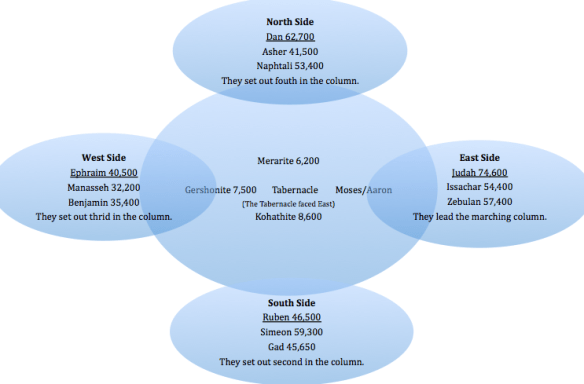
Tribes of Israel – Marching Order

This is Israel’s camping arrangement and marching order as found in Numbers 2-4.

  • Click on the diagram to make it bigger.
  • The underlined family was the first to lead and also camped closest to the Tabernacle area.
  • Check the birth order of the lead families as to who were the “first-born” or family leaders.
  • The marching order was also the order they presented the offerings to dedicate the Tabernacle in Numbers 7.

Tribes of Israel – Birth Order

Birth order is important and is mentioned many times in the Bible. The firstborn got a double portion of the inheritance but that double blessing was transferable. God seems to have fond affections for the “second born” son and several times they are put ahead of the firstborn. Ex.  Seth, Ephraim, Jacob/Israel, and of course Jesus*(see the answer to James) (see Timeline).

Leah

  • 1 Reuben*                                                                 
  • 2 Simeon
  • 3 Levi
  • 4 Judah

Bilhah

  • 5 Dan*
  • 6 Naphtali

Zilpah

  • 7 Gad*
  • 8 Asher

Leah

  • 9 Issachar
  • 10 Zebulun
  • 11 Dinah – the only daughter, see Genesis 34

Rachel

  • 12 Joseph*  – (a)Manassah*, (b)Ephraim but Jacob reversed the blessing and put Ephraim first
  • 13 Benjamin

Simeon and Levi lose their birth order rights in Genesis 34:30 and Reuben loses his in Genesis 35:22. Judah is now heir apparent until Genesis 37:3 where it seems that Jacob may be making Joseph (he was the firstborn of the favored wife) the leader of the family. Some experts believe the “coat of many colors” may have been a visible sign that Joseph was going to be given the “double portion blessing” and be made the family leader.  Not only did the brothers not like his dreams but when their father gave Joseph the “coat” that was just too much. So in Genesis 37 when they sell him to the Ishmaelites Judah is the ringleader (preserve his blessing) and Reuben is trying to rescue him (get back in favor with Jacob and hopefully he learned something).

The picture is Leah with Rachel from: http://www.google.com/imgres?imgurl=http://bibleencyclopedia.com/picturesjpeg/Leah_w_Rachel_67-63.jpg&imgrefurl=http://bibleencyclopedia.com/pictures/Genesis_29_Leah_with_Rachel.htm&h=614&w=400&sz=110&tbnid=Vci4cXEClxoKoM:&tbnh=99&tbnw=64&prev=/search%3Fq%3Dpictures%2Bof%2BLeah%2Band%2BRachel%26tbm%3Disch%26tbo%3Du&zoom=1&q=pictures+of+Leah+and+Rachel&usg=__KbmFiyhA-FIhWlDZFpBEJ8kzp40=&docid=d0RrbP5CPUreIM&hl=en&sa=X&ei=qUJyUNnONJKDqgGvwoG4Bw&sqi=2&ved=0CDIQ9QEwBQ&dur=673 

Moses’ Psalms

Psalm 90 is actually the only Psalm that has a sub-heading that identifies Moses as its writer (some Bibles do not include these) but it is fairly clear that his family was musical. Look at Exodus 15 even though Moses may not be credited with writing that song he did lead the Israelites in its singing and in verse 21 Miriam follows his lead and starts playing the tambourine and dancing. He also leads (recites) a song in Deuteronomy 32, so he seems to at the very least have been a songwriter.  Over the years as I have read Psalms 90 through 100, I have wondered why most of them have no subtitles and that Psalm 101 is clearly marked as being written by David? The exception is Psalm 92, which is identified as being for the Sabbath Day. (possible placement of Psalms)

Ok, now for an active imagination because there is no proof for this other than contextual clues, and some people may think that is a bit thin. Look at the job that Moses actually had to do; teach the children of Israel about God after they had been in a pagan land for 400 years. They were more knowledgeable about Egyptian gods than they were about Yahweh just because they were around those demon gods’ art and statues. He had approximately one million people who knew very little about God and had to be instructed in His ways. What better way to do that than through song; so now read these Psalms as Sunday School lessons and focus on themes. Also, think about the trials and problems the Israelites had in Exodus through Deuteronomy.

  • Psalm 90 – (think Exodus 15:26)
  • Psalm 91 – (think Exodus 17:15) to make God your fortress and He will protect you
  • Psalm 92 – (think Exodus 16:27)
  • Psalm 93 – (think Deuteronomy 5,6) shifting thinking from Egyptian gods
  • Psalm 94 – (think Exodus 10:29) a call for justice
  • Psalm 95 – (a lesson after Meribah and sending out the first spies) exhortation to praise God and not tempt Him
  • Psalm 96 – to praise God for His general judgments
  • Psalm 97 – the majesty of God’s kingdom
  • Psalm 98 – a general call to praise God
  • Psalm 99 – the mercifulness of God and His right to reign (some sources suggest that it may not have been the Samuel of 1 Samuel)
  • Psalm 100 – (think Exodus 40) giving praise to enter the new worship area

Psalm 111 is mentioned in Part 2. (See below.)

Thompson Chain-Reference Bible was a resource. NIV usually includes subtitles on Psalms.

Moses picture: http://www.google.com/imgres?imgurl=http://upload.wikimedia.org/wikipedia/commons/thumb/d/db/Moses_Pleading_with_Israel_(crop).

Please see Part 2In Part 2, I focus on Moses’ Psalms or Songs outside of the Book of Psalms.