Wisdom of Joash – Defending a god

Defending a god.

Joash is the father of Gideon (Judges 6:29 – 32).  His son, Gideon, had just tore down Baal’s alter and cut up the town’s Asherah pole and the townspeople were mad.  They wanted to defend Baal’s honor, who supposedly was a powerful god.  Joash replied to the cries for his son death by asking several questions (vs. 31) the most important one basically was “Are you trying to save your god?”  Josah then makes an inspired statement,”If Baal really is a god, he can defend himself.”

The people must have realized the wisdom in that statement because they eventually followed Gideon into battle and defeated the enemies of Israel.  It must have become apparent that the god they were defending would/could not punish Gideon.Gideon004

http://clipart.christiansunite.com/Bible_Characters_Clipart/Gideon_Clipart/ 

Top 20 Song or Musical Sunday School Lesson?

A look at Psalms 60 and 108

Previously, I wrote a blog entitled Where and When the Psalms Were Written. In that blog, I matched the verse in the Bible that may have been the inspiration for writing the Psalm. Psalm 60 and 108 were two of those psalms but I want to compare them because they have a large similar portion used in two very different psalms.

I believe Psalm 60 was one of the reasons I started doing the matching. Its timestamp was easy to find in 2 Samuel 8:13 and 1 Chronicles 18:12 which tells of the 12,000 Edomites and the Valley of Salt. The introduction and the verses don’t really match and if you do a “search” on the Valley of Salt there are several reasonable explanations as to why there may be differences. (The Valley of Salt is also a topic of disagreement because we are not sure where it is/was.)

Psalm 108 I originally put with 2 Samuel 6:5 when David was bringing the Ark to Jerusalem. David the Writer uses rhetorical devices in many psalms by repeating phrases but in these two Psalms, a large portion is used in apparently two different occasions much like Psalms 14 and 53. These “re-purposed” psalms are also in different “Books” within Psalms. I compared Psalms 135 to 136 because of similar content but they really are presented in very different styles.

Not all Bible translations have chapter “headings.” I like them because they can allow your imagination to soar as to the “when what, and why” they were written and used. Psalm 108’s heading is not a repeat, as most people will say all psalms were sung. “Song” and “psalm” here are two completely different words. I can imagine that it was a favorite that you might hear someone humming in the marketplace or while they were working.

Psalm 60, on the other hand, has all the markings of a formal arrangement that was used at special gatherings. Asaph may have been the “director” but we don’t know for sure. Miktam like maskil is thought to be a musical term whose exact meaning has been lost to us, what a shame. It also has a Selah in verse 4 which may signal a pause to give time to reflect. The fact that David set it to the tune of another well-liked song just shows that we have not changed all that much, my example is the hymn, “Amazing Grace” (it was set to a popular tune of the day). But the “for teaching” is what catches my eye. David knew the power of music to help with learning and remembering!

box 1

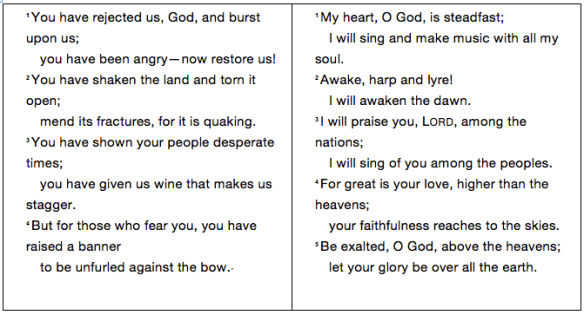
Psalm 60 shows great distress and turmoil and the unspoken “where are You, God.” The term “banner” in verse 4 is a very “visible signal” that pulls the learner back to the Father. The start of Psalm 108 could not be more different with phrases like “make music with my soul” and “your faithfulness reaches to the skies.” Well maybe not. Love and faithfulness reaching to the skies and a banner do sound like the same thing.
box 2

The shepherd, the ridiculed little brother, the youngest son, and the overachieving young man who feared little are all descriptions of David. As complex as David may be the last two lines in this shared portion would only come from the heart of someone who has been in God’s presence and has valued that experience – “human help is worthless” and “with God, we win.”  The box below – on the left is the shared portion, and the right side is my notes.

Reuben, Gad, Manasseh, Judah, Edom, Moab, Shechem, Genesis 49box 3New International Version (NIV) Holy Bible, New International Version®, NIV® Copyright © 1973, 1978, 1984, 2011 by Biblica, Inc.®  Used by permission. All rights reserved worldwide.

Jeroboam and His Altar

Ten pieces of a new garment was to signal the start of a “new work” of God. Jeroboam however let “Egypt” in and let a powerful promise fall to the floor. 1 Kings 13 is a story of God’s love and a call to repent that was ignored by a “chosen vessel.” The promise to Abraham was still in effect; the prophecy to Judah and the selection of David had not been forgotten but Father God needed revival. Solomon had broken faith with Jehovah so He went to the other tribe of leaders – Ephraim (the second-born of Joseph and chosen of God – Genesis 48:20).

Jeroboam, instead of believing God, reacted in fear and took bad advice (12:26 – 28). One creative idea he had was to start his own festival for god and make religion easy for the people. So 1 Kings 13 finds him by his new altar on the 15th day of the 8th month making sacrifices to a golden goat and cow. This whole chapter is a layered look into the failures of Judah, Jeroboam, and the “old system.” But it is meant to show Jeroboam that he should change; which he did not (13:33). There are four main characters in this story that we need to look at: the man of God, Jeroboam, the old prophet, and the lion.

The Man of God – was not a prophet, priest, apostle, pastor, or teacher just a MAN. He got a Word from God, now we are not told how or from whom but he knew what he had to do and was serious about doing. I normally would have added my own adjective to this man but no where is he called anything else, including the final mention of this tale in 2 Kings 23:19, but a man of God. He spoke against the altar and predicted what would happen in 2 Kings, he prayed for Jeroboam’s hand, and even refused a meal and a gift. The mistake he made was to STOP (vs. 14). Who knows, possible he was the next prophet that would have been used to call Judah/Israel to repentance instead he symbolizes Judah and their stopping.

Jeroboam – the talented child of a single parent home who had all the potential but looked the wrong way. He was a challenge to the established system (Solomon) so it tried to kill him. To this point in the story he could be a shadow of Jesus but by 1 Kings 12:26 he becomes an “antichrist.” Remember Jehovah is trying to call him back to obedience but in 1 Kings 13:6 he uses the chilling phrase, “ the Lord YOUR God.” Egypt won. Verse 34 finishes the tale even though it took many years; he was destroyed from the face of the earth. NOTE. In 2 Kings 15:8 another Jeroboam is mentioned but he is not related to the first one. The Books of Kings tell the story of both Israel and Judah while Chronicles tells the story of David’s family and only mentions the kings of Israel when needed.

The Old Prophet – had not moved with God and was jealous. This character I like the least, feel sorry for the most, and never want to become. (He could be the lukewarm ones in the Book of Revelations 3: 16.) If he had gotten the word about the altar he did not act on it and he had not left his old way and moved to Judah like many other had done (2 Chronicles 11: 13 – 17).   He recognized the move of God and instead of helping the “man of God” finish his mission he condemned him to death. Jehovah even gave him a chance to repent; he could have gone with the man instead of grabbing a final moment of glory. His final wish to be buried with the man of God was so his bones would not be burned in 2 Kings 23.

The Lion – was the only one who did as God had instructed him. He killed the man of 1 Kings 13God did not eat him but stood guard over his body. The Lion of the Tribe of Judah comes to mind. Whatever symbolism you want to put with this lion he definitely stopped “a problem” from going back to Judah.

See Jeroboam -The Lord YOUR God


Jeroboam – the Lord YOUR God

Proverbs 22:29 Do you see a man skilled in his work he will serve before kings. Solomon could have used Jeroboam as the inspiration for this proverb. He was a leader in his tribe (Ephraim) and led the work in building projects around Jerusalem. Because of Solomon’s change of heart toward God his children lost the rule of all of Israel. In 1 King’s 11:29 a prophet named Ahijah (#281 Strong’s Worshipper (brother) of Jah) delivers the news to Jeroboam that if he does what is right before God he can have an enduring dynasty. In verse 40 Solomon tries to kill him so he runs to Egypt. QUESTIONS:

  1. Who told Jeroboam or Ahijah? (They were by themselves.)
  2. Why always to Egypt?
  3. Did the treaty that Solomon have with Egypt end or is that just how Egypt works?

Shechem is where Rehoboam went to be made king and the first place Jeroboam fortifies. This place shows up a lot in Israel’s history. Jacob bought land there instead of going with his brother (Genesis 34). The “blessings and curses” were read there by Joshua (8:30) and Jesus talked to the woman at the well (John 4) at Shechem.

The trip to Egypt (bondage and false religion) was not good for Jeroboam. His first thoughts were against God who had proclaimed his kingship. The two golden calves he made are said to be a goat and calf idol in 2 Chronicles 11:15. These plus the shrines, forcing out Levites and ordaining anyone with the “right amount”, festivals, and altars were just too much and God called for an end of his reign. References to his poor choices are in 2 Chronicles 11:13 – 17 and in 2 Chronicles 13: 4 – 12.  The festival was made to take away from the Festival of Booths and was one month after it in the 8th month and 15th day. (See Cleaning Up to Celebrate)

The story in 1 Kings 13 was God’s attempt to bring Jeroboam back from his evil ways but he wanted none of that. He had been given the opportunity to have and do a great work. It had come by a personal word from God and was predicated on his following God the way David had done. From hero to zero the take away is stay away from Egypt and watch who you get advice from.

See Rehoboam and the Ammonites ,  See Jeroboam and His Altar


Rehoboam and Ammonites

Rehoboam’s, the troubled heir to Solomon’s throne, story must start with a look back at the Ammonites. His mother Naamah was an Ammonite, the son of Lot by his younger daughter (Genesis 19:38), certainly of royal birth, and probably very beautiful. She may have been the “most loved” of Solomon’s wives or Rehoboam showed more potential than any other his brothers. (See Rehoboam and His Mom)  But Solomon should not have married her as that was forbidden by the Law for kings/Israel to do. And it is probable that she was one who led Solomon away from Jehovah (1 Kings 11:1) in his later years and had him build a worship site to Moloch (Molek) the detestable god of the Ammonites. Apparently, Chemosh, the god of the Moabites, and Moloch were the same god just in different nations; it was a bull-man deity that demanded human sacrifice especially babies.

God, in Deuteronomy 2:19, warned Moses/Israel about attacking or harassing them as they went to the Promised Land. God was showing favor to Lot in this degree but the Ammonites and Moabites were the ones who hired Balaam in Numbers 22 and were so cursed in Deuteronomy 23:3 from entering the Temple. [Abraham and Lot were descendants of Terah (Genesis11: 27) who came from Shem (Genesis 9:23).] The Ammonites show themselves as enemies of Israel throughout the Bible and God compares them to Sodom and Gomorrah in Zephaniah 2:9. In Ezekiel 25: 1 -10, Jeremiah 25 + 49, and in other places, He is definitely against them; the lesson here is that God has His limits and they went too far. Other Israelites who had a conflict with them were:

  • Jephthah – Judges 10 + 11
  • Nehemiah – Tobiah
  • Jeremiah – Baalis (40:14) killed Gedaliah (God’s chosen leader for the remnant)
  • King Saul – Nahash 1 Samuel 11
  • David and Joab – 2 Samuel 10. It should be noted that David did have an Ammonite in his “mighty men” 2 Samuel 23:37.

(See Family and Foe)

Rehoboam had already heard that the kingdom was going to be broken up because of Solomon’s sins. So when he takes the advice of the “young men” he should have known what was going to happen. His arrogance and deception are enormous but it was in God’s plan.

Questions to be answered in heaven:

  • What were the names of the daughters of Lot?
  • Did those “young men” stay Rehoboam’s advisors?