Reflections on Job – His Friends

Job’s friends as compared to the soils in the Parable of the Sower

The comparison I saw was Job’s friends would be the people that would come from contact with the Word in the Parable of the Sower.  Job’s friends were not with out knowledge of God and His ways, just as the people in the parable may not have left the church and have some understanding of God.  Both of these groups miss the truth of God and would/did generously sprinkle in a good sounding philosophy.

Eliphaz (means God of gold,Strong’s 463 ) represents those that fell along the path and the devil takes away the word from their hearts so they may not believe and be saved. The verse that portrays Eliphaz is Job 4:12 and 15 + 16 – “A word was secretly brought to me” and “a spirit glided past me … but I could not tell what it was.” These are the people who missed God but still had an experience that was supernatural.  They know something exist but total surrender to Jesus will never take place because they are happy with the “higher” experience they have had.

Bildad (meaning of name unknown) represents those that fell on the rock and had no root so in the time of testing they fall away. The verse that portrays Bildad is Job 18:2 – When will you end these speeches?  Be sensible and then we can talk.  “Bildads” actually start to grow in God but hit a place where going deeper is just not possible for them.  They know the “language” but will always go to a natural solution with God as a cover instead of Jesus as the solution doing what naturally has to be done.

Zopher (means departing,Strong’s 6691) represents those that fell among the thorns and were choked by life’s worries, riches and pleasures and do not mature.  The verses that portray Zopher are Job 11: 6 and 20:3; 11:6 says, “For true wisdom has two sides” and 20:3 says, “I hear a rebuke that dishonors me and my understanding inspires me to reply.”  “Zophers” may be the hardest to detect because they are always in church or at Bible Study but they become easily offended an can drift between opinions very easily.  Who knows, if they could/would leave the weeds they would be ok.

Elihu (means God of him,Strong’s 453) represents those that fell on good soil and have a noble and good heart so they hear, retain, persevere, and produce a crop. The verse that portrays Elihu is Job 37: 23 The Almighty is beyond our reach and exalted in Wheatpower; in his justice and great righteousness, he does not oppress.  Now “Elihus” are not always perfect and sometimes a little rough around the edges but they will grow and produce a good crop.  A point that is easily missed is that these are the majority of the people in the Church not the other three.

See Job, Luke 8:1–15, Mark 4:1-20, Matthew 13:2-23 all verses are from the NIV.

the Picture is from http://all-free-download.com/free-photos/hd_picture_5_of_the_wheat_fields_under_the_sun_166083_download.html

Are You Grounded? The Bible and Science

Humility

The etymologies of many words that are used in science have a Latin origin because that allows everyone to have a common point of reference.  I was asked what was the origin of the word Humility.  After a dictionary search the word humility comes from the Latin word humilitas, which can be translated, humble, to be grounded, or humus (of the earth).  If you do a search of Wikipedia and other on-line sources you will find numerous opinions from various religions and philosophers even a best selling author of a business book on what it is and how important humility is to success.  Of course there are the criticisms of it by people like Nietzsche and others.

Humus to me as a gardener is the remains of organic material.  But as I look at this whole idea I still don’t see that humility has to be equated with weakness or something unimportant.  A garden grows better when you put humus back into the soil and instead of being something to walk on you may need to realize that it is actually supporting your walk.

∞Jesus, help us to have humility so we can also heal the sick, walk on water, clear out Temple Courts, and take our cross and follow You.

http://en.wikipedia.org/wiki/Humility

Putting On or Spandex Tight

Have you ever thought about putting on clothing as “sinking into a garment” or that you wrap or encircle yourself in your clothes?  Those are the visuals Paul is telling us to do when we put on the “armor of God” and important other things in the rome_soldierEpistles.

If you have ever sunk into something, other than water, that picture presented by the Greek word enduo (#1746, Strong’s) becomes very vivid.  As a boy I played in an abandoned sand quarry where the pits filled with silt/mud.  We tried to run across them and found ourselves waist deep in mud standing on a sandy bottom.  The mud wrapped around us as we sunk, and you could barely move.  It conformed to your body and held tight even when you did get free.  That is what I thought of as I read the definitions for enduo.  Now imagine all of those New Testament references in the graphic and that is how tight Jesus, or the armor of God, and all of those other things are to be attached to us.  Imagine having compassion and kindness Spandex tight so that they it could not be distinguished from you.

Saint Paul in Ephesians 6:10 – 17 uses two different words for what we are to do with the armor, in verse 13 the Greek word is analambano (#353, Strong’s) and enduo in verse 11.  So, Paul tells us to sink into the armor and then he tells us to “receive” the individual parts like the belt, shoes, and shield.  The Strong’s Concordance uses Mark 16:19 as an example for receiving; this is where Jesus was received into Heaven.  Even though it is not stated I have to think that Jesus was welcomed (received) with joy, excitement, and a celebration and that the Father purposely took Jesus to Himself.  So, when Paul teaches us about the armor in Ephesians, he wants to purposely receive it and sink into it so completely that it surrounds us.

Where did Paul get such an idea as to equate salvation as a helmet or righteousness as a chest protector?  As I have stated in another post called (God’s Will Has Made Your Will) Paul read them in Isaiah 59:17 where he is describing what the Lord put on when there was no justice and no one intervening.

Example of Things We Are to Put On

Examples of Putting On

The verses are from:

New International Version (NIV)

Holy Bible, New International Version®, NIV® Copyright © 1973, 1978, 1984, 2011 by Biblica, Inc.® Used by permission. All rights reserved worldwide

Clipart from: http://rome.phillipmartin.info/rome_soldier.htm 

Happy or Blessed

Screen Shot 2013-02-09 at 12.27.47 PM

What I love about Bible studies is you start on one thing and find yourself somewhere else and it is a great study too. This one started out as a study on light and ended looking at the word Esher, that means happy. (It will explain itself when I do the blog about light.)  In my Strong’s Concordance for the King James Version that has definitions from W.E. Vine adapted into the entries I found this and thought it was to good to pass up. (Strong’s #835)

Esher and the name Asher (son of Jacob) both come from the same root word and it can be translated blessed or happy. Most of the occurrences of Esher in scripture are in poems such as Psalms or Proverbs. Vine observes that the “prosperity” or “happiness” comes when a superior, usually God, has bestowed His favor on you such as in Deuteronomy 33:29. But he notes that according to Eliphaz Job was blessed and should have been happy not because everything was going good but because God favored Job (Job 5: 17-18). OUCH that runs against the modern thought process.

Vine’s final thought is that it is appropriate to translate Esher as “happy” but for modern readers it “does not always convey its emphasis” to us. Many modern translations do use blessed more than happy.

For a good example of the usage of this word please see http://www.craigladams.com/blog/files/Psalm-1-1.html for Psalm 1.

A good reference- http://biblesuite.com/hebrew/835.htm

Out of Egypt – Testing God 10 Times

Not to confuse this testing with the promise in Malachi 3:10 these are the testings that the children of Jacob did to anger God. In Numbers 14:22 God has forgiven the people again but He has had enough, yet even here we see God’s mercy. Moses’ spies have returned and pushed the people into the 10th testing of God. He sentences them to 40 years of wandering in the desert until the adults have died off. His mercy is that He credits them for the two years they have already been in the wilderness. Deuteronomy 2:14 clarifies this, they were at Kadesh when the spies were sent out and after 38 years of wandering, they have returned to Kadesh to enter into the Promised Land. (see First Two Year’s Timeline) These “10 tests” are also shadows of things we should avoid in our Christian walk.

  1. Exodus 14:11 – Wanted to be left in Egypt – at the Red Sea
  2. Exodus 15:22 – Grumbled about no water – Marah
  3. Exodus 16:3 – Grumbling about food
  4. Exodus 17:2 – Again grumbling about no water – Massah/Meribah
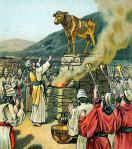
  5. Exodus 32:1 – Golden Calf – Mount Sinaiworshipping the calf
  6. Leviticus 10:1 – Nadab and Abihu – Mount Sinai
  7. Numbers 11: 1 – Complained about hardships – Taberah
  8. Numbers 11: 4 – Complained about the food – Kibroth Hattaavah
  9. Numbers 12: 1 – Miriam and Aaron talked against Moses’ marriage
  10.  Numbers 13 + 14 – The story of the spies – Kadesh Barnea

These were the 10 tests I found. There are other rebellions after the “10”, for example, Korah, Dathan, and Abiram in Numbers 16 rebel against Moses’ leadership; probably in reaction to going back into the wilderness. All of these testings took place in a two-year journey that should have taken about three weeks. I feel that part of the reason for the extended time was that the Lord had to train people who would trust in Him, establish His worship, establish a corporate identity and train an army who would/could fight. Remember they had been in Egypt for *430 years and had been reduced to slaves and indoctrinated into an Egyptian mindset.

The examples of what these “tests” represent/foreshadow will be matched to the numbers above. (I am sure there are other things that you can see in these tests. Please comment on what you see these tests represent.)

  1. This is “looking back” and not wanting to leave “Egypt.”
  2. Numbers 2 and 4 need to go together both are not trusting God for your needs but # 2 is a teaching that is a set-up for God “testing” them in #4.
  3. Believing and asking God for provisions
  4.  A test to see what they learned in 2 & 3.
  5. Making something else God.
  6. Doing things your way even when you know better; probably being drunk did not help.
  7. Not getting things right away, remember it was 2 years and no “milk and honey.”
  8. They got bored with God’s provision and wanted something else and listened to wrong influences.
  9. Talking against God’s leaders and racism to justify your actions.
  10.  Friends talking against God’s plan for your life.

Side Notes: (see Test, Attacks and Storms and Test, Test, Test)

  1. The number thirty-eight appears twice in connection with waiting and being put in a state of freedom. Deuteronomy 2:14 and the invalid in John 5:5
  2. The number forty deals with testing.
  3. The number 10 deals with Commands and Rulers (see Number 10)
  4. The Hebrew word “test” in Malachi 3:10 and 15 are the same words used in Psalms 81:7 when describing the waters of Meribah. It will depend on the translation you use.
  5. See Psalms 95:8, 106:32 for comments about Meribah.
  6. *Josephus in 2.15.2 states a different idea about the 430 years and splits it in half then there is a footnote confirming that as correct? I am looking into this idea, it is the only place I have ever seen this commented on. (see comment about Josephus)

http://clipart.christiansunite.com/1352029261/Old_Testament_Clipart/Old_Testament009.jpg