Seeds – Part of God’s Garden

Seeds – Part of God’s Garden

Pumpkin seed and Wheat

Pumpkin seed and Wheat

Recently I was asked if you could assess the planting of spiritual seeds, this was part of my answer.

To start with a study of seeds you must realize that the Father is a gardener at heart, after all that was where He first put Man, and He would walk around and enjoy His handiwork.  So I feel it is always fair to view the Kingdom as a garden where there are all sorts of plants each having its own purpose for being there.  Gardens can have different sections and purposes but still be considered a single garden.

The spiritual planting of seeds is discussed well in Mark 4 where three different stories are used that all talk about seeds.  The chapter has a version of the Parable of The Sower (4:1 – 20), an analogy of the Kingdom of God with the man who does not work for the crop (4: 26 – 29), and a second analogy where the Kingdom of God is compared to a mustard seed (4:30 – 32).  I will also use Matthew 13:24 – 30 which explains how to handle bad seeds.

The Sower

The Sower

The Parable of the Sower is a great way to assess the spiritual planting of seed because Jesus, the Master Teacher, explains the parable for the disciples and us so there is no mistake about its meaning.  The seed on the path represents people who hear the Word but Satan steals it.  The seed on rocky ground was received with joy but shriveled quickly when trouble came.  The unfruitful seed was sown into a place where worries and desires became more important, producing nothing.  But the seed on good soil multiplied itself and produced more seeds.  It is worth noting here that the seed on the good ground was also the majority of the seed planted in the field.  The “how” can we assess seed in this parable is done all the same way; it has to be allowed to start growing.

This idea brings in Mark 4:26 – 29 and Matthew 13:24 – 30 where the seed has been planted and has been allowed to grow.  In Mark, it is recognized that the framer’s job was to just plant the seed and the seed does the rest of the work until harvest time comes.  In Matthew, another problem with growing seed is covered in the fact that bad seed will at times be forced in with the good.  This parable shows the great love and patience of God in that He allows the bad seeds to grow because He knows that

Bad Seed

Bad Seed

sometimes if you pull “weeds” you can kill the developing good plant.

The size of the seed plus what type of seed was sown and what we can expect is shown in the Parable of the Mustard Seed.  Seed will produce exactly what kind of plant it has come from.  God can use a variety of seeds to produce the crops He needs to fill His barn.  The mustard seed may have been small but what it produced was useful and needed.   The plant mentioned in the parable may have been a Sinapis nigra or a Salvadora perscia.

The only way a farmer knows if his seed is any good is to wait for it to grow and produce a crop.  It is the same with a teacher of the Word; the only way we know if our spiritual seed sowing has been good is when we assess the crop.

http://www.freebibleimages.org/illustrations/parable-weeds/

http://www.freedigitalphotos.net/images/pumpkin-seed-and-wheatdried-cereal-seeds-photo-p182054

Senseless

Senseless

In Jeremiah 10 the word senseless (in the NIV) is used three times and anytime I find a word used that many times it signals a trip to the concordance.  If you use the King James senseless is translated brutish.  Looking in the Strong’s Concordance the word in Hebrew is (number 1197) baar, which means to kindle or consume (by fire or by eating).  The NIV translates several words senseless the one in Jeremiah 5:21 basically means “no heart” and the one in Jeremiah 4:22 means “stupid.”  Jeremiah (in the NIV) uses senseless more than any other book in the Bible. Psalms is next with most of those words meaning “foolish” or “stupid.”

In Jeremiah 10 three different groups of people are referred to as “senseless” or “brutish”:

  • V.8 – Those who are taught by wooden idols (The chapter starts off with a warning about learning the ways of the nations and being terrified by signs in the skies.)
  • V.14, 51:17 – Goldsmiths who are making idols. (See Comparison of Jeremiah 10 and 51)
  • V.21 – Shepherds who do not inquiry of the Lord.  The fruit of that is they do not prosper and their flocks are scattered.

Remember they are going to burned or consumed.

The shepherds are the group that concerns me just because of the “sheep” who are hurt because of their actions.  In Mark 3:1 – 6 are examples of this type of shepherd.  The Pharisees set a trap for Jesus using a cripple and when the man is restored they are furious and start to find ways to KILL Jesus.  I know people are still upset when it comes to the topic of divine healing and other moves of the Holy Spirit.  It is sad when any “religious movement” would not stand in awe of someone being healed or set free just because their doctrine never made room for Jesus to do miracles in their life time.

The Birth of a New Adam

Why do a post about Adam during Christmas?  The first week of Advent was to reflect on the Old Testament shadows and prophecies of Jesus and since Adam was “a pattern of the one to come” (Romans 5:14) my reading went to Genesis, Isaiah, and several other places.  Most references to Adam outside of Genesis are family tree notations like 1 Chronicles 1:1, Luke 3:38, or Jude 1:14.  1Corinthians, 1Timothy, and Romans actually do some of the explaining of the “pattern” so I am comparing the first Adam and the second Adam (Jesus).

Adam 1

Adam 2

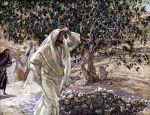
Other comparisons that are interesting: Adam sewed fig leaves together; Jesus cursed a fig tree before His crucifixion.  Eve came from Adam and the Bride is found in Jesus.

Notable things in Adam’s life – He was the first to operated on, first to make clothes, first to blame some else for his mistake, named all the animals in the Garden, first gardener, and the first to bury a child.

A word about Eve; evolutionists have come to the conclusion that there must have been an “Eve” who birthed all of mankind.  I saw a program where they spent forty minutes stating why there had to be one (Eve) and twenty minutes denying the concept.  The problem here is dual evolving of human DNA is unbelievable and I am sure that mathematically it has to be impossible.

In Hebrews, the first chapter, Jesus is clearly shown as “The Son.”  Several quotes from the Old Testament such as “You are my Son today I have become your Father” from Psalm 2:7, other verses that are mentioned at the beginning of Hebrews are     2 Samuel 7:14, and Psalm 45:6,7.   Several other verses that tell of things to come are Psalm 110:1 and Isaiah 8:17 where everything is put under His feet showing Lordship of all things.

The word “Adam” comes from a word that means, “to show blood”, “be flushed, or to turn rosy or ruddy.”  This possibly referred to his color. This leads to a question I just did not understand, “Why did God “hate” Esau (Edom)?”  He was a type of Adam (the sinner-man) being the firstborn and he was “red.”

Since Jesus was a second Adam, if we are found “in Him” we are a completely new and different race of people.

Putting On or Spandex Tight

Have you ever thought about putting on clothing as “sinking into a garment” or that you wrap or encircle yourself in your clothes?  Those are the visuals Paul is telling us to do when we put on the “armor of God” and important other things in the rome_soldierEpistles.

If you have ever sunk into something, other than water, that picture presented by the Greek word enduo (#1746, Strong’s) becomes very vivid.  As a boy I played in an abandoned sand quarry where the pits filled with silt/mud.  We tried to run across them and found ourselves waist deep in mud standing on a sandy bottom.  The mud wrapped around us as we sunk, and you could barely move.  It conformed to your body and held tight even when you did get free.  That is what I thought of as I read the definitions for enduo.  Now imagine all of those New Testament references in the graphic and that is how tight Jesus, or the armor of God, and all of those other things are to be attached to us.  Imagine having compassion and kindness Spandex tight so that they it could not be distinguished from you.

Saint Paul in Ephesians 6:10 – 17 uses two different words for what we are to do with the armor, in verse 13 the Greek word is analambano (#353, Strong’s) and enduo in verse 11.  So, Paul tells us to sink into the armor and then he tells us to “receive” the individual parts like the belt, shoes, and shield.  The Strong’s Concordance uses Mark 16:19 as an example for receiving; this is where Jesus was received into Heaven.  Even though it is not stated I have to think that Jesus was welcomed (received) with joy, excitement, and a celebration and that the Father purposely took Jesus to Himself.  So, when Paul teaches us about the armor in Ephesians, he wants to purposely receive it and sink into it so completely that it surrounds us.

Where did Paul get such an idea as to equate salvation as a helmet or righteousness as a chest protector?  As I have stated in another post called (God’s Will Has Made Your Will) Paul read them in Isaiah 59:17 where he is describing what the Lord put on when there was no justice and no one intervening.

Example of Things We Are to Put On

Examples of Putting On

The verses are from:

New International Version (NIV)

Holy Bible, New International Version®, NIV® Copyright © 1973, 1978, 1984, 2011 by Biblica, Inc.® Used by permission. All rights reserved worldwide

Clipart from: http://rome.phillipmartin.info/rome_soldier.htm 

Zelophehad’s Daugthers

The story of Zelophehad’s daughters is a story of family, love for a father, and a lasting legacy.  With only fifty words they had their wish come true, their father’s name did not “disappear” just because he had no sons (Numbers 27:1-11).  Now, this did not happen without conditions (Numbers 36) and a little reminder to Joshua and the elders (Joshua 17:4), twelve more words.  Their story is recorded in three books of the Bible-Numbers, Joshua, and 1 Chronicles.  If you timeline this, Numbers 27 occurs and then the elders of Manasseh in Numbers 36 are worried about land that has not even been won yet but God agrees and sets conditions for inherited land and how it should be passed on if no son was born to a father.  After Numbers 27 + 36 Moses is called to go up the mountain, view the land and die so this may have been the last set of rules he sought God on.

The girls loved their father and he had brought them up to be obedient and independent.  They had a strong sense of justice and knew that just because there was no male descendant that they should not exclude them from their rights in the Promised Land.  So they looked to God and the authorities to do the right thing.

Zelophehad’s daughters were very conscious of politics in the camp and were aware that their father had made some wrong choices. So they start their petition for the inheritance with the fact that he died for his own sins, not Korah’s.  Korah wanted to be a priest (Numbers 16) and lead a rebellion against Moses and Aaron (see Jude 11).  The daughters were very aware that he was not a perfect man when they said he died for his own sins, which would have been grumbling, complaining, and wanting to go back to Egypt.

Names are important in the Bible and it is always interesting to see what the names of people mean.  (I know that sometimes I make too much of the meaning.)  I always assume that the name we see was the one given them at birth but it is always possible that it could have been changed as they grew or that they were nicknames.  With that said here are the meaning for the daughters’ names from my Strong’s/Vines Concordance for the KJV.

  • Mahlah – 4244 – weak one
  • Noah – 5270 – movement (not exactly the same of Noah of the Ark)
  • Hoglah – 2295 – partridge
  • Milcah – 4435 – queen
  • Tirzah – 8656 – delightsomeness

Zelophehad’s name is used 11x in KJV and 9x in the NIV.  In the Strong’s Concordance it is not given a meaning but in the NIV Concordance, it listed as – shadow of dread, terror or protection from dread.  He is also the son of Hepher (pit or shame).  Maybe the Dead Sea Scroll’s shed new light on the root words that made up his name.

As part of Manasseh, the girls received land on the west side of the Jordan not in Gilead that was for the shepherds of the family.

The last mention of them is in 1 Chronicles 7:15. Where again it is pointed out that God had done something special for Zelophehad and his daughters. The land was the inheritance and it was important but his daughters gave him the gift of being remembered because they were brave enough to stand up for their family name and their father.