Miracles and Storms

Miracles, miracles, and miracles.

Matthew 21:21! Killing trees and removing mountains, ok how many of you as baby Christians went outside after reading that and tried to kill a tree? How long did you wait to see if it was dead before you decided that you did not have enough faith? Ok, did you ever do the James and John act and tried to call down lightning on something or someone? Remember they got rebuked. All of this resurfaced after listening to a great sermon on Elijah by Steven Furtick of Elevation Church. His main point was not the rain or “fire of God” but they made me think again about miracles. Yes, I believe in miracles and that God still does them today.

Father God in the Old Testament certainly handled things differently than in the New Testament. Jonah’s storm, Elijah’s drought, lightning, and rainstorm and don’t forget Moses’ plagues He certainly stepped in and used weather and “supernatural happenings” to make a point to/for His kids. That maybe is the key right there, God used His nature to make a point to/for His kids. (Forgive me, I don’t do well with “Mother Nature” anymore; please make mine Father God.) The only New Testament figures that I could find who would have that sort of power are the two witnesses in Revelations 11.

As I thought about Jesus as our example and His miracles this simple truth hit me hard. Jesus never called down lightning, asked for an earthquake, or created a violent wind. Jesus calmed storms He did not start them. He calmed storms to prove His Lordship over them. Jesus healed, fed, and comforted people. Well, what about when He said you would do “greater things” in John 14: 11-13. That phrase may also mean “more.” Jesus used the same phrase here as He did about sending the Holy Spirit – when I go to my Father. Doing better than raising the dead, don’t think so, but how about more often than He did. Smith Wigglesworth had quite a few documented cases. What if every believer raised someone!

Ok, what about Matthew 21, He promised, well I guess the next time you are hungry and are about to be crucified expect that fig tree to die. But until then do miracles like Jesus; focus on healing, feeding, and freeing that will be a lot better than a dead bunch of trees and no mountains.

Fruit and Nuts – Olives and Pistachios

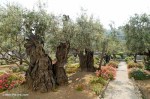
Olives, wow what an iconic plant that represents not only the Church but also God the Holy Spirit.

The tree was very important to the daily life of people throughout the Bible. But unlike some of the other fruits I have looked at it was the oil made from the olive berries that held the most importance to daily life. In my studies I found that the olive berries were eaten, usually preserved in saltwater, but that the oil was used for many things – light, medicine and anointing. There were other oils (sesame and walnut) in use during Bible times but at least in the Bible it seems that when you see oil it was olive oil. I had to check but I could not find one reference to olive berries being eaten in the Bible.

The first mention of olives, in Genesis, is the leaves found in the dove’s mouth that Noah sent out after the flood. The last mention of olive trees is found in Revelation and they represent the two prophets in chapter 11. Either olives or oil is mentioned in most, but not all, of the books of the Bible.

Paul in Romans 11:17 – 24 represents spiritual Israel as a olive tree that we were grafted on to in the place of unbelieving Israel. That scripture tells me two things: first, heed Paul’s warning about arrogance toward Israel and that they knew how to graft fruit trees two thousand years ago!

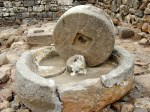
The olive oil is a picture of the Holy Spirit’s anointing and gifts. Getting the oil required that the olives be crushed in an olive press the same technique is used today and the grades of oil come from the milling and collection process. It paints an interesting picture for us Christians who want God’s anointing. Are you ready to be crushed in order to be useful to the Church?

Another interesting fact I learned in my study was that olive trees have no growth rings so you cannot accurately tell the age of the tree.  Just like the Church, it is an “ageless” growing organism that is to be producing fruit.

Mount of Olives http://www.bibleplaces.com/mtolives.htm

a good article http://www.hort.purdue.edu/newcrop/janick-papers/fruits-bible.pdf

Picture of olive tree http://www.freepik.com/index.phpgoto=2&k=olive&isCat=1&isKeyword=1&order=2&vars=2

olive press 

http://handsonjewishholidays.com/wpcontent/uploads/2011/11/chorazinolivepress.jpg

Pistachio Nuts

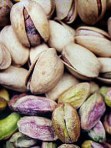
There is only one reference to pistachio nuts in the Bible (they did make it) and that is in Genesis 43:11.  They are part of the “gift” the brothers are to take back with them when they return to Egypt. I got the feeling Jacob was not only trying to bribe the “Man” but maybe open up a trading business. If you look at this story in Genesis chapters 42 and 43 the big thing I find interesting is the name shift, in chapter 42 it is Jacob in 43 it is Israel. (see What Was His Name) Maybe the shift here is because in chapter 42 Jacob is focused on himself while in 43 he is focused on the “family.”

The links below are interesting; check them out if you have the time.

pistachio nuts blog http://nutgourmet.wordpress.com/2009/02/08/nuts-in-the-bible/#comments

fun facts http://www.foodreference.com/html/f-pistachios.html

pictures of pistachio tree and nuts http://en.wikipedia.org/wiki/Pistachio

nice website about Israel, its food and land http://judaism.about.com/od/conservativejudaismfaq/a/dov_tubshvat_3.htm

The House of Smart and Dumb

In the house of smart and dumb

For several years you must come

Everyone rents a room

But you will choose just where you bloom

The stairs you climb is up to you but no one is excluded

Facilities are not the same

Utilities included

The power you will use

Determines just what dumb you lose

Few are those who lead the way

Most are they who simply stay

To climb the stairs takes a gladiator

But most just want the escalator

The day comes fast, the courses pass, for graduation yearning

And out the door you are pushed back in The Land of Learning

Moses’ Psalms

Psalm 90 is actually the only Psalm that has a sub-heading that identifies Moses as its writer (some Bibles do not include these) but it is fairly clear that his family was musical. Look at Exodus 15 even though Moses may not be credited with writing that song he did lead the Israelites in its singing and in verse 21 Miriam follows his lead and starts playing the tambourine and dancing. He also leads (recites) a song in Deuteronomy 32, so he seems to at the very least have been a songwriter.  Over the years as I have read Psalms 90 through 100, I have wondered why most of them have no subtitles and that Psalm 101 is clearly marked as being written by David? The exception is Psalm 92, which is identified as being for the Sabbath Day. (possible placement of Psalms)

Ok, now for an active imagination because there is no proof for this other than contextual clues, and some people may think that is a bit thin. Look at the job that Moses actually had to do; teach the children of Israel about God after they had been in a pagan land for 400 years. They were more knowledgeable about Egyptian gods than they were about Yahweh just because they were around those demon gods’ art and statues. He had approximately one million people who knew very little about God and had to be instructed in His ways. What better way to do that than through song; so now read these Psalms as Sunday School lessons and focus on themes. Also, think about the trials and problems the Israelites had in Exodus through Deuteronomy.

  • Psalm 90 – (think Exodus 15:26)
  • Psalm 91 – (think Exodus 17:15) to make God your fortress and He will protect you
  • Psalm 92 – (think Exodus 16:27)
  • Psalm 93 – (think Deuteronomy 5,6) shifting thinking from Egyptian gods
  • Psalm 94 – (think Exodus 10:29) a call for justice
  • Psalm 95 – (a lesson after Meribah and sending out the first spies) exhortation to praise God and not tempt Him
  • Psalm 96 – to praise God for His general judgments
  • Psalm 97 – the majesty of God’s kingdom
  • Psalm 98 – a general call to praise God
  • Psalm 99 – the mercifulness of God and His right to reign (some sources suggest that it may not have been the Samuel of 1 Samuel)
  • Psalm 100 – (think Exodus 40) giving praise to enter the new worship area

Psalm 111 is mentioned in Part 2. (See below.)

Thompson Chain-Reference Bible was a resource. NIV usually includes subtitles on Psalms.

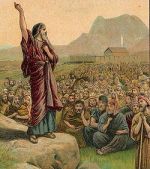
Moses picture: http://www.google.com/imgres?imgurl=http://upload.wikimedia.org/wikipedia/commons/thumb/d/db/Moses_Pleading_with_Israel_(crop).

Please see Part 2.  In Part 2, I focus on Moses’ Psalms or Songs outside of the Book of Psalms.

Fruit and Nuts – Grapes + Recabites

Grapes, raisins, vines/branches, and wine

When it comes to symbolism what better icon is there than the grape plant for representing the Church of Jesus?  Jesus used it in parables, it is part of our communion and it is referred to throughout Scriptures. Now as with most symbols you can attach several meanings to grapes and its vines; I am going to look at a few and let God reveal others to you.

  1. Part of Communion – The wine is to represent the Blood of Jesus. * Sorry, I did not say grape juice! I do go to a church that uses grape juice but ancient Israel would have had to ferment it in order to keep it. Several churches I know use grape juice so as to not have weaker Christians stumble and I am good with that!* But wine is a “living drink” having come from many individual grapes all put together and joined by yeast (it does not have to symbolize sin) to become something new. Yeast in Luke 13:21 is used as a picture of the Kingdom of God.
  2. Jesus refers to Himself, as the Vine and we, the Church, are the branches. John 15:5
  3. Nazirites – People separated to God for a season could not eat or drink any part of the grape plant while under the vow. (Look in Numbers 6 and remember that Samson was a Nazirite and so was John the Baptist, probably.) Interesting type and shadow, that people in the Old Testament who choose to get close to God had to give up grapes, a symbol for the church.
  4. Medicine – In 1 Timothy 5:23 Paul urges Timothy to use a little wine because of his stomach; the alcohol can kill germs.
  5. The vine in Judges 9: 12+13 – refuses to rule over other plants so that it can do its job. I did not find any reference to a “vine” that was not grape.
  6. Misuse of wine – I guess the one that stands out is Noah getting drunk after the Flood. Proverbs 20: 1- “Wine is a mocker” (NIV) speaks for its self or Proverbs 23:29-35, “When will I awake so I can get another drink.”
  7. Raisins – They are grapes with most of the water (Holy Spirit) taken out of them but they still can revive a weak individual. Ex. 1 Samuel 30:12

However, you view wine drinking is between you and Jesus but the grape plant and its fruit are and always will be part of Church symbolism.

The picture of the grapevine is from http://free-extras.com/images/growing_grapes-5434.htm

Recabites (NIV) or Rechabites (KJV)

First, my apology to anyone who is not familiar with American slang; the word “nut” can carry several meanings and for this blog, it is someone who is crazy (at least according to worldly standards).

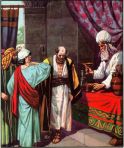
The main story of the Recab family is found in Jeremiah 35. Here the prophet Jeremiah is instructed by God to have all of the men of the family come to the Temple and serve them wine. No pressure right, THE MAN of God invites you to church and expects you to join in “the boys night out” he is throwing. They refuse and state that they don’t drink because of a long-standing family tradition. (Drinking alcohol is not the point but it could be; I know it is a very volatile topic. I don’t drink because it is one thing that God delivered me from when I got saved. I have found out through the years that it is not me who is uncomfortable with not drinking but the drinkers around me.) They also state another family tradition of not owning houses or planting fields. Now all of this combined for some people would qualify them as “NUTS”, no “American Dream” of your own house; then to top all of that off they tell the man of God, NO.

So who were these Recabites who would say no when put into such a pressure situation? According to 1 Chronicles 2:55 they are one of the family groups that came from Caleb, the faithful spy in the Exodus story. Now there are several “Recabs” in the Bible and not all of them are from Caleb and when you read verse 55 you may recognize Kenites and again there are several groups with this name that do not seem to be related. But more specifically they may have come from the Jehonadab who sided with Jehu in 2 Kings 10 (it makes you wonder if they are part of the 7000 in 1 Kings 19) to get rid of Ahab and the prophets of Baal. So taking a stand and following God was a long time family tradition for the Recabites.  And in Jeremiah 35:19 God honors them because they honored the instructions of their ancestors. With a promise to always have a family member who serves God!

The picture of the Recabites is from http://lavistachurchofchrist.org/Pictures/StandardBibleStoryReadersBook5/images/scan0017.jpg