
Psalm 80

I have been looking at the names that describe God so as I read Psalm 80 its three repeating verses caught my eye. The verses are #3,7 and 19; the verses add a name of God each time it repeats, and part of my study was to look at body parts and it talks about the face of God.

The three names that are added are:

1. God – Elohim means great or mighty one

2. Almighty – Saba focuses on power to conquer or means commander of the army (host)

3. Lord – Yahweh implies a personal covenant relationship with the true God

Different translations handle these verses differently so checking several will be a good study. (I used the NIV.) I did a definition study of the other words in the verse and a loose translation without the names would be:  Physical bring us back O (different names) establish favorable circumstances as a sign of favor so that we can be rescued from earthly enemies.

If you now read the verse adding the definitions for the names, it really adds a new depth to the verse.

I like how Asaph added another name as the Psalm proceeded. Now there are three other sets of names in Psalm 80 the first is “Shepherd of Israel” and then in verses 4 and 14 and these are combinations of Lord, God, and Almighty; if numerology interests you that is six times the names of God are used and a total of twelve individual uses.

Asaph starts the Psalm by calling on the Shepherd of Israel who led Joseph.  I like that title – Shepherd of Israel.  I read several ideas about why he would start off with Joseph and then mention Ephraim, Benjamin and Manasseh so know that you will find many ideas. So here is mine; Joseph is actually the “firstborn heir” which was an important position in a Hebrew family.  Benjamin was his brother by the same mother and Ephraim and Manasseh are his children; that would make them Rachel’s (the “loved wife”) children. Jacob was making Joseph the “ruler” of the family when the brothers got rid of him. One sign of this was the coat of many colors. He actually was the first-born son just not the first-born son, but Reuben lost the birthright of the first-born (Genesis 35:22).

Here are a few other “nuggets” that I found in doing this study.

  1. “Restore” carries the idea of return or repent; it is different from the New Testament “repent” or metanoia. Metanoia is a mental change while shoob or restore usually refers to a physical return.
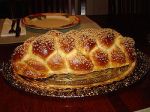
  2. The word for face is paneh which comes from panah; it means to turn or look. Another word is paniym and it refers to the “face bread” or shewbread that was put into the Tabernacle.  They did not have a physical image of God, but they had the bread. I am not an etymologist, so I do not know if they are related but the Spanish word for bread is pan.
  3. I read in my Bible Glow app; that the psalms in Book 1 (#1-41) more often use Yahweh (the Lord) and Book 2 (#42-72) uses Elohim (God) more often, there is no apparent reason for this grouping.
  4. A little background – this is in the Third Book of Psalms and most of these are attributed to Asaph (means gather or collector). He was a Levite and part of King David’s praise team.

I used my Strong’s Concordance with Vines Dictionary as a reference book. pic of bread from http://en.wikipedia.org/wiki/Challah

Hope and LORD God


This study is going to cover several things; it started out as a look at the word “hope” and then I noticed the differences in Lord God. So I had fun comparing the passage in different translations.

I set Psalm 71 in 1 Samuel 30:6 (see psalm position), this passage is where Ziklag was burned, because it sounds like someone trying to encourage them self in the Lord.

Hope in verse 5 is tiqvah #8615 (Strong’s Concordance, 2001) and means a cord or attachment, it is used 34x; other usages are expectancy and line. While in verse 14 it is yachal #3176 and means wait and to be patient, it is used 42x; other usages are tarry, trusted, and variant. If I am really exploring a word I will look up all the usages of the word and how they are set in the passages.

Other Old Testament (King James) words that are translated as hope are:

  1. #983/982/986 – batach –refuge, security, trust ex. –Ps. 16:9, 22:9, Eccl. 9:4
  2. #2342 – chuwl – twist, whirl, dance, writhe (in pain), figurative-to wait ex. – Lam. 3:26
  3. #2620 – chacah – to flee (for protection), to confide in  “It is often used where God is compared to a rock, shield or one with protective wings. ex. –Prov.14:32
  4. #2976 – yaash – to despond (no hope) ex. – Jer.2:25
  5. #3689 – kecel – fatness, silliness, (in a good sense) trust ex. – Job 31:24
  6. #4009 – mibtach – from 982 refuge, security, assurance ex. – Jer. 17:7
  7. #4723 – miqvah – something waited for, confidence, collection (of something) ex. – Ezra 10:2
  8. #7663/7664 – sabar –to scrutinize, to expect ex. – Is. 38:18, Ps. 119:116
  9. #8431 – towcheleth – expectation ex. – Job 41:9                                        Interesting note – in the KJV I do not see a reference for “hope” until the Book of Ruth.

The New Testament (KJV) really only has one word for hope but according to Vine’s Dictionary it has several definitions (Vine’s is in my concordance).

# 1680/1679 Elpis (noun and verb) to anticipate (with pleasure), expectation, confidence

Hope is not a fruit of the Spirit – Galatians 5:22; if you look at the list of things to add to your faith in 2 Peter 1:5+6 you will notice it is not there either. I feel it is because if you get those things they are what allows you to have HOPE.

Notice the variations from Lord God, Lord Jehovah, Sovereign Lord to just repeating Lord twice. I have seen people pick a verse like this to use as a comparison when they are shopping for a new Bible.

Psalm 71

Complete Jewish Bible (CJB)              For you are my hope, Adonai Elohim, in whom I have trusted since I was young.

New American Standard Bible (NASB) 5 For You are my hope; O Lord [c] God, You are my confidence from my youth. [c] Heb YHWH, usually rendered Lord

Darby Translation (DARBY)                   For thou art my hope, O Lord Jehovah, my confidence from my youth.

New International Version 1984            For you have been my hope, O Sovereign Lord, my confidence since my youth.

Holman Christian Standard Bible (HCSB)For You are my hope, Lord God, my confidence from my youth.

King James Version (KJV)                    For thou art my hope, O Lord God: thou art my trust from my youth.

New King James Version (NKJV)        For You are my hope, O Lord GOD; You are my trust from my youth.

Wycliffe Bible (WYC)                           For thou, Lord, art my patience (For thou, Lord, art whom I put my trust in); Lord, thou art mine hope from my youth.

Amplified Bible (AMP)                          For You are my hope; O Lord God, You are my trust from my youth and the source of my confidence.

Psalm 70

Douay-Rheims 1899 American Edition (DRAFor thou art my patience, O Lord: my hope, O Lord, from my youth;

All of the references came from: www.biblegateway.com (each has their own publishing company) Use the parallel function at the right side of the page after you have gotten your scripture on the screen.


Judas in the Old Testament

Finding foreshadowing of the New Testament hidden in the Old Testament has been a study I always enjoy. This year I marked out months just for that in my study plan so here is the first. What I would attribute to Judas being like is found in several Psalms. I will mention the Psalm but also where I think the inspiration for that Psalm came from in scripture and who was the shadow of Judas.

Psalm 52David was writing this about Doeg the Edomite from 1 Samuel 22. He was the instrument of destruction for an entire branch of the priestly family; this was part of the sentence handed down from the Lord because of Eli and his wicked sons in 1 Samuel 2.  The final part of the story is found in 1 Kings 2:27.  Psalm 52:1 – 4 gives a look at what I think he was like: boasted of evil, practiced deceit, loved evil and spoke harmful words. Verses 5 -7 talks of his downfall and how he is remembered: in everlasting ruin, uprooted from the living, destroyed others.

Psalm 55 – Verses 12 – 14, 20 and 21 also talks about Judas’ character. “My companion, my close friend, with whom I once enjoyed sweet fellowship as we walked to the house of God”, Psalm 55:13,14 (NIV). And in verse 20 +21, “My companion attacks his friends; he violates his covenant.”  A possible point when this was birthed is 1 Samuel 22:3 when David is hiding his parents from King Saul.  But as I thought about it, it could be referring to his cousin Joab the commander of the army and a consistent problem for David or even his son Absalom.

Psalm 41:9 Even my close friend, whom I trusted, he who shared my bread, has lifted up his heel against me. This verse is quoted in John 13:18.

Psalm 109:1 – 20 – verse 8 is quoted in Acts 1:20 May his days be few; may another take his place of leadership. (Matthias) I think this Psalm was written because of Nabal in 1Samuel 25:35. The reason for this is in vs. 16 – 20 and describes both Nabal and Judas – never thought of doing a kindness, hounded the poor, needy and broken hearted, loved to pronounce curses and wore them like a garment.

Psalm 69:25 is also quoted in Acts 1:20 “let there be no one to dwell in their tents.”

Zechariah 11:12 – If you think it best, give me my pay; but if not keep it. So they paid me thirty pieces of silver. (Matt. 26:15)

So as expected Judas has some of the worst guys in the Bible providing his foreshadowing: Doeg the Edomite (priest killer), Nabal (the selfish fool) and possibly Joab (under minding cousin) and Absalom (son with ambition).

Where/When I Think Psalms Were Written

I think David and the other writers of Psalms wrote as a reaction to what was going on in their life. Even though my list is very subjective (and not complete) it has helped me to locate psalms with other scriptures. I had to save this as a picture because of how I typed it many years ago, so please click here to view my list, I hope it will be a blessing and a help in your Bible studies.  psalm position  This is also in David the Writer.

King David the Writer

I once heard someone say that David was a yo-yo when he wrote Psalms because one psalm he was up and one psalm he was down.  I was just starting to write and I recognized how silly that statement was because David did not write them all at one time and that he was writing these as a response to the times he was living in and what he was experiencing. To read David’s psalms are to read his struggles and victories of his life, his cries for help and his shouts of praise. Songwriters don’t always write just happy songs or just sad ones. And if you study psalms many of them may have been written for specific reasons (scholars have classified them as to content).

A study of psalms would be incomplete without a reading of Samuel, Kings and Chronicles. So I started to place the Psalms in 1 & 2 Samuel and 1 Chronicles (see Joined) where I thought they might have been written.  Some of the psalms give you clues in the titles; some translations and Bibles don’t always include those.  For the other ones I tried to place myself in the moment or look for other clues.  I know the Chronological Bible does something similar but I have never really looked at their placement because I wanted this to be from a writer’s point of view not a timeline one.

I am sure that if you look at the list you may put some in a different location.  That is fine as these are just my guesses as to where I would have written them.  But I would challenge you to check mine out and then do your own list; the only rule to guide this would be that you must have a reason for its placement.

I am not finished with this yet because some are hard to place but by the end of the year I may have another list to post.  You will need to click on the link that is part of WordPress.com as it is saved in there as a media file.  My original copy is a word document and should be put into a table or in EXCEL but that will be a while in coming.

Have fun and I want to hear your feedback as you place the Psalms where you think they should go!

Click here to see my list.   psalm position