Bread in the Bible – Feeding Many

Jesus feeding many people at one time in the Bible is found in all of the Gospels. The stories are important because it was one of the signs that the Jews had decided their coming Messiah would do. There are many lessons that you can find in the story of the mass feedings. Here are the references for each Gospel.

  • Matthew 14 – 16
  • Mark 6 – 8
  • John 6
  • Luke 9:10 -17

The timing of these events is important. John the Baptist has been beheaded and Jesus is headed to Jerusalem. This puts these feedings near the end of His forty months of ministry. Matthew and Mark have a feeding of 5,000 in Israel and then a separate feeding of 4,000 people near the Decapolis on the east side of the Sea of Galilee (See Mark 7:31 and 8:1). The miracles and conversations in and around these miracles are important in the big story. The leftovers were epiousios provision.

Luke – This is the basic story; it is before the Transfiguration which agrees with Matthew and Mark. Like them, it has an interesting thought in it. Jesus broke the bread, and the disciples gave it to the people. I see the Great Commission in that simple statement. John has Jesus disturbing the food; that is not a big deal but it is in line with him proving Jesus is the Son of God.

John – The French printer did a great job with Chapter 6 when he selected where to start and end the content of the chapter. Most of the chapter is about bread and Jesus as the Bread of Life. Remember, John is proving Jesus is the Son of God by highlighting miracles. John has more than seven great miracles in his book, but people tend to focus on the major seven.

Starting in verse 25, Jesus covers a lot of theology. His introduction of communion and comparing Himself to manna and the Bread of Heaven upset many Jews. This section does mesh well with the section in Matthew.

Mark and Matthew – The Chosen had good drama in Season 3 that ended with Jesus feeding the masses and Peter’s walk on the water. Our Gospel writers and the Holy Spirit did a better job (lol). The in-between and after is what has gotten my attention. So, please do not separate the two feedings, but view those chapters as one big section with a lot of traveling between the two main courses. My points will not be in order. John’s beheading, for me, is the start of the third block of teaching on the Kingdom of God.

  • Matthew 15:2, the Pharisees, and Clean/Unclean – Both times after Jesus fed the masses the Pharisees swooped in and challenged Him. After the 5,000 they complained all those people in the wilderness did not wash their hands before eating. Jesus took charge and changed the subject to put the focus on them and they did not like it. After the 4,000 they wanted another sign; think of the miracles in John. They had a list of things the Messiah would do and again Jesus did not play along. At this point, they had several years’ worth of miracles to choose from, but religious paradigms are very hard soil for things to sprout and grow in.
  • Yeast/Leaven – In the natural yeast changes the wheat and water and, in the process, makes a gas that causes the bread to rise or grow. (Take several Muse Moments in this section.) To say that yeast is always compared to sin and is bad is not completely correct. The grain offering at Pentecost was two loaves baked with yeast (Leviticus 23:17). Jesus also compared the kingdom of God to yeast that was put into a large amount of dough (Matthew 13:33, Luke 13:21). Yeast bread was part of the daily diet and possibly it was used to make beer; another common food.  The hypocrisy of the leaders is what Jesus did not want His disciples to consume. He had been giving them pure leaven and wanted that to fill them, not the teachings and mindsets of the Pharisees.
  • Travels – Jesus knew His time was about over. He was teaching His followers and wanted to be left alone. After the 4,000 He took His followers and went north to Caesarea Philippi, where Peter finally declared Jesus as the Son of the Living God. He also left the Galilee area after the 5,000 and went to the seacoast of Tyre and Sidon. (Elijah met a widow there and helped her.) The distances were not great but the separation was what He wanted. This separation provided quiet but also protection for His followers. The destinations were a shadow of going to the nations.  
  • Matthew 15: 26 – This interaction with a Canaanite woman is a foundation stone for Peter and Paul to preach the Gospel to Gentiles. This woman just needed crumbs, leftovers from the full loaf of bread for her miracle. Because of her faith, she got exactly what she needed from Jesus. Matthew has this trip in between the feeding of the two great masses. Mark places the second feeding in the Greek-influenced east bank. Did the disciples pick up on the connection? First to the Jews, then to the Gentiles. 5,000 were fed with twelve baskets of leftovers, then 4,000 and seven baskets were filled. Jesus gave “crumbs” to a Canaanite mother and then fed many in the Decapolis.
  • Reteach – I am pulling this morsel from a completely different basket. Our Master and Teacher gave His disciples a test and a lesson with the feeding of the 5,000. As a teacher, I see the feeding of the 4,000 as a retest, Jesus wanted them to do the miracles. I do not believe they got an A in that particular lesson.

I see the test of feeding the 5,000 as the end of the lesson from them going out 2×2 in Matthew 10. It has a connection to when the Children of Israel did not ask and seek God for provision AFTER He delivered them out of Egypt.

Bible Map: Genneseret (bibleatlas.org)

It is time to put a wrap on this study of Feeding the Masses. Yes, there are more lessons and things to look at; I did not touch on the symbolic meaning of the numbers involved. The most important reference to bread is left, communion.  

A few musings I picked up along the way.

  1. It takes many individual kernels of grain to make a loaf. They have to be picked, cleaned, ground up, mixed together, and baked.
  2. Were there people who ate twice of the miraculously multiplied bread? Besides His immediate followers.
  3. With Jesus a little can become a lot.

What is your favorite thought of bread?
Yeast

This study on yeast will focus on Matthew 16: 5-12, where we get the term “yeast of the Pharisees and Sadducees”. Some background information will help make sense of my study. (See below for other studies on yeast.) I have termed this section of Scripture the third block of teaching about the Kingdom of God (Matthew 13:53 to 20:34).

Pharisees and Sadducees

The Sadducees aligned with the priest or kohen. It is probable that Zachariah, the father of John the Baptist, was a Sadducee. The Temple was the center of their religious world.

The Pharisees believed more in the priesthood of every father for his family. They still worshipped at the Temple, but the local synagogue was their focus.

Both groups had their own “teachers of the Law”. Many times, the term applies to the Sadducees, but it may have been specific men inside each group.

In the Gospel of Matthew, there are four groups of scriptures that have these two groups in conflict with Jesus-Chapter 9, Chapter 12, Chapters 15-16, and Chapters 19-23. Yes, there are other references. Chapters 15 and 16 come after feeding the 5,000 and the 4,000. (Only Matthew and Mark have the feeding of the 4,000.) Matthew has the Pharisees confronting Jesus after the feeding of the 5,000 with the complaint that the disciples (people) did not wash their hands according to the oral tradition. Where would they find that much water on the mountainside? Matthew 15:12 states that Jesus’ answer offended them. After feeding the 4,000, the Pharisees demanded a “sign from heaven” to prove Jesus was for real. In Chapter 19, they ask about divorce and the same topic comes into play on the Temple Mount before Passover.

Yeast

In the Bible, there is two yeast. Physical yeast for making bread, beer, and wine (The Egyptians used baked bread to make beer.), and metaphorical yeast, as in Matthew 16:6 and Matthew 13:33. Most of the references to yeast carry a negative connotation however, in 13:33 it refers to the work of the Church of Jesus.

I want to share a yeast of the Pharisees and Sadducees from 16:5-7. The disciples forgot bread and then decided Jesus was mad because- “It is because we didn’t”. Yes, this is just part of verse seven, but the principle is there. We didn’t do something; how can we be good enough?

The yeast of the kingdom is different. The best two examples I thought of were Matthew 28:19, “go and make disciples”. My other one is Acts 2: 42- “they devoted themselves to”. You may have others, but these are the two that came to my mind.

Yeast-Before Passover

Yeast, a Model of Church Growth

Yeast, All Bad?

What I Learned From Yeast

Bible and Science-Yeast, A Model of Church Growth

Bible and Science-Yeast, A Model of Church Growth

Matthew 13:33 “The kingdom of heaven is like yeast that a woman took and mixed into a large amount of flour until it worked all through the dough.”(NIV)

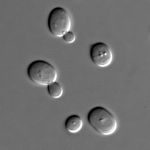
To understand this passage we need to look at how yeast grows. Yeasts are eukaryotic and can divide by a process called budding. (Most cells divide into two even-sized cells.) In budding a small uneven sized pouch of cell material forms on the “mother cell.”yeastS_cerevisiae_under_DIC_microscopy In this pouch go all of the organelles and other chemicals that are needed for it to live; since it is eukaryotic DNA also goes into the bud. The mother cell has given the bud everything it needs to live on its own including the reproduction information – DNA. The bud may stay attached to the mother cell and actually start its own bud. (Under a microscope I have seen several of these all strung out from the mother cell.)

Churches may grow the same way. The church can send out a few people who are equipped with everything needed to start and grow a new church. (Personal Opinion: I see Hillsong Church growing in this method around the world.)

∞Jesus, let me be like Isaiah and say, “Lord, send me.” Isaiah 6:8

http://www.touregypt.net/featurestories/bread.htm

http://www.wholefoodsmarket.com/blog/get-know-nutritional-yeast?sf28652915=1

http://en.wikipedia.org/wiki/Yeast

pic from http://en.wikipedia.org/wiki/Yeast#mediaviewer/File:S_cerevisiae_under_DIC_microscopy.jpg

What I Learned From Studying Yeast

What I Learned From Studying Yeast

This study started with Matthew 13:33 and Luke 13:21 and as usual, it spread from there.   The fact that it is paired with the Parable of the Mustard Seed in both of these passages is important. Jesus was showing the importance of small things done in and for His kingdom. Many times we overlook the little things we do as not important. Most of the literature I read about yeast in ancient cultures seemed to agree that they did not know about the yeast cell and that they were infusing something living into the bread dough. In our normal thinking that would be right because microscopes were not around but you have to wonder if Jesus knew!

Depending on the translation you will need to look for the words yeast, leavened, and unleavened if you want to study more on this topic. KJV does not have the word yeast but NIV does.

The amount of flour was interesting as the passages stress it was a large amount. In the NIV that amount is referenced three times: Genesis 18: 6, Judges 6:19, and in 1 Samuel 1:24.   In Genesis, Abraham tells Sarah to make that much bread for the visitors. In Judges, Gideon uses that much flour to make a meal for the angel and in the Book of Samuel Hannah took that much flour with her as an offering when she dedicated her son to God. The amount roughly translates to twenty quarts or forty cups. If you have ever made bread that is enough for at least eight to ten loaves of bread. The regular offering amount with a sacrifice would have been four quarts. I guess Abraham and Gideon were putting their “best foot forward” to impress their guests or to make sure they had extra to take with them.

In 1 Corinthians 5: 6- 8 Paul clearly says to get rid of the “old yeast” (NIV) because Jesus had gone through the Passover. But he names the yeast as “malice and wickedness,” which is also done in other places in the Gospels and the New Testament (the yeast were named Ex. yeast of the Pharisees and Herod). If you have ever used a sourdough starter you may understand the idea of old/bad yeast. If the starter goes bad you WANT to throw it away and start over, as it really smells bad.

At a small home fellowship, we once attended the pastor had an interesting revelation during communion one Sunday. (We used real wine and sometimes yeast bread. I know but that is what happened. We also used saltines if that is all we had.) Anyway for the wine and the bread to become what they were many grapes and grains of wheat were brought together but it required yeast to convert them into that usable form.

A final thought on wine and yeast. Wine/beer was/is made with the action of yeast. The wine was allowed/required to be presented as part of the offering at a sacrifice (Leviticus 23:13). The yeast in wine makes enough alcohol to kill itself and when the bread is baked that normally kills off the yeast. One was required and the other was forbidden! The Biology teacher in me still will wonder if it has something to do with the living organism? NOTE: From my reading, the Egyptians apparently made their beer from baked bread.