Jehosheba – A Hero

Jehosheba – A Hero

Jehosheba is definitely not a household name, which is a shame, and is only mentioned in one story of the Bible but her act of bravery is one of the greatest in the Bible. Her story is found in 2 Kings 11 and 2 Chronicles 22: 10 -12. In the KJV two variations of her name are used but the meaning of her name is “Jehovah sworn.” I will apply that meaning to God’s love and promise to David to have one of his heirs on the throne of Israel.

Her story starts with Jehoshaphat’s fixation with the fallen Northern Kingdom of Israel (See – A Warning For Today). Jehoshaphat chose for his son and heir, Jehoram, a wife (Athaliah) from the family of Ahab king of Israel. She was probably the daughter of Jezebel, it is implied but not stated but it would add a deeper twist to the story. Jehoram followed after Israel’s sins and was killed by Jehu when he killed the family of Ahab (2 Kings 9). When this happened Athaliah started to kill off the royal family (her grandchildren) so she could be the ruler of Judah. Jehosheba bravely takes her youngest nephew, Joash, and hides him from her mother. She has already seen her uncles killed by her father so when her mother starts killing her nephews she intervenes. I have no doubt that Athaliah would have killed her own daughter and I am sure that Jehosheba knew that also. For six years Jehosheba and her husband Jehoiada, the priest, hides her nephew until he is seven. This really is a brave, defiant act of righteousness and allowed the promise of God to David to be fulfilled.

FYI: The “sheba” part of Jehosheba is connected with the number seven. “Jeho” is from Jehoshaphat's Timelinethe name of God Jehovah.

Noah and Moses

Trivia question!  What do Noah and Moses have in common?

A tebah, it is pronounced tay-baw.  It means, “box” and it is # 8392 in the Hebrew and Aramaic Dictionary in the Strong’s Concordance. The King James translates this word into ark.  Noah and Moses are the only two people in the Bible to have a tebah.

Moses’ mother, Jochebed (Exodus 6:20), used slime, you gotta love King James, Moses036(chemar, #2564 – bitumen) in Exodus 2:3 to coat his ark (tebah.)  Chemar is used in two other scriptures: Genesis 11:3 (Tower of Babel) and Genesis 14:10 (Valley of Sodom).  Jochebed also used pitch (zepheth, #2203 – asphalt because it softens or liquifies in the sun).  The other two uses of zepheth are in Isaiah 34:9 where it foretells that Edom’s streams will be burning zepheth.

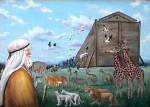
Noah had pitch (kopher, # 3724) to coat his ark, both inside and out (Genesis 6:14).  Noah's arkThis is the only place where kopher is used as that type of covering; the majority of its translations are our word ransom.  In Exodus 30:12 every Israelite in the census who “crosses over” is to redeem himself with a “half-shekel” or about 6 grams of money (It does not say if it was gold, silver, or copper.)  It was collected to service the Tent of Meeting.  In Isaiah 43:3 it is also used as the word ransom but here the “Savior of Israel” says He gave Egypt as your kopher.

I know what you are about to say, “What about the ark of the covenant?”  It is aron and it also means box and is translated ark, chest, and coffin (#727 in Strong’s).  ark of the covenantThe origin of this word carries the idea of “gathering.” Joseph was buried in an aron (Genesis 50:26) and Jehoiada the High Priest with Joash (2 Kings 12:9) made an aron to collect money to rebuild the Temple.

Final Thoughts:

  • I am sure that Noah and Moses’ tebah were rather plain and very functional whereas the aron’s were very fancy and well decorated.
  • It is a beautiful picture that Noah’s ark was coated in redemption, inside and out.
  • I am not sure what to think about the fact that the coating on Moses’ basket is associated with a sinful place (Sodom), judgment (Edom), and a structure built to glorify man over God (Babel).

The clipart is from http://clipart.christiansunite.com