Are You Grounded? The Bible and Science

Humility

The etymologies of many words that are used in science have a Latin origin because that allows everyone to have a common point of reference.  I was asked what was the origin of the word Humility.  After a dictionary search the word humility comes from the Latin word humilitas, which can be translated, humble, to be grounded, or humus (of the earth).  If you do a search of Wikipedia and other on-line sources you will find numerous opinions from various religions and philosophers even a best selling author of a business book on what it is and how important humility is to success.  Of course there are the criticisms of it by people like Nietzsche and others.

Humus to me as a gardener is the remains of organic material.  But as I look at this whole idea I still don’t see that humility has to be equated with weakness or something unimportant.  A garden grows better when you put humus back into the soil and instead of being something to walk on you may need to realize that it is actually supporting your walk.

∞Jesus, help us to have humility so we can also heal the sick, walk on water, clear out Temple Courts, and take our cross and follow You.

http://en.wikipedia.org/wiki/Humility

Lightning Then Thunder – The Bible and Science

Job 37

He unleashes his lightning beneath the whole heaven and sends it to the ends of the earth. After that comes the sound of his roar; he thunders with his majestic voice.  When his voice resounds, he holds nothing back. (NIV) The underline is mine.

As a cloud is getting ready to discharge lightning it sends out a leader, which is like a path for the electrons to follow. (They are seen with special high-speed cameras.) The leaders actually “step” their way to the ground going several yards at a time.  When the leader touches the ground the electrons are released and we see a bolt of lightning.

From NOAA

From NOAA

As the energy goes through the air it is super-heated to as much as 50,000 degrees, which causes the air to expand very rapidly.  This causes the thunder that we associate with lightning.

In a respect, this is very much like God when He speaks to His people through prophecy.  God sends prophecy a little at a time until the moment arrives and what He has been speaking comes into being.  Jehovah started speaking about Jesus and His coming to redeem man in Genesis 3 and it was talked about or foreshadowed in the next sixty-five books until Jesus came in the Gospels.

∞Father, whether it is a whisper or bolt please speak to us and show us Your energy.

http://www.lightningsafety.noaa.gov/temperature.htm

http://www.lightningsafety.noaa.gov/science/science-overview.htm

To Know God

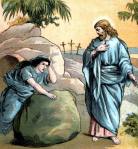
jesus at door

To have a greater knowledge of God you can always study more.  This will be a logos word where you can add to your understanding and become familiar with other people’s exploration into who God is and what He does.  Reading more books will also help to expand your knowledge of God.  In these studies you can pick the aspect of God you’re interested in and find many quality books and study-helps that will advance your understanding of God.

Then you could do the WWJD approach.  But here a good foundation in who Jesus is and what He did is required.   After all, if you are asking yourself what would Jesus do you should have read the Gospels several times so you can base your actions on the understanding you have.  One good thing here is if you keep doing it you will grow and change. (I read a post on Facebook recently that said using this approach you should not rule out overturning tables and beating people with a whip.)

I recommend doing what Psalm 46:10 says to do which is Be still and know that I AM God.  The term “be still” has several meanings and can be translated to be silent, be at rest, or to stand one’s ground.  But in Psalm 46:10 it means to be feeble, weakened, or faint.  The term “know” is yada and it means to know by observing, reflecting, or by experiencing something.

This leads back to the studying/experiencing God we talked about before.  There are logos and rhema words/experiences with God.  People who pursue God by just reading about Him will never have more than that and can, they lose that.  But when you have/get a rhema word from God you are changed, it has spoken to your heart and you will not be the same.  Now when this person gets the logos word they find new and deep truths about God and are eager to share them.  It is not easy to quiet yourself and be still but it is the way God suggested that you do it.

door 1

Luke 6:40

A student is not above his teacher, but everyone who is fully trained will be like his teacher. – Luke 6:40 (NIV).

Preachers002The first thing you better make sure of is that you pick a good teacher.  The King James Version uses slightly different words but the meanings are the same, it has disciple instead of student and master instead of teacher. The word student/disciple is mathetes the Strong’s says it is a person who has “thought accompanied by endeavor.”  Teacher/master is didaskalos and according to Strong’s Concordance it is “one who teaches concerning the things of God and the duties of man.”  But it is the phrase, perfect (KJV) or fully trained (NIV) which is katartizo which means “to complete thoroughly, repair or adjust but does not necessarily mean that the thing was broken”, that is the major word in this verse.

preacher Sermon_on_the_Mount005Luke is the only gospel that records this verse and it is placed with or in the parable of the blind leading the blind.  After much reflection, I believe that it should be placed with that verse and it actually completes the parable.  If you have a “blind teacher” of the things of God even with thought and action you will still be blind to what God has and wants for you.  But the phrase “fully trained” has the missing part.  If you have picked your teacher well they will impart themselves to you and the qualities that are important will be carried on.  I think most good teachers wish for their students to excel past them in some form, I know that I have had students who will know more than myself simply because in science there is always more to know.  But if I were teaching/disciplining someone in the ways of “God and man” I would hope to see more fruit in their life after I have given them all I can because part of my teaching must be to show them the Father and Jesus.

Art from – http://clipart.christiansunite.com/

Seeds – Part of God’s Garden

Seeds – Part of God’s Garden

Pumpkin seed and Wheat

Pumpkin seed and Wheat

Recently I was asked if you could assess the planting of spiritual seeds, this was part of my answer.

To start with a study of seeds you must realize that the Father is a gardener at heart, after all that was where He first put Man, and He would walk around and enjoy His handiwork.  So I feel it is always fair to view the Kingdom as a garden where there are all sorts of plants each having its own purpose for being there.  Gardens can have different sections and purposes but still be considered a single garden.

The spiritual planting of seeds is discussed well in Mark 4 where three different stories are used that all talk about seeds.  The chapter has a version of the Parable of The Sower (4:1 – 20), an analogy of the Kingdom of God with the man who does not work for the crop (4: 26 – 29), and a second analogy where the Kingdom of God is compared to a mustard seed (4:30 – 32).  I will also use Matthew 13:24 – 30 which explains how to handle bad seeds.

The Sower

The Sower

The Parable of the Sower is a great way to assess the spiritual planting of seed because Jesus, the Master Teacher, explains the parable for the disciples and us so there is no mistake about its meaning.  The seed on the path represents people who hear the Word but Satan steals it.  The seed on rocky ground was received with joy but shriveled quickly when trouble came.  The unfruitful seed was sown into a place where worries and desires became more important, producing nothing.  But the seed on good soil multiplied itself and produced more seeds.  It is worth noting here that the seed on the good ground was also the majority of the seed planted in the field.  The “how” can we assess seed in this parable is done all the same way; it has to be allowed to start growing.

This idea brings in Mark 4:26 – 29 and Matthew 13:24 – 30 where the seed has been planted and has been allowed to grow.  In Mark, it is recognized that the framer’s job was to just plant the seed and the seed does the rest of the work until harvest time comes.  In Matthew, another problem with growing seed is covered in the fact that bad seed will at times be forced in with the good.  This parable shows the great love and patience of God in that He allows the bad seeds to grow because He knows that

Bad Seed

Bad Seed

sometimes if you pull “weeds” you can kill the developing good plant.

The size of the seed plus what type of seed was sown and what we can expect is shown in the Parable of the Mustard Seed.  Seed will produce exactly what kind of plant it has come from.  God can use a variety of seeds to produce the crops He needs to fill His barn.  The mustard seed may have been small but what it produced was useful and needed.   The plant mentioned in the parable may have been a Sinapis nigra or a Salvadora perscia.

The only way a farmer knows if his seed is any good is to wait for it to grow and produce a crop.  It is the same with a teacher of the Word; the only way we know if our spiritual seed sowing has been good is when we assess the crop.

http://www.freebibleimages.org/illustrations/parable-weeds/

http://www.freedigitalphotos.net/images/pumpkin-seed-and-wheatdried-cereal-seeds-photo-p182054