Special Days – Before Passover

Special Days – Before Passover

Saint Paul’s life as a Jew was built around a series of “special days.”  These are found in Leviticus 23; the major ones start with Passover which leads to the Feast of Weeks (Pentecost) and ends with the Day of Atonement (there are other Jewish holidays).  We as Christians have days that we celebrate; the two most important holidays are Christmas and Easter.   Even though Paul warns the Galatian Church about the observation of special times (Galatians 4:10) I tend to believe that he was warning them not to make these things stumbling blocks or doctrinal (fellowship) issues.  After all, the Father did pick these special days and even ended His work of creation with the Sabbath.

As a child, we always had an Advent wreath and I have used this tradition to help me focus on the day we have chosen to celebrate Jesus’ birth.   In the next few weeks, I will focus on the time in Jesus’ earthly mission that went from Passover to Pentecost.  To Jews, this period is known as the “Counting of the Omer.”  We as Christians tend to forget this period until Ascension Sunday and then Pentecost.  This time period is important in the history of the Church, each of the four Gospels and Acts record events that occurred in these fifty days.  My hope is that this will help us focus on the “types and shadows” found in the Jewish holidays and to celebrate the outpouring of the Holy Spirit and the start of Kingdom work.

I have chosen to write this series of posts to follow the Jewish holidays not the Christian days.  If you want to use these post from Easter to Pentecost Sunday wait a few days to start as they are not the exactly the same, this year Passover is several days before Easter.  Who is right?  Read Galatians 4:10.🙂

Joel 2: 30/Acts 2: 17

Today is Pentecost Sunday, 2015 and I have been studying the term – Wonder. Ok, Pentecostthese connect because the Holy Spirit is causing the Church to speak in tongues, prophesy, see visions, and has promised to show wonders and signs. The Old Testament word is mopheth and the New Testament word is teras. In my Strong’s Concordance, teras is something “strange that causes wonder and causes you to marvel, it is always in the plural. Wonders appeal to the imagination.”

These things have been given to the Church so that mopheth pronounced “mo faith” can rise in us!

pic:  http://clipart.christiansunite.com/1402137661/Pentecost_Clipart/Pentecost004.jpg

Pentecost-Happy Birthday Church of Jesus

Pentecost or fifty days after Easter is the end of a time period known as “Counting of the Omer” and for the Jews, it is the time period they remember the Exodus to the giving of the Law at Mount Sinai.  For the Christian, it marks the birth of the Church and the giving of the Holy Spirit.  The Hebrew letter Nun the fourteenth letter of the Jewish alphabet represents Pentecost, which means fifty. Jesus during the Resurrection had shown Himself to the Disciples and had taught them about His Kingdom.  After forty days He ascended into Heaven leaving them ten days to seek Him about this promised “Holy Spirit” that was to come.  You have to wonder if they fully understood what Jesus was talking about or what was about to happen?  Had Jesus explained that when the Holy Spirit came that they would walk in a new anointing and power that had not been experienced by that many people before? In Leviticus 23: 15 – 22 the observance of Pentecost is described.  The main offering is the “firstfruits” of the season that is two loaves of baked bread that are to be waved before the Lord.  The unusual thing about these loaves is that they are to be made with yeast.  Normally offerings brought to the Temple were to be yeast-free as it is a type and shadow for sin.  As the Hebrew4Christians website notes these loaves represent the Jew and Gentile being presented to God as firstfruits.  In one parable found in Matthew 13: 33 and Luke 13: 20 yeast is compared to the kingdom of God.  (Yeast is a living organism that serves a purpose in a sense they give what they are in life!  Instead of sin maybe it is the type of yeast you are using!) PentecostActs 2: 2 + 3 tell about the “sound of a violent wind” and “what seemed to be tongues of fire.”  Other than God can be dramatic if He wants to be, maybe they symbolize the ram-horn trumpets and the fire for the burnt offerings that had to be made on Pentecost.  I have wondered if the Disciples really knew what “wait for the gift my Father promised,” meant?  They had seen Jesus operate in miraculous power but you wonder if they thought it would show up like that? I know that many who are Christians do not claim a “Pentecostal” experience is valid for today.  Many make fun of it just as the Disciples were accused of being drunk but Peter dispelled that idea immediately (2:15).  His closing comments in Acts 2: 38 + 39 talk about the “gift” (the one they had been waiting for) and says that the “promise is for you and your children and those who are far off” so that should include everyone since the first Pentecost and I did not notice that the “gift” was going to change in any way.  Think about the gift of Pentecost! http://www.hebrew4christians.com/Holidays/Spring_Holidays/Shavuot/shavuot.html

http://clipart.christiansunite.com/1402137661/Pentecost_Clipart/Pentecost004.jpg

Women and the Resurrection

Studying the Resurrection has settled several things for me and one of them is that all of Jesus’ contacts on Easter morning did not happen by chance.  The fact that Jesus and the angels talked only to the women of the group of disciples was not by chance. (John and Peter showed up but no one talked to them.) I feel that it was the fulfillment of Genesis 3:15 because the woman’s seed had crushed the serpent’s head so the ladies should have been the first to know that Jesus was alive.

I think it is noteworthy that women were present on the way to the cross, present at the cross, and boldly had gone to the grave while the only man that was mentioned at the cross was John.  The women that are listed as being at the grave and/or cross are Mary Magdalene, Mary the mother of Joses and James the younger, Salome, Joanna, and the others (possibly Mary Jesus’ mother, His aunt, and Mary the wife of Clopas who was at the cross).  I compiled this list from Mark 15 and 16, Luke 24, and John 19.  Mary Magdalene is mentioned in all four Gospels as being near the tomb on Easter.  In Exodus 23:17 it says that three times a year all the men are to appear before the Lord so the women being present at the feast showed their commitment to God and to Jesus.

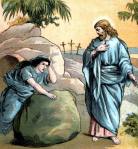
Mary Magdalene has become the center of a lot of controversies but I think she knew The_Resurrection015what she had been delivered from and was thankful for it.  She seems to have been a detail-oriented person who was very outgoing and was not afraid to take charge of something and get it done.  Mary also had the ability to get other people on board with a project and get things finished.  She above anyone else would not have been the least bit intimidated by the negative disbelief of the men and her persistence paid off by moving John and Peter to go to the tomb.  I doubt she was alone when Jesus called her by name but it is possible and would be consistent with her character; she was going to find the body of Jesus and properly bury Him.

Jesus rewarded the faithfulness of women and settled for all times their importance in the Church by first showing Himself to them that Resurrection Morning.  He used them to challenge the men to believe and to get moving to Galilee as He had told them.

http://clipart.christiansunite.com/Easter_Clipart/The_Resurrection_Clipart/index3.shtml