Nehushtan – Numbers 21:4-9

The old generation has passed away and it is now time for the “children” to enter the Promised Land. (See Timeline) Miriam and Aaron have died so it is now Moses, Joshua and Eleazar (Aaron’s son) are leading the people. Israel, not Moses, has cried out about Arad, a Canaanite king, has come out against them and Israel has completely destroyed them. They now must go around their cousins, Edom, because God will not let them have their land. (See Edom) So what do they do?

  1. Grow impatient
  2. Speak against God
  3. Speak against Moses
  4. Bring out the ubiquitous complaints no water, bad food, no bread and are we to die in the desert.

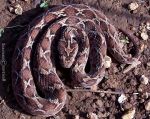
I know this cycle is old and you think they would have learned but they have not; makes you think about our complaining. In verse 6 God sends venomous snakes; these are Saw_Scaled_Viper_Echis_carinatusprobably the Carpet or Saw-scaled Viper. People start to die so they once again confess their sins to Moses and he prays for them and God gives them a way out. The thing that really stands out here is God did not remove the snakes; He requires an act of faith before they can be healed. They must look at a brass snake (See copper) on a pole.
In John 3:14-15 this act of faith is explained as a type and shadow of Jesus and the salvation He would bring because of the cross. And just as John 3:16 is next, so the people went on to get water and defeat Sihon and Og.

But the story of the brass/bronze serpent apparently does not end when they moved on and camped at Oboth. They kept it and it became an object of worship because in 2 Kings 18:4 Hezekiah breaks it up because they were burning incense to it. It seems to be human nature to get stuck on something that works; God used that for a time but He moved on and did other great things and used other things to deliver the people. They seemed to miss the point – Worship God and not things. (See Superstitious)

http://en.wikipedia.org/wiki/File:Saw_Scaled_Viper_Echis_carinatus.jpg
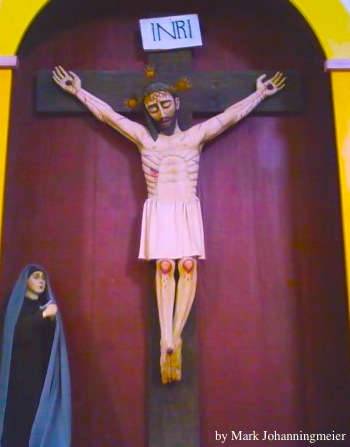
Holy Week – Friday

Crucifix from Misson Espiritu in Goliad,TX

Matthew 27:1-61, Mark 15:1-47, Luke 22:66 – 23:56, John 18:28 – 19:42

See Holy Week 2014 – Friday – Jesus Asked For a Drink

Exodus 12:3-6 is the story of the Passover. The Israelites were to pick a one-year-old sheep or goat on the 10th day and take care of it until the 14th day when it was to be killed at twilight. (God started a “new month” for them; so there was a civil calendar and a religious calendar.) This shadows the last five days. The “darkness over the land” now makes sense because His time before Pilate and the trip with the cross was done in the morning. There needed to be “twilight.”

Moses as a type of Jesus ate the Passover lamb and then led the people to freedom; so Jesus ate the lamb and then led us out of sin to freedom. The Gospel of John makes so many connections between Jesus and the lamb – His silence during the trials and no breaking of His bones. The only questions Jesus answered were ones that directly dealt with His kingship and His relation to the Father.

Jesus trials are even shadowed when Moses had his meetings with Pharaoh. Pilate, however, was at least making an attempt to let Him go (it was a weak attempt). As I read John I wondered how the Gospel writers got conversations between Jesus and Pilate; another question that has to wait until Heaven.

I wish I could remember whose sermon this came from but here is something to hold on too – It maybe Friday but Sunday is coming!

Happy or Blessed

Screen Shot 2013-02-09 at 12.27.47 PM

What I love about Bible studies is you start on one thing and find yourself somewhere else and it is a great study too. This one started out as a study on light and ended looking at the word Esher, that means happy. (It will explain itself when I do the blog about light.)  In my Strong’s Concordance for the King James Version that has definitions from W.E. Vine adapted into the entries I found this and thought it was to good to pass up. (Strong’s #835)

Esher and the name Asher (son of Jacob) both come from the same root word and it can be translated blessed or happy. Most of the occurrences of Esher in scripture are in poems such as Psalms or Proverbs. Vine observes that the “prosperity” or “happiness” comes when a superior, usually God, has bestowed His favor on you such as in Deuteronomy 33:29. But he notes that according to Eliphaz Job was blessed and should have been happy not because everything was going good but because God favored Job (Job 5: 17-18). OUCH that runs against the modern thought process.

Vine’s final thought is that it is appropriate to translate Esher as “happy” but for modern readers it “does not always convey its emphasis” to us. Many modern translations do use blessed more than happy.

For a good example of the usage of this word please see http://www.craigladams.com/blog/files/Psalm-1-1.html for Psalm 1.

A good reference- http://biblesuite.com/hebrew/835.htm

The Exodus Story in Other Places

glory 1

People may argue parts of the Exodus story and how it could not have happened. But the fact that the story is retold throughout the rest of scripture should speak volumes about its validity and its credibility. (This may not be all of them but you get the idea.)

  • Gideon  – Judges 6:13 – Questioned about the miracles
  • Jephthah – Judges 11:15-27 – Retold conquest story
  • Micah 6: 1-5 – The Lord had a case against Israel and highlighted the Exodus to prove his point.
  • Ezekiel 20:4 – God giving a discourse to the elders of Israel about their love for idols of Egypt even though He brought them out of Egypt and gave them a good land.
  • 1 Corinthians 10:4 – Spiritual lesson about Israel being baptized into Moses and Israel sharing spiritual food and drink and still some died in the desert.
  • Moses’ Psalms 90 -100 – I still think they are a series of songs to teach the people about God and His requirements.

Psalms

  • 66: 5-12 A highlight telling of Israel’s time in Egypt and their leaving.
  • 77: 11-20 A call for Jeduthun to remember and meditate on the miracles of God; the parting of the Red Sea is the focus of what God did.

Just a thought, look at Psalm 78-83 as a block for teaching people after Jerusalem fell.

  • 78 A comparison of Israel’s testing God and His mercy and miracles.
  • 80: 7-11 A call to God to remember that He did bring Israel out of Egypt and to have mercy on them again.
  • 81:3-10 To remember that God brought Israel out of Egypt and established that He should be praised.
  • 95: 8-11 Not to harden your heart as people did at Meribah.
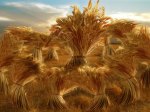
  • 105:16-45 A Sunday School lesson of Abraham, Joseph, the plagues, and the joseph-dreams of wheatExodus.
  • 106 A history of God’s faithfulness in not destroying Israel starting in Egypt and going through the Conquest into the unfaithfulness in the Promise Land.
  • 114 It reminds Judah who they belong to and that mountains, hills, and the “waters” obey the Lord.
  • 135:8-14 That man (Egypt, Pharaoh, Sihon, Og, and the kings of Canaan) will not stop God’s people.
  • 136:10-22 Resembles Ps. 135 

Picture of Sheaves from http://www.freebibleimages.org/photos/joseph-dreams/

Timeline for the 38 Years of Wandering

Much of this is not documented with timestamps but it averages out between thirteen and sixteen months per campsite. The longer time frame happens if you exclude the sites I put in italics from Numbers 21:10-20; they are not mentioned in Moses’ list of stages. (Please excuse the different size fonts as I was trying to keep it on one page.) My concordance does have meanings for some of the names of the campsites but they are usually just listed as “campsites.” (See the Number Thirty-eight in the Bible.)

Time Where Scripture What Happened
Rithmah Nu. 33:18Deut. 2:1 Should be the first camping area of the 38 yrs.
Rimmon Perez Nu.16, Deut. 11:6-7 Korah, Dathan, and Abiram, Aaron’s staff buds, Perez means “breach” that is why I put this here.
Libnah
Rissah
Kehelathah
Mount Shepher
Haradah
Makheloth
Tahath
Terah
Mithcah
Hashmonah
Moseroth
Bene Jaakan
Hor Haggidgad
Jotbathah
Abronah
Ezion Geber
M1 y40 Kadesh/Desert of Zin(Sin) Nu. 33:36Nu. 20:1 Miriam died, Edom denies passage (would have been Passover)
D1 m5 y40 Mount Hor, a border of Edom Nu.20: 22, 33:37 Aaron died, king of Arad attacks and then is destroyed, the bronze snake
Zalmonah
Punon
Oboth Nu. 21:10
Iye Abarim, a border of Moab Nu. 21: 11
Zered Valley, River Arnon border of Moab and Amorites, Mattanah, Nahaliel, Bamoth, Valley in Moab by Mt. Pisgah Nu. 21:10 – 20Deut. 2: 14 + 24 – 3:11 Israel (no longer Moses) defeats Sihon and Og. Numbers 21: 21- 35 Pisgah is by the Dead Sea  – Deut. 3:17,26-29 Moses died there 34: 1
Dibon Gad Nu.21: 30
Almon Diblathaim, near Mount Nebo Nu.33: 47
D1 m11 y 40 Plains of Moab across from Jericho, from Beth Jesimoth to Abel Shittim this is near Beth Peor Nu. 25:1, 33:49Deut. 1:3, 3:29, 4:3-4, 23:3-6 In the story of Balaam, Moses talked about the division of the land