The Number Seventeen in the Bible

Seventeen as a number is used sixteen times in the KJV; six of those are associated with the numerical list of people, two have a positive inflection, and eight have a negative association.  Five of the negative associations are connected with rulers of the land.  The seventeenth letter of the Jewish alphabet also has a connection with a leader of Israel.

Peh or Fey is the seventeenth letter of the Jewish alphabet.  In the Hebrew numbering system, it is the number 80.  Peh is associated with the mouth and the power of speech.  This reminds us of the power of our words for both good and bad.  Moses is the leader that ties these thoughts together.  According to some teachings he was 80 years old when he was given a “new mouth” to speak with. (He stuttered.)

The two positive references are Genesis 47:28 and Jeremiah 32:9. These show God’s provisions and mercy for believers.  Jacob lived in Egypt and was taken care of by Joseph for 17 years before he died, he never thought he would see the day.  Jeremiah paid 17 units of money for a field while Jerusalem was being attacked; it was to show the people that there would be a positive end to the situation.

The first two mentions of 17 are the starting and stopping of Noah’s Flood (Genesis 7 + 8).  This is when God was cleansing His world from the evil that was running rampant.  Using the lunar calendar (30 days to a month) they are 150 days apart.  Joseph Prince in his devotional book (July 25) states that the seventh day of the seventh month became the day Jesus rose from the dead during the Feast of Firstfruits. The next use of 17 is Genesis 37:2, it is the age of Joseph when he spoke out against his brothers; they plotted evil against him (this did turn out for good).  He was a prisoner for thirteen years before he became ruler of Egypt.

The other five references to 17 all involve kings/rulers and are either how long they have reigned or connected to when they began.  The rulers are Rehoboam, Ahaziah, Jehoahaz, Ahaz (Pekah is the reference).  They are in the Kings Timeline post.

http://www.hebrew4christians.com/Grammar/Unit_One/Aleph-Bet/Pey/pey.html

http://www.walkingkabbalah.com/hebrew-alphabet-letter-meanings/
Samuel and His Accomplishments

The Prophet Samuel who was raised by Eli, the priest of God, is a foundational person in the spiritual life of Israel.  He is the key spiritual figure between Moses and the prophets Elijah and Elisha.  His story is found in 1 Samuel chapters 1 through 25. Most people have heard at least one sermon about him and the references probably came from 1 Samuel: 1 -3; they are used a lot in meetings where young people are the target audience.  While studying his role in the anointing of the first two kings of Israel, Saul, and David, it became apparent just how important he really was to Israel.

We are not told how old he was in chapter 4 when Eli, Hophni, and Phinehas all die on the same day.  Nothing is mentioned of him until 1 Samuel 7: 3 when he is calling Israel to repent.  Verse two gives us a time stamp of twenty years that the ark was in Kiriath Jearim.  Why had it not been returned to Shiloh?

A possible reason is that there was no priest who was of age to carry on the proper worship at the Tabernacle or “Temple.”  Phinehas had sons (4:20 and 14:3) but who trained them in their duties as a priest?  I will guess that Samuel either did the training or at least had a hand in doing it; after all, he studied under Eli.  There needed to be an Aaronic priest to serve before the Ark, Samuel was from Ephraim. (Side note – If I was writing this as a novel the Benjamite in 4:12 would have King Saul’s father, Kish.)

While at Mizpah, where Samuel was leading Israel in their return to God, the Philistines attacked trying to keep them in slavery.  Samuel’s leadership was being put to the test and his response is a true act of faith.  He orders the people to continue in their “crying out to God” and he offers a sacrifice.  God responds to this “faith action” with thunder, “loud thunder” that caused the defeat of the enemy.  (I will assume there was a storm with lightning, but what if God just spoke at the enemy and they heard it as thunder.)

The next time reference is Chapter 8:1 and all it says is that Samuel is “old.”  This and the fact that Nahash the Ammonite king was threatening Israel (12:12) made the people think a “king” would be better.  The remaining years of Samuel’s life were spent in hearing about Saul chasing around after David trying to kill him.

The final reference to Samuel in the Book of Samuel is in chapter 28 after he is dead.  Saul breakers his own decree and the Law of God and consults a witch/medium.  Samuel comes “back” and rebukes Saul once more.

The other mentions of Samuel’s life and deeds are found in 1 and 2 Chronicles. 1 Chronicles 9:22 he and David assigned gatekeepers.  I could think that David just added or continued to what Samuel did since Samuel would have been dead when David got around to doing this.

In 1 Chronicles 26: 28 the things that Samuel had dedicated for the “Temple” were brought in when Solomon had finished the building.  So it seems that Samuel was honoring God with offerings even when the Ark was still in the Tent.

1 Chronicles 29: 29 states that Samuel was a writer/historian.  Other people probably took his work and that of other historians and wrote the Books of Samuel, Kings, and Chronicles.  I have done parallel studies of these books and combined them into one manuscript.   

2 Chronicles 35: 18 mentions that Samuel was the last leader to celebrate Passover correctly.  He did his best to get Israel to honor God as described in the Law of Moses.

There is still more post to come from the study of the anointing of the first two kings, but I have developed a new appreciation for Samuel and his place in the Bible and the spiritual history of Israel.

Joshua and Caleb – A Thought on Leaders

Joshua, Moses’ aide, the chosen leader to take Israel into the Promised Land is truly an outstanding person.  He does not have many negative things written about him, and the incident with the Gibeonites is the only major problem he has.  He is only one of the two “fighting men” who left Egypt that crossed the Jordan.

Caleb, the other faithful witness, is the other “fighting man” who made it into the Land.  He was a leader in the Tribe of Judah and probably had a great influence on Othniel, the first judge (Judges 3: 7).

Leaders who are called of God are really hard to find.  Many people do hold offices and fill a need but “Generals” are really rare.  We read about these two men but we don’t think about the numbers and percentages associated with them crossing into the Promised Land.  Exodus 12: 37 says there were 600,000 fighting men who left Egypt; that makes Joshua 0.00016% of that number and Joshua and Caleb 0.0003% of the total number of men who walked through the Red Sea.  Moses had picked other leaders to help him judge the tribes so there were people who helped, but the “Generals” really are hard to find.

Joshua and Encouragement

The education, the training, and a mentor who walked with him for 40 years; Joshua had the whole package on his resume.  God had His eye and hand on Joshua for a long time.  God knew that Joshua could do the job He had called him for, but He also knew Joshua needed encouragement.  In Deuteronomy 1:38 and 3: 28 God tells Moses to encourage him.  Moses in 3:21 does encourage Joshua and it continues in 31: 6, 7, and 23 by telling him to be strong and courageous.  This encouraging continues in the Book of Joshua chapter 1; God encourages Joshua and so do the leaders of the tribes of Ruben, Gad, and Manasseh.

Joshua gave what he got in Joshua 10: 25 when he encourages the leaders of the people to be strong and do what God called them to do.

I guess the life lesson here is your leaders need to be encouraged.  They give a lot when they are doing their job so speak into their life and encourage them.

Joshua By the Books

One study technique that I use is to list references from my concordance to get a good look at what I am studying.  Doing this for Joshua gave an interesting twist to this study.  So the first post in this series will be Joshua by the Books of the Bible.

Exodus Chapters 17, 24, 32, and 33  This is where we first meet Joshua and God puts him in the history books:

  • He leads the army against the Amalekites
  • Goes with Moses up the mountain and utters the phrase, “Sounds like war in the camp” when they come back down.
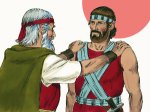
  • He is identified as Moses’ “young aid” that does not leave the first “tent of meeting.” 006-moses-joshua“Young” here may refer to the fact that he is in his twenties and not married.

Numbers Chapter 11, 13, 14, 26, 27, 32, and 34

  • He wants people to be stopped because they are prophesying, his “youth” is recognized again as Moses corrects his attitude.
  • Moses does a name change; it goes from Hoshea (deliverer) to Joshua (Yahweh saves).
  • He is associated with Caleb and exploration of the Land and recognized for their positive attitude and faith.
  • He is credited with having the Spirit and is to be commissioned to lead when Moses dies.
  • Gets orders from Moses, sited as having wholeheartedly followed God
  • He gets the important job of assigning the land once the conquest is over.

Deuteronomy 1, 3, 31, 32, and 34

  • The first three mentions of Joshua are to encourage and commission Joshua as the new leader.
  • Joshua is with Moses while he sings his final song.
  • Chapter 34 is the commissioning with laying on of hands and the imparting of the 005-moses-joshuaSpirit to Joshua.

Joshua  Some of the notable things about Joshua that is in his book is where he was encouraged, Chapter 1, and he then prays for the sun to stand still and encourages his commanders, Chapter 10.  In his farewell speech Joshua (24:15) delivers the great quote, “As for me and my house we will serve the Lord.”  I find that an interesting verse because he has no children listed in the genealogies.  He also left no successor to lead Israel as recorded in Judges.

Judges Chapter 1 and 2

  • Israel is asking God who will lead them since Joshua is dead.
  • Joshua’s age at death is 110, which means he lead them approximately 50 years after the initial conquest.

1 Kings 16:34 tells of the curse that Joshua put on the rebuilding of Jericho.

1 Chronicles 7:27 list his family line in the tribe of Ephraim.

Nehemiah 8:17 refers to the celebration of Booths and compares it to Joshua’s time.

Acts 7:45 Stephen is telling of Moses, Joshua, and the Tabernacle.

Hebrews 4:8 states that Joshua did not give the people rest and that a new Sabbath is yet to come.

In looking at the verses it seems that in the narrative Exodus Joshua was trained, in Numbers he is established in the community, Deuteronomy he is launched as the leader, and in Joshua he does the job that was assigned to him.

Pics belong to Sweet Publishing/FreeBibleimages.org and were found in http://www.freebibleimages.org/illustrations/joshua-challenge/