The Number Sixteen in the Bible

The Number Sixteen in the Bible

Ses (6) and asar or esreh (10) are the Hebrew words that are used to form sixteen (16). The number sixteen is not used in the New Testament.  There are ,however, sixteen soldiers that guarded Peter in Acts: 12.ay_purpi

The majority of the time that “sixteen” is used it is with kings or leaders. Several kings ruled for sixteen years (Ahaz – 2 Ch. 28:1, 2 Kg. 16:2; Jotham – 2 Ch. 27:1and 8, 2 Kg. 15: 33; Jehoash – 2Kgs.13:10) and one began his reign (Uzziah – 2 Kg. 14:21, 2Ch.26:1) at sixteen years of age. In 1 Chronicles 24 the number of leaders in one family was sixteen and who got the sixteenth duty position (chapters 24, 25).

In Joshua 15 and 19 it is associated with towns and villages in Judah and Issachar. The two most interesting times sixteen is used is in Ex. 26: 25, 36: 30 with the silver bases for the west end of the Tabernacle and the number of days that it took to clean the Temple during Hezekiah’s rule (2 Ch. 29:17).

Normally, I would try to make connections with all of these but to me there was nothing clear. The sixteenth letter in the Hebrew alphabet is ayin, which means “eye or spring.” (See the references for further study.) It was in this idea that I found a loose connection. God had His “eye” on those kings and leaders, the Tabernacle, and the cleaning of the Temple. The hebrew4christians website is a good study on the “eye” of God.

The Number Fifteen in the Bible – Cleaning Up to Celebrate

The number Fifteen -15 in the Bible.

FYI – Depending on the translation and the concordance you use some of these numbers may appear different.  For this study, I just wanted the number fifteen (15).  The NIV and KJV handle numbers differently.  The KJV will spell them out like eight hundred and fifteen while the NIV will write 815 (Genesis 5:10).  Also, the NIV translates some numbers in standard units (what Americans will understand) like 15 feet while the KJV would say 10 cubits (Zechariah 5:2).

  • The first number fifteen (cubits – this is twenty feet) is in Genesis 7:20 and is the depth of water covering the mountains with the Flood.
  • The second usage is with the walls of the courtyard of the Tabernacle.  There were two fifteen cubit walls forming the east side leaving a twenty cubit gap that had an offset hanging acting as the gate (Exodus 27:14).
  • The third usage is in Exodus 16:1 (see 10 Test and Timeline).  This marked the second month of the Israelites marching out of slavery.
  • The most references are with Feasts (Leviticus 23).

As I thought about the fifteen cubits in Genesis I realized it was not the depth of water but the fifteen.  God used the water to “clean” the earth of corrupt humanity.  Several source listed below will tell you that if you added the letter yod (10) and the letter hey (5) you would get 15 which happens to spell out a name of God.  In Hebrew, however, it is written with the 9th (teth) letter and the 6th (waw) letter out of respect for God. (Sorry, Hebrew letters are also used as numbers.)

The total width of the courtyard for the Tabernacle was 50 cubits, that was the west and east side (the one that faces the sun).  So as you entered on the east side to worship there was a 15 cubit wall on your left and your right. (See Camp and Marching Order) The bases holding up the curtains/walls also had a fifteen associated with them. (Think about that for a minute!)

The most references with fifteen belong to 15th of the month because several Feasts (celebrations) start on that day – Unleavened Bread, Booths/Tabernacles, Purim, and several you may not find in a Christian Bible.  Passover is on the 14th of the first month and the 15th is the start of Feast of Unleavened Bread, which is also when Pharaoh let Israel go because the firstborn all died (another cleaning/judgment).  The Feast of Tabernacles celebrates the exodus when Israel lived in booths waiting for everyone over twenty to die.  A “silent/hidden” fifteen is associated with the Feast of Pentecost (Leviticus 23: 17 – 21) it is the number of offerings:

Why the fifteenth of the month?  If you do not know it the Hebrew calendar is set on a 30-day month (lunar cycle) with the month being the actual unit of time.  The first day is the new moon so the fifteenth day would be the full moon of each month.  Here are some thoughts about this: the Feast was a reminder of the “best” of Egypt dying and them leaving; full moon is a reflection of sunlight at its best; it still could add up to be a name of God. (Something to think about.)  To be fair to one source I read which said 15 represented “rest.”  The Feast do start (and end) with a day of rest but the first one, the day after the first Passover, was them leaving in a hurry. These Feasts (Day of Atonement/Yom Kippur and Feast of Tabernacle) were so important that Jeroboam set up a false holiday on the 15th of the 8th month to act as a distractor for the Ten Tribes (1 Kings 12:33).  In Ezekiel 31:17 it is talking about Egypt, the time frame the 15th day of the first month (Passover/ Unleavened Bread).  Purim is the holiday from the Book of Esther and is still celebrated today (enemies got cleaned out).

Another notable story that has fifteen wrapped in it is the healing of Hezekiah where God added fifteen years to his life (2 Kings 20:6, Isaiah 38:5).  One resource concluded that fifteen must deal with “addition” because fifteen years were added to his life.  His reign was twenty-nine years long so this extra fifteen years started in the fifteenth year of his reign.

Some other non-holiday references with fifteen being a part of the story are (You will find these scriptures in a King James Version.):

  • Hosea 3:2 where the prophet bought his wife back for fifteen pieces of money (a picture of Jesus redeeming His Bride)
  • Solomon had columns in rows of fifteen holding his house up (1 Kings 7)
  • Ziba in 2 Samuel 9 had fifteen sons
  • 2 Kings Amaziah king of Judah lived 15 years then he was killed (cleaned out)
  • Asa king of Judah threw a party in the 15 years of his reign to renew the seeking of God – 2 Chronicles 15:10
  • Bethany was fifteen furlongs from Jerusalem
  • Paul spent fifteen days with Peter (Galatians 1:18)
  • Acts 27:28 finds Paul in a boat over fifteen fathoms of water.  Chronologically this would be the last listing of fifteen in the Bible.  The first reference (Genesis 7:20) had fifteen units of water and a boat also. (Just saying.)
  • Luke 3:1 is where John the Baptist starts to preach and that was the 15th year of Tiberius.  (Another party was starting.)

God “cleaning things” and “parties starting” seem to happen, a lot when the number fifteen is involved.  The feast were times to enjoy God and His goodness by drawing close to Him so they are cathartic in themselves.

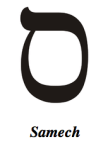
Screen Shot 2014-05-17 at 8.07.29 PMThe fifteenth letter in the Hebrew alphabet is Samech.  I will list some things associated with it but follow the links to the various sources for a better study (Please note that some are Messianic Jew/Christian and others are strictly Jewish).

  • Numerically it represents the number sixty.
  • The priestly blessing has fifteen words and sixty letters.
  • It means “to support” or “to protect.”  This is all forms of support: spiritual, financial, physical, moral, etc.
  • Samech (15) and Mem (13) surround/support Nun (14).  Samech and Mem are the only fully enclosed Hebrew letters. (See studies on Thirteen and Fourteen).  Nun may represent someone who is “bent down.”
  • Because it is circular it represents the wedding ring.

There are still other references with the number fifteen (15) in the Bible but I hope you will continue to study as this number/letter has a lot associated with it.

References/Resources

The Number Fourteen in the Bible

The significance of the number fourteen in the Bible is very understated if you are just 14looking in a concordance, as there are not a lot of instances of it mentioned.  Many of them are associated with one very important day but fourteen and its symbolism goes very deep and starts with how it is written in Hebrew. Each of the twenty-two letters in the Hebrew alphabet represents a number.  The first nine letters are the ones for single digit numbers and the others take on higher numerical values.  An acrostic psalm is one that each verse/section starts with a letter of the alphabet so they either have twenty-two verses like Psalm 25 and 34 or twenty-two sections.  Psalm 119, which is acrostic, is divided into twenty-two sections of eight verses.  (Please see my blog for different way to read Psalm 119.)

The fourteenth letter of the Hebrew alphabet is Nun, like Joshua, and is pronounced “noon”; in the counting system it represents the number fifty.  The meanings and types and shadows that are associated with Nun really are a great study in itself so I will encourage you to look deeper but here are my gleanings from the literature.  Nun equals the word David so it is immediately associated with the Messiah. (See more on fourteen in the Book of Matthew and the Christmas story.)  For Christians it goes deeper than that since it also means “fish” in Aramaic, which leads to the symbol of the fish or ichthus.  The thirteenth letter in Hebrew is Mem, which represents water that is needed for fish.  Nun is a shared letter with several other languages so in the literature you will see that it also represents a snake/eel and seeds.  The snake that Moses made in the wilderness, Nehushtan, was a shadow of Jesus and He referred to Himself as a “seed of wheat” that had to “fall to the ground and die.”  Nun is used to portray life and faithfulness so you can see it is a very symbolic letter.

There are two different Nuns, one is standing and the other is kneeling.  They can also be written with “crowns.” (Please see the website Hebrew4Christians listed below.)  When they are combined to make the word Nun they represent the righteous one (who is upright) and faithful one (who is bent) or love and fear.

fn_bluei                                                                          n_bluei

“image copyright Bitsela, used courtesy of free-bitsela.com”

Numerically, Nun is fifty or Pentecost, which leads to what I would like to propose the number 14 means in Scripture – the new thing actually starting.  Pentecost was the beginning of the Church of Jesus and the new anointing of the Holy Spirit.  Just as 13 was signaling the start so 14 is the start.  Remember Mem is before Nun in the alphabet. Just as Joshua son of Nun “started” the Promise Land or David started the family tree of Jesus things associated with 14 show things starting.  My groupings below are just a product of my need to sort things but hopefully, they will help.

Fourteen

  • Exodus 12:6 – The 14th day of the month was the start of Passover or when Israel as a nation was started.  Most references to 14 in the Bible are about a Passover that was being celebrated.
  • Esther 9:15 – The day of Purim was the 14th day of the month; this is when the Jews were allowed to kill their enemies.  This started a new period of freedom for them.
  • Ezekiel 40 – Fourteen years after Jerusalem was destroyed Ezekiel had the visionKing's timeline the end of the New Temple.  In verse one, the reference to 25 years is how long Ezekiel was in exile. (Please see the timeline at Jeremiah 52.)  One way to look at the 70 years of Exile is 14 x 5 = 70.
  • Acts 27:27 – It was the 14th day of being in the storm when Paul got the crew to eat so they could start “new” on the island.
  • Matthew 1:17 – Matthew used fourteen because David translated into numbers equals fourteen.  (See Jesus’ Generations in Matthew)

7 + 7 = 14

  • Genesis 8:9 -12 – Noah sent the dove out twice and waited a total of 14 days.  That showed that the earth had dried and started growing again.
  • 1 Kings 8:65 – Solomon and the people had 14 days of partying for the new Temple.
  • 2 Chronicles 30:15 – Hezekiah and the people had 14 days of partying for Passover. Which had not been celebrated in a long time so it was a sort of new beginnings.

12 + 2 = 14

  • Ezra 3: 1+8 – Zerubbabel and the people had been back in Jerusalem a year and in the second month of the second year they started to build the Second Temple, 12 months + 2 months = 14 months.  In the 7th month of the first year, they built the altar and started sacrificing burnt offerings so it could be a 7+7.

Other 14’s (You may need to work with me here.)

  • Genesis 31:41 – Jacob worked 14 years for his wives and then started working for his family.
  • Book of Joshua – The tribe of Benjamin and a “clan” of Judah got 14 towns each to start a new life in the Promise Land.
  • 2 Kings 18:13 – Hezekiah and Jerusalem were attacked in his 14th year as king, and he got the boil with the death sentence (20:1).  But he got a new lease on life and 15 more years (2 Kings 20:6).
  • 1 Chronicles 25:5 – Heman had 14 sons through the promise of God so he had a new reason to praise God.

“Pushing it” 14’s

  • Genesis 14 – King of Sodom rebels in his 14th year and Abraham rescues Lot.  In verse 22 is where Abraham starts to really acknowledge God, up until now God was “doing for” Abraham.
  • Exodus 14 – Moses and the people were directed back to the Red Sea so they could actually start out of Egypt; until now they were just wandering around inside of Egypt.
  • No, I did not check all Chapter 14’s in the Bible so who knows what gems of knowledge are waiting to be found.  Yes, I did check all the 13th chapters when I studied the number 13.

Acrostic Psalms

A quick look at the “14th verses” of some of the acrostic Psalms. (This is not all of the acrostic psalms.)  These may not show a “starting” I just like the scripture.

  • Ps 25: 14 The Lord confides in those who fear Him; He makes His covenant known to them.
  • Ps. 34: 14 Turn from evil and do good; seek peace and pursue it.
  • Ps.37: 25 – 27 Verse 27 is similar to Ps 34:14 Turn from evil and do good; then you will dwell in the land forever.
  • Ps.145:14 The Lord upholds all who fall and lifts up all who are bowed down.
  • Ps 119: 105 Your word is a lamp to my and a light for my path.

The 14’s after the 13’s

Remember Joseph after 13 years of slavery/prison was the leader of the country in the 14th year and several others that I listed in the post on The Number Thirteen in the Bible.  I hope this study has shown you that biblically fourteen is important and that the significance of fourteen is alive and well in your life and that “new things” are starting in your life now.  A study of the number fifteen is available at Cleaning Up to Celebrate. A study on sixteen in the Bible is at Sixteen In The Bible.

http://bethaderech.com/learning-hebrew-the-letter-nun/

http://hebrew4christians.com/Grammar/Unit_One/Aleph-Bet/Nun/nun.html

The Nun graphics came from http://free-bitsela.com/gallery/main.php?g2_itemId=897&g2_page=6

The Number Thirteen in the Bible

The number thirteen in the Bible heralds that a change is coming. We like to attach all sorts of meanings to numbers, but the truth is that God created numbers for His use (See Genesis 1). Thirteen as used in the Bible is another number that God uses to show His plan for His people.

Numerology is part of studying the Bible; there are certain numbers that have been assigned certain meanings.  Three, seven, six, twelve, eight, and forty are just a few numbers that most Christians will be able to give you as having an important significance in the Bible. Three is a “God” number for the three persons of the Trinity.  Seven represents completeness from the seven days of the week. Six is the number of man this comes from the fact that we were made on the sixth day and the number 666 from the Book of Revelation.  Twelve represents the government as shown by the twelve disciples and the number of the tribes of Israel (the sons of Jacob). Forty is the number of testing or trail as shown in the years spent by Israel in the wilderness and the length of days Jesus was tested after He received the Holy Spirit. Eight is the number of new beginnings given that the eighth day of Creation started a new week.  The number fourteen is also an interesting study if you would like to see mine you may click this address https://ificouldteachthebible.wordpress.com/2013/07/21/the-number-fourteen-in-the-bible/  A study of the number fifteen is available at Cleaning Up to Celebrate.

Unfortunately, people and Christians in particular start to focus on the number instead of the God of the numbers. So we get people with triskaidekaphobia which is the fear of the number thirteen. Beliefs about this number are varied and separating fact from fiction is impossible. Some early ideas on this number and its “significance” to bring bad luck are hinged on the assumption that there were only 13 people at the Last Supper and that Jesus died on a Friday the 13th. (World Book Encyclopedia)

WHY I would like to offer a different look at the number 13 from a Biblical perspective. I already know that this does not fit into most numerological frameworks but I will ask you to follow through with my reasons and then you make up your mind.  I will show that a possible meaning for the number thirteen is the signal for the “start of or the beginning of something new.”  I am not trying to mix this with the number eight in any way.

Examples of Thirteen in the Bible These are a few of the instances that there are thirteen of something and each of these represents the “start of a new thing.”

1. In Genesis 17:25 Ishmael is circumcised at the age of thirteen which is when God made the promise to Abraham; this contrasts with Isaac being circumcised at eight days old.

2. 1 Kings 7:1 Solomon took 13 years to complete his palace.

3. Genesis 14: 4 Sodom rebelled after 13 years of servitude to Chedorlaomer king of Elam (Babylon) and Abraham rescued Lot.  This brought on Melchizedek’s blessing and Abraham’s covenant with God.

4. Esther 3: 12 Haman had orders written on the 13th day of the first month about the 13th day of last month to kill all Jews.  They have to defend themselves and so put an end to the threats of Haman the Agagite, who is an Amalekite, and a new time of freedom for the Jews.

5. Jeremiah starts his ministry in the 13th year of Josiah (Jeremiah 1:2).  Josiah had started purifying the land in his 12th year of being a king.  Jeremiah may have been 13 years old when his ministry started.  The term for his age shows a child up to the age of becoming a young man.

6. Joseph was 17 years old when he was taken as a slave. He was 30 when Pharaoh put him in charge of Egypt (13 years). Genesis 37:2 to 41:46.

7. The Children of Israel went around Jericho 13 times before they yelled and the walls fell down.

There are many more “13’s” in the Bible but I hope you get my point about it showing a “new start.”

My personal feeling about thirteen/Friday the 13 and other lucky things is summed up in this: It is bad luck to be superstitious!  ← (This is another post in my blog.)

So I look at it this way.

 Number 13

graphic by Ryan Johanningmeier

Ryan Johanningmeier – Oklahoma, USA, RyanJo Productions, Oral Roberts University | about.me