
Jeroboam – the Lord YOUR God

Proverbs 22:29 Do you see a man skilled in his work he will serve before kings. Solomon could have used Jeroboam as the inspiration for this proverb. He was a leader in his tribe (Ephraim) and led the work in building projects around Jerusalem. Because of Solomon’s change of heart toward God his children lost the rule of all of Israel. In 1 King’s 11:29 a prophet named Ahijah (#281 Strong’s Worshipper (brother) of Jah) delivers the news to Jeroboam that if he does what is right before God he can have an enduring dynasty. In verse 40 Solomon tries to kill him so he runs to Egypt. QUESTIONS:

  1. Who told Jeroboam or Ahijah? (They were by themselves.)
  2. Why always to Egypt?
  3. Did the treaty that Solomon have with Egypt end or is that just how Egypt works?

Shechem is where Rehoboam went to be made king and the first place Jeroboam fortifies. This place shows up a lot in Israel’s history. Jacob bought land there instead of going with his brother (Genesis 34). The “blessings and curses” were read there by Joshua (8:30) and Jesus talked to the woman at the well (John 4) at Shechem.

The trip to Egypt (bondage and false religion) was not good for Jeroboam. His first thoughts were against God who had proclaimed his kingship. The two golden calves he made are said to be a goat and calf idol in 2 Chronicles 11:15. These plus the shrines, forcing out Levites and ordaining anyone with the “right amount”, festivals, and altars were just too much and God called for an end of his reign. References to his poor choices are in 2 Chronicles 11:13 – 17 and in 2 Chronicles 13: 4 – 12.  The festival was made to take away from the Festival of Booths and was one month after it in the 8th month and 15th day. (See Cleaning Up to Celebrate)

The story in 1 Kings 13 was God’s attempt to bring Jeroboam back from his evil ways but he wanted none of that. He had been given the opportunity to have and do a great work. It had come by a personal word from God and was predicated on his following God the way David had done. From hero to zero the take away is stay away from Egypt and watch who you get advice from.

See Rehoboam and the Ammonites ,  See Jeroboam and His Altar
 

Rehoboam and Ammonites

Rehoboam’s, the troubled heir to Solomon’s throne, story must start with a look back at the Ammonites. His mother Naamah was an Ammonite, the son of Lot by his younger daughter (Genesis 19:38), certainly of royal birth, and probably very beautiful. She may have been the “most loved” of Solomon’s wives or Rehoboam showed more potential than any other his brothers. (See Rehoboam and His Mom)  But Solomon should not have married her as that was forbidden by the Law for kings/Israel to do. And it is probable that she was one who led Solomon away from Jehovah (1 Kings 11:1) in his later years and had him build a worship site to Moloch (Molek) the detestable god of the Ammonites. Apparently, Chemosh, the god of the Moabites, and Moloch were the same god just in different nations; it was a bull-man deity that demanded human sacrifice especially babies.

God, in Deuteronomy 2:19, warned Moses/Israel about attacking or harassing them as they went to the Promised Land. God was showing favor to Lot in this degree but the Ammonites and Moabites were the ones who hired Balaam in Numbers 22 and were so cursed in Deuteronomy 23:3 from entering the Temple. [Abraham and Lot were descendants of Terah (Genesis11: 27) who came from Shem (Genesis 9:23).] The Ammonites show themselves as enemies of Israel throughout the Bible and God compares them to Sodom and Gomorrah in Zephaniah 2:9. In Ezekiel 25: 1 -10, Jeremiah 25 + 49, and in other places, He is definitely against them; the lesson here is that God has His limits and they went too far. Other Israelites who had a conflict with them were:

  • Jephthah – Judges 10 + 11
  • Nehemiah – Tobiah
  • Jeremiah – Baalis (40:14) killed Gedaliah (God’s chosen leader for the remnant)
  • King Saul – Nahash 1 Samuel 11
  • David and Joab – 2 Samuel 10. It should be noted that David did have an Ammonite in his “mighty men” 2 Samuel 23:37.

(See Family and Foe)

Rehoboam had already heard that the kingdom was going to be broken up because of Solomon’s sins. So when he takes the advice of the “young men” he should have known what was going to happen. His arrogance and deception are enormous but it was in God’s plan.

Questions to be answered in heaven:

  • What were the names of the daughters of Lot?
  • Did those “young men” stay Rehoboam’s advisors?

Eliashib “Why is the house of God neglected?”

Who is Eliashib?  Well, definitely not a top 40 Bible character!  Can’t find him then go to Nehemiah 13.

Eliashib is a priest; well not just a priest he is the High Priest (v. 28) after the 70-year (Sabbath) rest of the land that Jeremiah predicted.  This was because Israel had forgotten about Jubilee and that the land was to get a rest also.

The quick storyline of Nehemiah – Nehemiah, an official of King Artaxerxes, petitions to go to Jerusalem and rebuild the town wall.  He does it in record time but he has opposition Tobiah and Sanballat who hate Israel and Jerusalem.  Nehemiah sets things right and is called back to Artaxerxes.  (We will assume Ezra the priest has died.)

Eliashib who apparently has not read the Book of Moses (or did not care) cleared out the room reserved for the grain offering for the Levites and let Tobiah move in.  This set several things into motion.  The Levites had to go back to their fields because of no more grain offerings.  No Levites, no one to stop merchandise from coming into Jerusalem on the Sabbath. Then Nehemiah found that men were marrying foreign women.  These were some of the sins that lead to the destruction of Jerusalem and here they were doing it again.  Who was leading this destructive behavior, the High Priest?  It was so bad the Eliashib had allowed his grandson to marry into Sanballat’s family.  So the boy would have been in line to be the High Priest.

What happened, the people read the Bible and put an end to it and then the man of God shows up and changes the High Priest because he ran Eliashib and his family off.

Point is READ your Bible and Know the Word.

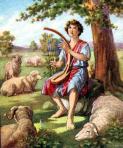
Last point – The people had read Deuteronomy 23:3 that no Moabite should be allowedDavid052 into the assembly of God.  What about David and Solomon?  Their grandmother was Ruth the Moabite.  Did God just overlook His Word?  Look at Ruth 4:9 Boaz as kinsmen-redeemer got Ruth as a wife.  He redeemed Ruth!  I image it was just like Jesus redeeming us, we became new people in the sight of the Law and anything in the past cannot be counted against us.

http://clipart.christiansunite.com/1379673661/Bible_Characters_Clipart/David_Clipart 

Jeremiah 10 and 51

While reading on lightning in the Bible I noticed that Jeremiah 10: 12 – 16 and 51: 15– 19 are almost exactly the same.  Having the same theme run through a book or even several books is not unusual, after all, God can repeat Himself if He wants.  But if God repeats Himself it is usually to stress a point or confirm what was said, or in the case of the History Books – Samuel, Kings, and Chronicles two different people wrote for two different audiences. (See Kings and Samuel)  The repetition here seems to be for making the point of God’s power and authority to do the acts that were to follow.

In Jeremiah 10:12 -16, the passage is introduced by a statement that false gods did not make the heavens and earth, the NIV has a footnote that it is written in Aramaic.  (Probably for the people of/in Babylon or as a further study has found, it was a common language of the day.)  God is angry because of the idols His people are making and worshiping.  So after the passage, the destruction of Israel and Judah is foretold.  This apparently made people mad because Baruch son of Neriah, his scribe, notes that the people of Anathoth, his hometown, wanted to kill him.  Jeremiah is a member of the priestly class and Anathoth is a city that was set apart for the priest by Joshua and Moses; nothing like making your family mad, especially if they are church leaders.

In Jeremiah 51: 15 -19 the introduction to the verse is the prophesying that Babylon will be filled with men eager to destroy the place, and it is followed by the acts that will happen when the city is destroyed.  The end of this story is chapter 51:59 – 64 where Jeremiah asks Seraiah, Baruch’s brother, to pronounce complete and lasting ruin on Babylon. (Saddam Hussein tried/started rebuilding ancient Babylon before the Gulf War, it came to a stop.)  It is interesting that the last sentence is, “The words of Jeremiah end here.”

The final part of this study is found in Psalm 135: 7.  The passage about the lightning, rain, and wind is also here as it is found in Jeremiah.

He makes clouds rise from the ends of the earth; he sends lightning with the rain and brings out the wind from his storehouses.” (NIV)  In a previous post I compared Psalm 135 and 136 for similar content (see that post).  But the same themes in Jeremiah are here also:

  1. The Lord does what pleases Him. (vs. 6)
  2. The destruction of an enemy is told. (vs.8 – 11)
  3. Idols are worthless pieces of silver and gold. (vs. 15 – 18)
  4. Jacob and Israel are treasured possessions. (vs. 3 – 4)

I can still see David writing Psalm 135 but the prophetic nature of this Psalm now becomes even clearer.  Ok, maybe Jeremiah/Baruch did write it and threw in verses 19 – 21 just to aggravate his kinsmen.

Bible studies are fun, you start with lightning and end up comparing prophesy in Jeremiah.

Tribes of Israel – Manasseh

Manasseh was the first-born child of Joseph who was put as a “second son” by Jacob. Joseph in naming Manasseh and Ephraim demonstrates that he was perfectly happy with his new life and had no intention of going back. (Genesis 41:51+52) He had the power to send a message back to his family but he did not.

I wonder how these two acted around the rest of the family? They were children of the ruler of the country they lived in and because of being Egyptian possibly had more privileges. From Genesis 48:1 I would wonder if Joseph even allowed them to live around his brothers? Joseph may have had them marry within the family but Manasseh definitely owned slaves and even had a foreign concubine.

1 Chronicles 7:14+15 talks about Manasseh’s two notable descendents: Gilead and Zelophehad.  In Numbers 36 Zelophehad dies in the exodus and leaves only daughters, these girls stand up for themselves and their father’s lineage. The daughters go to Moses and plead their case before God; this leads to a new decree to acknowledge women as heirs. It may not sound like much but that was groundbreaking territory when women were viewed much of the time as second-class people or property.   The other descendent was Gilead who was to lend his name to the area of the east bank of the Jordan River that wasTwelveTribesofIsraelebible the inheritance of the tribes of Manasseh, Rueben and Gad. This is a contrast to Zelophehad’s daughters; Gilead comes from an Aramean concubine and a group of people who were not Israelites (Huppites and Shuppites). Just like Bilhah and Zilpah this concubine was a slave that Manasseh used and was so elevated to a slightly better status in the household. You get the feeling that the children were valued but not the mother (Sarah and Hagar).

In 1 Chronicles 5: 18 -26 it gives two contrasting stories; one of faith and trust in God and the other of unfaithfulness to Him. In verse 20 the East Bank tribes cry out to God for help in the middle of a battle and are helped and overcome their enemies. In verse 25 it tells of the unfaithfulness that gets them taken away by Tiglath-Pileser.habor_river

Actually, Manasseh’s descendents were on par with the other tribes; they did their part in taking the Promise Land and showed up at all the right times and were active during the life time of Saul and David. Lo Debar is in the allotment of land given to Manasseh and it was this area that David went to when he ran from Absalom.

Map from http://www.biblestudytools.com/resources/maps/twelve-tribes-of-israel-map.html and eBibleTeacher.com.

http://bibleatlas.org/full/habor_river.htm  large map,