Jesus Received Something Beautiful

Wednesday of Holy Week finds Jesus having a meal with Simon the Leper.  There are three main characters in this story: Jesus, Judas, and a woman.  The woman, according to Matthew and Mark, opens a container of very expensive perfume and Annointing_Jesus002pours it on Jesus’ head.  Even though it does not say it I can image Judas starting the complaining about the cost of perfume and getting really mad when Jesus puts a stop to the chatter ( that is in John 12).  This anointing may have been the key to Judas betraying Jesus.
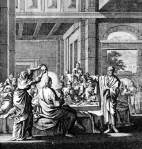
Jesus’ reaction is amazing, not only does He let the woman pour oil on His head/body but also defends the action.  He allowed her to minister to Him in this rather extraordinary way.  He knew that she had received a revelation that He was about to die and that He needed to be anointed.  Notice there was no reaction about His statement that He was about to die.  Jesus put this act of obedience in a very important position so it will be told when the Gospel is preached.  She did three notable things: she got a revelation, acted on it, and she gave a tremendously valuable monetary gift.

There are two other references to Jesus being anointed: Luke 7:36 – 39 and John 12:1- 8.  John’s telling is still probably this story even though chapter 12 starts with “six days before Passover.”  I would tend to blame modern man’s need to put punctuation into Greek text; if this is not an oversight maybe Jesus was anointed twice during the week, once before the ride into Jerusalem and then before His trials, both would have been fitting.  Luke has a different story about Jesus being anointed and given that he did a lot of research before writing his gospel I would tend to think that there was at least two different occasions that Jesus is anointed.  The main similarity is the name Simon but that was a common name, plus would a Pharisee risked having Him to dinner while everyone was looking for a way to kill Jesus?

Imagine now that Jesus and His clothes have been anointed on Wednesday what Thursday and Friday must have been like.  Judas sitting next to Jesus at the Passover meal still smelling the perfume and being angry, the mob and the chief priest had to smell Him while they are going through the arrest and trial, Pilate smelling the perfume while he is questioning Jesus, and the soldiers trying to beat the fragrance off Him so they can crucify Him.

Matthew 26:3-16, Mark 14:1-11, Luke 22:1-6

See Holy Week 2013 – Wednesday
http://clipart.christiansunite.com/1395139261/Pictures_of_Jesus_Clipart/Annointing_Jesus_Clipart/Annointing_Jesus002.jpg

Jesus Saw

Tuesday of Holy Week Jesus once again started in Bethany and had a full day of teaching and telling parables.  With the variety of teaching activities Jesus saw:

  • Disciples amazed by a dead tree. Matthew 20:20
  • Teachers of the Law who loved themselves but not people. Luke 20:1 – 21:38
  • Duplicity and a Roman coin. Luke 20:23+24
  • The rich and a poor lady who gave all she had. Luke 21:1
  • Someone answer wisely. Mark 12:34
  • Beautiful stones. Luke 21:34
  • The end of the age. Mark 13

Other Tuesday of Holy Week post – Tuesday

References are studied from the NIV, scriptures for Tuesday of Holy Week are Luke 20:1 – 21:38, Matthew 21:18 – 26:2, and Mark 11:20 -13:37.

Jesus was Hungry

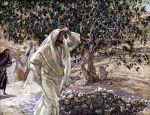
Jesus_Curses_Fig_Tree_JamesMonday of Holy Week starts with Jesus in Bethany and the walk back to Jerusalem.  The problem however was Jesus was hungry (Mark 11: 12).  On the natural side of things you have to wonder why his host had not supplied breakfast?  Was Jesus being a good guest and did not wake them up or had they even stayed in anyone’s house?  They certainly had to return the donkey from the day before and the Mount of Olives and Bethany were places of seclusion and safety after the big parade into Jerusalem.

After the jokes you could make about hunger and being grumpy Jesus’ actions in the Temple and with the fig tree are significant.  (See my study on figs) and (Monday, Holy Week 2013) Hunger is a complex chemical reaction of the body that involves several of your body systems: nerves, blood, digestive, and hormonal systems.  Jesus’ body was ready to break the night’s fast and to get back into a properly functioning track.  His expectation of fruit on the tree even though it was not in season really was not out of line, as they will do that.  But the curse on the tree foreshadows the experience He is about to have in the Temple and what will happen to religious bodies that do not bear fruit.  The Temple (tree) is not bearing fruit even though it appears busy (leaves) so it is not helping the people just feeding itself.  The whole system from priest, to animal sellers, moneychangers, and worshippers were not functioning properly.

Jesus’ physical hunger and His supernatural zeal for the Temple and the things of God The_Moneychangers001are driving forces that demanded action.  So when He could not be satisfied stopping the problem was His response – curse on the tree and stopping the merchandise.

References for Monday of Holy Week: Matthew 21: 12-17, Mark 11:12-19, Luke 19:45-47, John 12: 20-50

http://en.wikipedia.org/wiki/Hunger_(motivational_state)

http://clipart.christiansunite.com/1395052861/Pictures_of_Jesus_Clipart/The_Moneychangers_Clipart/The_Moneychangers001.jpg

http://christimages.org/biblestories/jesus_curses_the_tree.htm

Jesus Had a Need

Palm Sunday, which celebrates Jesus’ ride into Jerusalem, begins what we call “Holy Week.”  Starting at the Mount of Olives, Jesus begins the day with a powerful statement that has slipped by me for years – Jesus had need of a donkey.

Jesus on the Donkey

Jesus on the Donkey

Needs.  A little word, everyone has them and we spend most of our lives working to take care of them.  We confuse needs and wants, they really are quite different and we must separate the two.  But to need something so that you can continue in life and business that is an important item.  Recently my wife read a short article by Bishop Fulton Sheen on how Jesus had “needs.”  That should have been no big deal, after all, he was human but that need was a donkey.  It was a necessity that He had to have that young donkey, not its mother but the colt.  I know that Jesus had a small group of women that supplied His needs in Galilee (Mark 15: 41) but somehow you never seem to think about Jesus having needs and that a human would take care of them.  The Greek word for needs in the story of Palm Sunday with the ride into Jerusalem is chreia (Strong’s 5532) and it implies employment, demand, necessity, business, and needs.

I am sure that Jesus was used to walking and probably had walked many miles to just get to the Mount of Olives.  So when He asked two disciples to go get a donkey they had to think it was strange and then He said it was a need.  In Isaiah 62: 11 the prophecy says that the king was to come into Zion riding a colt so Jesus knew that the donkey was a necessity.  (I like to think the house they went to belonged to Mary and Martha.)  For Jesus to fulfill His supernatural destiny He had to borrow that donkey.

Thoughts:

  • We will have needs just like Jesus so we can fulfill our destiny.
  • God may use people to help supply our needs.
  • We may not recognize our needs but it could be something as simple as a borrowed donkey.
  • God knows what your needs are and has already positioned them for you to find and use.

See the rest of Holy Week 2014

Palm Sunday references are Matthew 21: 12-17, Mark 11: 1-11, Luke 19: 29-44, John12: 12-19. http://clipart.christiansunite.com/1394966461/Easter_Clipart/Palm_Sunday_Clipart/Palm_Sunday001.jpg

The Parable of the Sower and Jude

The Parable of the Sower is a favored parable  because of Jesus

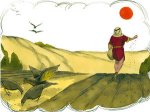
The Sower

The Sower

explaining it.  You don’t have to worry about various meanings because Jesus tells the disciples exactly what He wanted them/us to know and see in it.  He clearly states that the Word will land on four types of people.  As I said in Job’s Friends that the majority of the seed lands in the field and those people will produce a good crop.  The Word also lands on other people and it does grow in two of the three of them it just does not produce a good crop.

In the Book of Jude, the half-brother of Jesus takes time to warn the people to beware of men/leaders who are there for their own benefit and are hurting people.  Jude names Cain, Balaam, and Korah as the types and shadows of these men.

Cain, the first-born child, is the type of the natural man who is jealous and angry and is willing to kill the spiritual.  He is the “pathway” where the Seed could not grow.  Think about what he had thought; he could talk with and hear God.  It may have been that he saw God, yet it did no good because as it says in 1 John 3: 11 – 12, “ His actions were evil and he belonged to the evil one.”  This happened because he refused to master sin (Genesis 4:7).  So the “way of Cain” is to kill the spiritual so you do not have to face your actions.

Balaam, a mystic in Numbers 22, is an example of the “rocky ground.”  He called God Lord (see Lord My God) and seemed to want to do His will but he had no root even though people recognized the Abrahamic covenant working in him.  His error was that he used his knowledge of the spiritual to make a financial profit.  He counseled Moab to have Israel sin sexually so that they would not be holy and out from the covering of the Lord’s blessing.

Korah, a Levite in Numbers 16, is the soil with the “weeds.”  This area is on the edges of the field and it is possible for it to produce fruit but it has problems that mess up its full potential.  (see Seeds)  His rebellion was against God’s earthly authority and thinking he could do someone else’s job and that God would bless him.  Part of his family did go on to serve as musicians so good did come from the family.

Luke 8:1–15, Mark 4:1-20, Matthew 13:2-23

The picture is from http://www.freebibleimages.org/illustrations/parable-weeds/