Easter 2015 – Things Borrowed

In the Hillsong United song Love Is War, from their Zion album, they make a statement that Jesus’ tomb was borrowed. That phrase started this study. I realized that was not the only thing borrowed or lent to Jesus during what we call Holy Week. I will also be looking at the things that were given to Him and then there was Saturday.

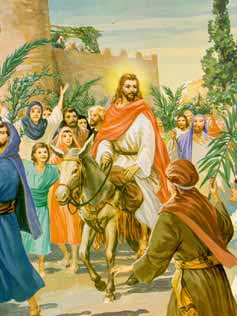
  • Palm Sunday – Jesus directed two disciples to go borrow a colt, (Matthew 21:1-11) this was to fulfill Isaiah 62:11. The people putting (lending) down their cloaks
    Jesus on the Donkey

    Jesus on the Donkey

    and cutting branches equate to the “red carpet” treatment and cut down on the dust the guest of honor had to deal with.

  • Monday – Jesus left Jerusalem each night and went to the Mount of Olives/Bethany to sleep, a place to stay (Luke 21:37).
  • Tuesday – Jesus borrowed the Temple Courtyard to do His teaching; he did this Monday through Thursday but here are the references listed with Tuesday: Matthew 21:23, Mark 12:35, Luke 20:1 and 21:38.  A coin (denarius), Jesus asked for this to end the question about paying taxes to Caesar: Matthew 22:19, Mark 12:15, Luke 20:23.
  • Wednesday – Nothing is recorded about Jesus borrowing anything on this day.
  • Thursday – The “ROOM” or upper room may be the one in Acts 12:12 which belonged to John Mark’s mother. The other things Jesus used, which probably were in the room, were a towel and washbasin. Matthew 26:18, Luke 22:16, and John 13:4.
  • Friday – To stay with the song Love Is War I will say that Jesus borrowed Joseph’s tomb but really Joseph thought he was giving it to Jesus.

This thought is just an extra but in Luke 23:25 when Pilate released Barabbas that made him the “scapegoat.” He was released and Jesus was sacrificed this practice was ordered in Leviticus 16 and was done on the Day of Atonement.

Psalm 103 – Barak the Lord

I know I have read this Psalm (103) many times, in my Bible it has highlights and underlines I even imaged a place and time that David would have written it but that apparently did not mean I studied it. Well, for the place and time I could see David having penned this awesome song in 2 Samuel 12:16. This is where David is pleading for the life of the first child he had with Bathsheba. For seven days David is pleading with the Eternal God of Israel; I am sure he was stating why he would follow such a great God. David would also be reminding God of His awesome deeds and righteous ways, part of this would be comparing things David can see to the Father’s bigger realities. But what pulled me into this study was the phrase – “Praise the Lord, O my soul.”

KJV vs. NIV and Hebrew vs. English has always been a reason for me to study and Psalm 103 continues this tradition. The NIV translators rendered barak to mean, “praise” while in Hebrew it is “bless.” Vine’s Dictionary adds it is – to kneel, bless, be blessed, or curse.

I liked that it started and ended with “Bless the Lord, O my soul.” Taking that thought a step farther I only found two psalms that begin and end with that phrase, 103 and 104. There are several that begin and end with “hãlal” or Hallelu Yah or as we say in English – Hallelujah! I believe those Psalm are 135, 146 – 150.  Verses 1, 2, 20, 21, and 22 a, b begin with barak and verse 1, 2, and 22b add the phrase “O my soul.” So six times (man’s number) it is said to “bless” the Lord, actually the three that add “O my soul” are for David (men) while the other three are directed at other creations.

Verses 19 – 22 are a “verse” or thought within this psalm. They deal with God’s kingdom and who should barak. David notes that angels, heavenly host, all His works, and my soul are to bârak. At first I was puzzled by angels, heavenly host and all works, I thought for sure David was repeating himself but a check of the Hebrew definitions added to the depth of this Psalm. The “angels” or messengers seem to be a specific group of created beings while the “heavenly host” is the rest of God’s army. This is consistent with the rest of Scripture because different “classes” of angels are mentioned in the prophets and Revelation. “All His works” is just that, everything thing else: plants, animals, the waves, and the heavens.

Psalm 103 ends as it began, a personal call for the individual to barak his God with everything that is within him.

Salem or Sodom – After

While reading Genesis 13,14, and 15 for the Salem or Sodom series this idea started to stand out, Abram did things and “after” they were done new things opened for him. Actually “after” seems to be a theme in Abraham’s life but I will start with the Sodom story. Genesis 13:14, 14:17, and 15:1 all have an example of “after.”

Genesis 13:14 Lot has finally left Abram and went east to the Jordan River valley in order to separate what must have been a large camp of shepherds. Lot and Abram were living in the highlands between Bethel and Ai along the main highway that ran north to south in the country. Abram gave Lot his choice and he went to the lowlands and eventually pitched his tents outside of Sodom. Abram in chapter 12 had received two promises but “after” Lot left God’s message was to physically go claim his promise. He left Luz (Bethel) an area of springs and probably almond trees (luz = almonds) and went south past Salem to Hebron to live by an ally.

Genesis 14:17 is the second “after.” Abram has just rescued Lot when Bera comes out of hiding and tries to influence him but God sent Melchizedek king of Salem to support Abram. Abram chooses God and gets blessed, tithes, and puts the king of Salem in his place. Even though Bera got the people and the goods it is very possible that Abram’s speech made him an enemy.

Genesis 15:1 is the last “after” in the Sodom story. This one could be placed in Hebron and if Josephus’ telling of the story is correct God is reassuring Abram that He will reward him. This is where a son is promised to Abram and he and God do a blood covenant. (That bloody scene of walking between animals cut in half is how a covenant was cut. Basically, if you break covenant this is what happens to you.) I just wonder if Abram was thinking about the kings he had defeated and the ones he may have insulted.

With these examples of “after,” Abram does something and God has an increase for him. Many times we as Christians have to “step out the boat” before we find God has already prepared the situation and us for us to get a blessing.

Some of the other “afters” in Abraham’s life is found in Genesis 18 when God says he will instruct his household that will come and chapter 22 and his testing with Isaac.

Salem or Sodom – Lot, Complex or Confused

Lot the nephew of Abram, has been the topic of many sermons I have heard over the years. In thinking about him I realized many of those sermons really were not about him but how the people he was with interacted with him. Most of those teachings also have been on the negative side and probably did a Lot of bashing. Ok, he had problems but 2 Peter 2 calls him righteous and Jesus in Luke 17 uses him as an example, at the least he is a very complex character.

While pondering this post I heard a sermon by Pastor Carter Conlon entitled Please God, Don’t Ask Me to Do One More Thing!  Lot was not the object of this sermon but the Church at Laodicea (Revelation 3) was. I realized that Lot and Laodicea had a similar problem – they were lukewarm.

Wait a minute aren’t they suppose to get spit out?

Yes, but here is where a praying family member comes in. Abram and possibly Terah, his father, had followed God’s leading (Genesis 11: 31). Lot, like Terah, may have heard God’s call to go to Canaan but only Abram actually did it, so Lot had pray support. I get this idea from Genesis 19:16 “the Lord was merciful to them” (Lot’s family) and 19: 29 “He (God) remembered Abraham.” It is the first use of the word mercy in the Bible, the word is hemlâ and it is only used twice in Scripture. The other usage is in Isaiah 63: 9 it also has a distressed Lord, a “saving angel”, and God lifting and carrying people. (There are other words for mercy but it is the first one.) In his sermon, The Right People by Joel Osteen (February 15, 2015) the point is made that Abraham had to release Lot from his life. Abraham needed this separation so he could focus on God not because Lot was a heathen. Would the story have been different if Lot had not taken the Jordan Valley?  Remember 2 Peter 2.

Peter calls Lot a righteous man who was vexed by his surroundings. First, why this statement could be made:

  1. He was at the gate of Sodom and insisted the angels go to his house, – he knew what would happen to them, he was protecting them.
  2. His daughters knew Lot’s standard of living – they had to get him drunk.
  3. The men of Sodom said he was “judging” them – they knew he lived differently.
  4. Lot knew the angels were speaking the truth and preached the first “fire and brimstone” message (Gen. 19: 14) – his son-in-laws thought he was joking.

Now, for the lukewarm problems:

  1. He went from camping near Sodom to living in it.
  2. Why did he not move?
  3. Was he honored more because of Abram and the rescue?

A friend of mine compared Abram and Lot and the state of their houses by how each treated the angels. Abram had his household prepare the food while Lot seems to do all the work in Sodom.

Thoughts:

  1. Usually being at the gate of a city showed a position of authority and prestige.
  2. Where did Lot’s wife come from?
  3. Where were his flocks, herds, and herdsmen?
  4. Why were singular nouns used in 19: 18 +19? This referred to himself (not family) and the angel/Lord.

When He Left

The night of the attack (Genesis 19) must have been horrible. Neighbors wanting to rape your guest, offering your daughters to appease an angry crowd, and your family laughing at you about their pending death was just the first scene of this tragedy. In reading several translations of the Bible (Moffat and Knox among others) verse 15 could give the impression that there were other family members besides the two daughters who were “with him.” When Abraham was bargaining with God (Genesis 18: 16 – 33) did he count all of the children/family of Lot – 50? You can count the four in the house and two sons-in-law with parents and get ten but what if Lot had other family members living in and around Sodom and then there are his herdsmen. Did they get out? That could have been some of the hesitations!

Finally out of the city, Lot does some bargaining of his own (must have run in the family). He gets permission to go to Zoar. Was there family there or maybe his herds? Maybe the problem with the mountains was that would have taken him to Abraham, who wants to hear I told you so! But the tragedy continues when his wife looks back. The “looking back” carries the idea of longing for what was left; after all, she was married to the person who got everyone rescued and there still may have been family.

Jesus in Luke 17: 28 uses Lot as a warning, he and Noah are examples of righteous people saved before a judgment. Noah is from water and Lot is from fire and Lot’s wife is added to help adjust attitudes about physical goods and their hold over our lives. Luke 17, 2 Peter 2, and Jude carry the same messages and examples which just goes to show that a good sermon needs to be repeated.

Cave Over Family

I understand Lot and the girls leaving Zoar because they would have been looked at as the cause for the destruction of the valley. But a cave over family?  Ok, some families I might understand, but the caves in that area always seem small and dusty. Where were his resources coming from to live? Where the girls right in that NO ONE was around? Abraham lived in Hebron at this time, which is west of the Dead Sea and Jordan while it may appear Lot went east. The thought behind this is God honored Moab and Ben-Ammi by giving them land in Ar and not letting Moses and Israel bother them (Deuteronomy 2: 9 +19), this area is to the east of the Dead Sea. Ruth, a grandmother of David and Jesus, was also a Moabite so Lot still had a part in the salvation story. The boy’s descendants became enemies of Israel and are even mentioned in Psalm 83 as trying to destroy their family.

Lot’s daughters should be the ultimate symbol of guarding your family by whom you choose to be around. They were well trained in the thoughts of Sodom probably having been born after the rescue. Being in Sodom and living with Lot must have been confusing.

Abraham

Their stories will always be intertwined and comparison will always be made which may or may not be fair. So I am directing my thoughts to the boundaries of Genesis 19. Did Abraham send men to look for/rescue his nephew? Since it was burning (vs. 27) he knew God had not found ten righteous people so had he assumed the worst? It is apparent that somehow they meet again because Chapter 19 was written with all of its gory details. The only comparison I want to make is that Abraham refused the goods of Sodom and Lot hesitated because of Sodom.

Sermon by Carter Conlon: Please God; Don’t Ask Me to Do One More Thing! – http://www.tscnyc.org/media_center.php?pg=sermons&mi=25512
Salem or Sodom – Bera, King of Sodom

Bera may be the most audacious person in the Bible! He is also a type and shadow of the devil. First, he is a king who allowed and possibly encouraged his people to sin. He then takes part in a rebellion against his overlord with the other rulers of the Valley of Siddium. They lose to the coalition lead by Kedorlaomer. The kings with the armies go hide in the hills while their families and towns are looted. The rout and panic of his army were so bad they were falling in tar pits. Then he expects to get his stuff/people given back to him! (Genesis 14)

Abram and his friends come in and save the day, and are traveling back toward Salem probably heading to his village. Out of the hills/hiding come Bera and meets Abram in the Valley of Shaveh or king’s valley, which is identified as the valley near Jerusalem. (The only other mention of a king’s valley in the Bible is in 2 Samuel 18:18 in a reference to Absalom.) I am sure there are a lot of ways to look at the goods Abram recovered, but it is possible that not all of it belonged to the Jordan River valley kings. So Abram could have made claim to everything he had just won and really who was going to take it from him, the kings who had just lost it! So Abram honors the Lord and gives a tithe to Melchizedek. I think the wicked king was getting nervous about losing so much stuff with no chance of getting it back. To curb the flow of goods Bera asks/claims the people, so Abram tells him what is going to happen and why. The nerve of that guy to be asking or claiming anything is unbelievable. But one thing is for sure, Salem brought the party and Sodom brought nothing.

Bera, just like the devil, knows people are more valuable than goods. The riches could have been a distraction for Abram because once you have all of that stuff you have to fight to keep it and Bera would have had more people.

The lesson to be learned here is what Bera/the devil does to a Christian in a fight. Abram had gotten a victory and probably was just hoping for some quiet time. But out comes someone to congratulate you on the victory. Many times that person will be a distraction from what you need, which is what Melchizedek brought, something to refresh and strengthen you. We Christians usually equate the bread and wine with communion but the truth is Melchizedek was throwing a party (feeding) for the victor because they were tired. Abram wisely discerned that Bera and the goods were not the reason he went to battle, that was to get his family back and that mission was accomplished. Bera lost everything, hid while someone else got the job done, and still claimed he was owed something.

https://www.biblicaltraining.org/library/valley-shaveh