
Amalekites: An enemy from Moses to Mordecai to_______! Part 2

Balaam mentions the Amalekites when he was supposed to be cursing the Israelites and says that they were “first among the nations.” (See Numbers 24:7,20)  See Lord my/your Lord. 

They are mentioned several times in the Book of Judges but the next big dealing is when King Saul is trying to wipe them out in order to fulfill the command of God against them. See Amalekites: Part 1   This really is the start of his downfall when he was caught up in the greed of the Amalek animals, we can only speculate why he kept Agag the king alive; possibly to ransom him for more money.  So it is fitting that after the Philistines wounded him that an Amalekite is the one to kill him (2 Samuel 1:1 – 16).

David did better when it came to the Amalekites, he killed the young Amalekite who killed Saul and also wiped out the raiding party that burned his town of Ziglag. He had other battles with them and caused a great deal of destruction on them and the Edomites in general.  All of this may have caused them to flee the area and find a home in Persia and Babylon. Which is where Esther and Mordecai find a man with a hatred of the Jews named Agag (See Numbers 24:7).
Amalekites: An enemy from Moses to Mordecai to_______! Part 1

We are not finished with Esau and his descendants and the trouble they are going to be to Jacob’s side of the family. Esau had Eliphaz, by Adah his first wife, who had a concubine named Timna who had Amalek (Gen. 36:12). She is attributed to Adah (a true wife in the genealogy) but is listed last. For Timna see 1 Chronicles 1:36-39.

The Amalekites are cursed, and the Israelites are to be fighting them from generation to generation because they attacked the Israel column (Exodus 17:8-15) as they headed to the Promised Land. Deuteronomy 25:17 – 19 is a serious statement to the Israelites about that incident; it is that commission that King Saul is trying to accomplish in I Samuel 14 and 15.

Josephus 2.1.2 assigns Amalek to the country of Idumea; this is where King Herod came from. Davis Dictionary of the Bible says the Idumeans had circumcision forced on them after being conquered by John Hyrcanus a Maccabean ruler. This is why the Jews hated Herod so much, he was not a Jew and very possibly an Edomite and he could have even been an Amalekite.

A side thought on this – there was always some kind of contention within Abraham’s family; Ishmael and Esau did not seem like contented brothers and uncles, but their genealogies made it into the Bible so that tells me that some communication did exist between parts of the family.  Since Moses is credited with writing Genesis and parts of Esau’s history was definitely happening while they were in Egypt there was communication.  Moses may have gotten some of the information while he was in Midian.

Other references to Esau/Edom/Amalek being destroyed or facing the judgment of God.

Jeremiah 2:

Ezekiel 35

Obadiah

Malachi 1:2-5

https://ificouldteachthebible.wordpress.com/2011/11/13/ishmael-and-es…and-foe-part-2

The Lord my/your God

Have you ever noticed in the Old Testament who claims God as their Lord?  We know Balaam as the guy who had a donkey talk to him to refocus his thinking; even that did not help him by the end of his story. In Numbers 22:18 Balaam, son of Beor, claims the Lord as his God when he is talking to the princes of Moab.  This is pretty amazing since he clearly was not an Israelite. In Numbers 22:5 it says his native land was near the River (Euphrates).  According to verse 6, the king of Moab credits him with the blessing of Abraham. How? My best guess is he was a grandchild of Abraham from his third wife – Keturah (Gen. 25: 1) or he was a descendent of Edom (Esau) because he is a “son of Beor” (Genesis 36:32); remember Abraham was a man who would teach his children about God (Genesis 18:19). Balaam knew God and could talk with Him, but he still became a “seed type #2” in Luke 8: 13.

King Saul after an amazing call to be king. Enjoyed many victories that clearly had come from God. He even had Samuel, the prophet for his tutor. Saul reached a point when he becomes a “your God” person.  After a great victory against the Amalekites, he forgets God and surrenders to fear and greed.  When Samuel confronts King Saul about his disobedience in 1 Samuel 15:15 King Saul says that the cattle were for sacrificing to the Lord your God.  Why not say the Lord our/my God? It is a shame that his thinking and his words showed that even though he had known the Lord he stopped claiming Him as his God; he became “seed type #3” in Luke 8:14.

(see LORD vs. Lord)

Lo Debar – Why Hide a Grandson There?

Why would you hide an heir apparent in a “Lo Debar?” (see Lo Debar) That connection with King Saul goes back a couple of generations to the Book of Judges.  In chapter 21 Israel had killed off almost all of the Tribe of Benjamin and had cursed them on top of all of that.  But to find wives for the 400 Benjamites who remained they killed off everyone in a town in Gilead except for the young women. So, when the newly crowned King Saul takes off to rescue Jabesh Gilead in 1 Samuel 11 it was probably because he had family there.  Not only did he rescue his family but also, he upped his standing in Israel at the same time.  So, his connection with that part of the land of Israel is family ties so the young Mephibosheth would have been safe.      ( see Lo Debar – Another Look )

A place called Lo Debar

After many years of reading the Bible, you start to ask questions because you see things that you know were “not there before.” Some of these blogs will be from “old treasures” and some will be “new treasure” because God wants us to keep moving forward going from “glory to glory” in our knowledge of Him.
A great reason to study the Bible on your own is what happened to me because of a place called Lo Debar (2 Samuel 9). A preacher had taught about Mephibosheth, son of Jonathan, son of King Saul, who was living in Lo Debar. (see Lo Debar-Why Hide a Grandson There?)  ( see Lo Debar – Another Look this is a look at all of the people in the story.)
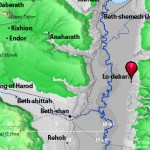
lo-debarLo Debar means “no pasture or no communication”. The negative of the place was so emphasized that I have for 20 years thought that it was a “dump”. Well, another preacher taught about it and did not highlight the “dump” idea, so I knew it was time to study. Part of the study was to go look on Google maps to find where it was, that was fun and it gave me an idea why it may have been called that. One of David’s benefactors (Makir of Ammiel, 2 Sam. 17:27) was from Lo Debar and he brought to David as he ran from Absalom pots, vessels, and bedding, which is what was made in Lo Debar. On further study it seems that Lo Debar possible locationLo Debar may have been a gateway to Gilead and important in its protection, so it seems that it may not have been a “dump.” Resources: Atlas of the Bible by Collins, Zondervan NIV Exhaustive Concordance, and Easton’s Bible Dictionary

The map is from http://bibleatlas.org/lo-debar.htm ,the pic is a screen shot from Goggle Earth.