Time – Days, Months, and a Year – Before Passover

Time – Days, Months, and a Year – Before Passover

Biblical units of time are slightly different than the ones we use.  Genesis 1 gives day, night, seasons, days, and years; the first use of “months” are in the Flood story with Noah.  These units are important in the Passover story, but I am not going into them in depth. (I did a post about the Biblical Calendar; it takes a slightly different direction than what I need here but it is a good read.)

Day

The twenty-four-hour cycle is the same but biblically the day starts at sundown, not sunrise.  Joseph Prince said that allows us to start the day resting, think about it!  In Exodus 12, the Passover story, the Lamb is killed at twilight – the start of the day.  I am sure that I may slip up on specific days/dates; this is another reason that I chose to follow Passover and not Easter.

Year

In Exodus 12 God redefines the Israelite calendar picking a new first month.  They have gone back and added up all of the previous generations so their yearly number is over 5000.  Since this is marked off by seasons and lunar cycles there is an 11-day difference in length.  The High Priest could put in “leap years” to set the year back with the seasons.

Month

On the Jewish calendar, it is the month of Nissan.  I have read enough to know that there was a civil and religious calendar, and there are spots in scripture where the civil calendar is used – be careful if you are trying to make a specific point.

The other thing about the biblical month is that it follows the lunar cycle.  That makes some of the months 29 days long and some 30 days long.  The modern Jewish calendar is interesting; you should do a search and read on it.
The Lamb – Before Passover

The Lamb – Before Passover

Exodus 12:3 – On the tenth day of this month each man is to take a lamb for his family. (NIV)

That little lamb was the main course of the meal, a shelter from the death angel, and a representation of Jesus.  Father God was very specific about how many would eat from it, how it was to be cooked, what was to be served with it, how to eat it, and what to do if any was left.  I have to wonder if the Israelites fully realized what the next several hours would bring them.  Had the experience of the plagues built their faith?  Did their hearts race as Moses told them to be ready to leave? Were there questions in their minds about asking for the riches of Egypt?  Or were they happy with a great meal but tired at the thought of having to make bricks the next day!

The “tenth day” of Easter week would have been the Sunday ride into Jerusalem and the Monday clearing of the Temple.  The Gospels of Mark and Luke tell us of the day that Jesus cleared the Temple of the merchants (Mark 11:12 and Luke 19:45).  Both of these writers also include a statement about how the leaders of the people reacted – they picked Jesus to die and started looking for ways to do it.  The book of John (12:20 – 36) adds the details of Jesus predicting His own death and the Father answering Him as He prayed for glory to be given to God.  Even though the people turned on Jesus this was also the time when they “picked” their lamb.

Special Days – Before Passover

Special Days – Before Passover

Saint Paul’s life as a Jew was built around a series of “special days.”  These are found in Leviticus 23; the major ones start with Passover which leads to the Feast of Weeks (Pentecost) and ends with the Day of Atonement (there are other Jewish holidays).  We as Christians have days that we celebrate; the two most important holidays are Christmas and Easter.   Even though Paul warns the Galatian Church about the observation of special times (Galatians 4:10) I tend to believe that he was warning them not to make these things stumbling blocks or doctrinal (fellowship) issues.  After all, the Father did pick these special days and even ended His work of creation with the Sabbath.

As a child, we always had an Advent wreath and I have used this tradition to help me focus on the day we have chosen to celebrate Jesus’ birth.   In the next few weeks, I will focus on the time in Jesus’ earthly mission that went from Passover to Pentecost.  To Jews, this period is known as the “Counting of the Omer.”  We as Christians tend to forget this period until Ascension Sunday and then Pentecost.  This time period is important in the history of the Church, each of the four Gospels and Acts record events that occurred in these fifty days.  My hope is that this will help us focus on the “types and shadows” found in the Jewish holidays and to celebrate the outpouring of the Holy Spirit and the start of Kingdom work.

I have chosen to write this series of posts to follow the Jewish holidays not the Christian days.  If you want to use these post from Easter to Pentecost Sunday wait a few days to start as they are not the exactly the same, this year Passover is several days before Easter.  Who is right?  Read Galatians 4:10.🙂

Cut Jesse Some Slack!!!!!

Cut Jesse Some Slack!!!!!

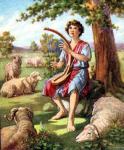
Having heard these sermons for several years now I can truthfully say we should cut Jesse some slack.  When Samuel anointed David as king, David was not there initially.  It has become the rage to blast Jesse for disrespecting his youngest son, the sermon this weekend included David’s mother in the “let’s hate David club.”  I am not sure what it would be like to be the youngest of eight sons, but I would bet the toughest of Jesse’s sons was David.  Why he had seven bothers to fight with, that lion and bear never stood a chance.  I would guess that by the time he was anointed, David was the overachieving little brother who would not back down from anyone or anything.

Think about the day Samuel shows up in Bethlehem.  The town leaders were in panic mode, and they had to find Jesse and sons.  David, as the youngest, was tending the sheep, and probably left at first light.  A job that every other brother had done when they were the youngest.  David may have been an hour or two walk from town by the time Jesse was told to come with his sons.

In our twentieth century, western mentality it was WRONG to leave David out.  What if it was just normal and practical to hurry to the sacrifice because it would have been rude to keep Samuel waiting three hours while they tried to find the pasture David was tending the sheep in?   Who knows, David may have been composing the 23 Psalm that morning, and it was inconvenient for him to leave in the middle of the tune!

In addition to all of that Jesse is mentioned forty-four times in the NIV.  God did not seem to upset about David’s treatment because in Isaiah 11: 1 and 10, and in Romans 15: 12 the term “the root of Jesse” is used to describe Jesus.  The term “root of David” is used twice in Revelations, chapter 5 and 22.

Okay, I do not know why David was not there to start with.  But this may be one time to not westernize a Bible story to make a point that was not there.  Saul’s servant in 1 Samuel 16: 18 certainly had plenty of good things to say about David and I find it hard to believe that Jesse was not proud of all of his sons, especially the child of his old age.

In Samuel – The Anointing of David I look at it from Samuel’s side.  I believe it was a test for the old prophet to go and anoint a new king.

pic from:  http://clipart.christiansunite.com/1379673661/Bible_Characters_Clipart/David_Clipar

Christmas Characters – Gabriel and Other Angels

Christmas Characters – Gabriel and Other Angels

Daniel, Zechariah, and Mary are identified as having met Gabriel.  I like to think that Joseph, the shepherds, and the Magi also saw this angel who “stands in the presence of birth-of-johnGod.” This is a good place to note that Elizabeth is the only person in Luke 1 who did not see Gabriel; I think this speaks of her willingness and faith to do God’s will just on the witness of what happened to Zechariah.

Daniel is not a Christmas character but in chapters 8 and 9 of his book Gabriel is sent to him to explain visions about the end times and of “the Anointed One.”  In both of these meetings, Gabriel is described as looking like a man. (No, wings?!)

Different Dealings

Zechariah and Mary (and Daniel) had face-to-face encounters with Gabriel and spoke to him and asked questions.  God specifically had Gabriel do these appearances; Zechariah and Mary would have known the name and the importance of their meetings from the readings of the Book of Daniel.  Was it because of the importance of the message or to gauge their response that they had their face-to-face?   The assurance of Zechariah’s encounter would have boosted Mary’s faith and resolve when the gossip and the first meeting with Joseph happened.

I have tried to connect Zachariah’s service with the birth of Jesus in the Post – The Day of Atonement, Passover, and Epiphany.  The results are not what I expected about the birth time of Jesus.  The legend/history is better than I thought.

Shepherds

They also physically saw angels.  I like to think Gabriel was the first angel to appear followed by the choir, but we are not told for sure.  They did not doubt, like Zechariah, but hurried to find Jesus.

Joseph

Joseph had several dreams with an angel giving him instructions.  I like to think that it was Gabriel in those dreams; because when he and Mary started to compare notes it would have built his faith and confidence.  Why Joseph did not have a face-to-face meeting I don’t know?  I am putting this in the “God knows how to talk to you” department and am glad that Joseph responded by doing the will of God.

 Magi

The Magi were warned (in a dream) not to return to Herod and share their findings.  It would make a great story if it had been Gabriel and they shared the warning dream with Joseph and Mary.  It would have boosted faith all around and given urgency to Joseph when he had his dream to flee to Egypt.

pics – http://www.freebibleimages.org/illustrations/