Bible and Science-Yeast, A Model of Church Growth

Bible and Science-Yeast, A Model of Church Growth

Matthew 13:33 “The kingdom of heaven is like yeast that a woman took and mixed into a large amount of flour until it worked all through the dough.”(NIV)

To understand this passage we need to look at how yeast grows. Yeasts are eukaryotic and can divide by a process called budding. (Most cells divide into two even-sized cells.) In budding a small uneven sized pouch of cell material forms on the “mother cell.”yeastS_cerevisiae_under_DIC_microscopy In this pouch go all of the organelles and other chemicals that are needed for it to live; since it is eukaryotic DNA also goes into the bud. The mother cell has given the bud everything it needs to live on its own including the reproduction information – DNA. The bud may stay attached to the mother cell and actually start its own bud. (Under a microscope I have seen several of these all strung out from the mother cell.)

Churches may grow the same way. The church can send out a few people who are equipped with everything needed to start and grow a new church. (Personal Opinion: I see Hillsong Church growing in this method around the world.)

∞Jesus, let me be like Isaiah and say, “Lord, send me.” Isaiah 6:8

http://www.touregypt.net/featurestories/bread.htm

http://www.wholefoodsmarket.com/blog/get-know-nutritional-yeast?sf28652915=1

http://en.wikipedia.org/wiki/Yeast

pic from http://en.wikipedia.org/wiki/Yeast#mediaviewer/File:S_cerevisiae_under_DIC_microscopy.jpg

Bible and Science-Yeast, All Bad?

Bible and Science-Yeast, All Bad?

Leviticus 23: 17 Bring two loaves of bread baked with yeast as a wave offering.

Mark 8:15 “Watch out for the yeast of the Pharisees and that of Herod.”

Most of the time when yeast is mentioned in the Bible it is connected with sin. The references to the loaves of bread at Pentecost (see Happy Birthday Church of Jesus) and the kingdom of heaven (God) is said to be LIKE yeast (Matthew 13:33) are the only positive references. Scripture does not tell us why yeast has gotten this labeling. The Israelites could have it for baking their regular bread but it could not be used for bread connected with any offering or feast (except Pentecost).

yeastS_cerevisiae_under_DIC_microscopyYeast lives by breaking down sugars. Carbon dioxide, which causes bread to rise, is one product and the other is alcohol. Yeast may be found on all kinds of surfaces but they will live on the outside of fruit and grains; this is why they will naturally spoil and ferment. God knew/knows this He made them. But these facts should not have them be connected to sin (my reasoning here). Some yeast is considered “good” and some are termed “wild.” The wrong yeast in a batch of beer or wine and you do not get the specific taste you are wanting. So bread makers and brewers are particular about what they put in their wares.

After reading a lot of literature on the subject here are some ideas as to why yeast may be connected with “bad.”

  1. It works unseen and affects everything it is in.
  2. The smell could be associated with something dead.
  3. It may give a sour taste to the bread.
  4. Egypt had cult worship related to bread and beer.

I am leaning to #4 as the reason because Father God did not want anything Egyptian imported into His worship. The Israelites had enough problems with this so why add another thing like yeast in bread.

∞ Father, let me spread good in Your Kingdom.

http://www.touregypt.net/featurestories/bread.htm

http://www.wholefoodsmarket.com/blog/get-know-nutritional-yeast?sf28652915=1

http://en.wikipedia.org/wiki/Yeast

pic from http://en.wikipedia.org/wiki/Yeast#mediaviewer/File:S_cerevisiae_under_DIC_microscopy.jpg

What I Learned From Studying Yeast

What I Learned From Studying Yeast

This study started with Matthew 13:33 and Luke 13:21 and as usual, it spread from there.   The fact that it is paired with the Parable of the Mustard Seed in both of these passages is important. Jesus was showing the importance of small things done in and for His kingdom. Many times we overlook the little things we do as not important. Most of the literature I read about yeast in ancient cultures seemed to agree that they did not know about the yeast cell and that they were infusing something living into the bread dough. In our normal thinking that would be right because microscopes were not around but you have to wonder if Jesus knew!

Depending on the translation you will need to look for the words yeast, leavened, and unleavened if you want to study more on this topic. KJV does not have the word yeast but NIV does.

The amount of flour was interesting as the passages stress it was a large amount. In the NIV that amount is referenced three times: Genesis 18: 6, Judges 6:19, and in 1 Samuel 1:24.   In Genesis, Abraham tells Sarah to make that much bread for the visitors. In Judges, Gideon uses that much flour to make a meal for the angel and in the Book of Samuel Hannah took that much flour with her as an offering when she dedicated her son to God. The amount roughly translates to twenty quarts or forty cups. If you have ever made bread that is enough for at least eight to ten loaves of bread. The regular offering amount with a sacrifice would have been four quarts. I guess Abraham and Gideon were putting their “best foot forward” to impress their guests or to make sure they had extra to take with them.

In 1 Corinthians 5: 6- 8 Paul clearly says to get rid of the “old yeast” (NIV) because Jesus had gone through the Passover. But he names the yeast as “malice and wickedness,” which is also done in other places in the Gospels and the New Testament (the yeast were named Ex. yeast of the Pharisees and Herod). If you have ever used a sourdough starter you may understand the idea of old/bad yeast. If the starter goes bad you WANT to throw it away and start over, as it really smells bad.

At a small home fellowship, we once attended the pastor had an interesting revelation during communion one Sunday. (We used real wine and sometimes yeast bread. I know but that is what happened. We also used saltines if that is all we had.) Anyway for the wine and the bread to become what they were many grapes and grains of wheat were brought together but it required yeast to convert them into that usable form.

A final thought on wine and yeast. Wine/beer was/is made with the action of yeast. The wine was allowed/required to be presented as part of the offering at a sacrifice (Leviticus 23:13). The yeast in wine makes enough alcohol to kill itself and when the bread is baked that normally kills off the yeast. One was required and the other was forbidden! The Biology teacher in me still will wonder if it has something to do with the living organism? NOTE: From my reading, the Egyptians apparently made their beer from baked bread.

Jesus was Hungry

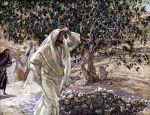
Jesus_Curses_Fig_Tree_JamesMonday of Holy Week starts with Jesus in Bethany and the walk back to Jerusalem.  The problem however was Jesus was hungry (Mark 11: 12).  On the natural side of things you have to wonder why his host had not supplied breakfast?  Was Jesus being a good guest and did not wake them up or had they even stayed in anyone’s house?  They certainly had to return the donkey from the day before and the Mount of Olives and Bethany were places of seclusion and safety after the big parade into Jerusalem.

After the jokes you could make about hunger and being grumpy Jesus’ actions in the Temple and with the fig tree are significant.  (See my study on figs) and (Monday, Holy Week 2013) Hunger is a complex chemical reaction of the body that involves several of your body systems: nerves, blood, digestive, and hormonal systems.  Jesus’ body was ready to break the night’s fast and to get back into a properly functioning track.  His expectation of fruit on the tree even though it was not in season really was not out of line, as they will do that.  But the curse on the tree foreshadows the experience He is about to have in the Temple and what will happen to religious bodies that do not bear fruit.  The Temple (tree) is not bearing fruit even though it appears busy (leaves) so it is not helping the people just feeding itself.  The whole system from priest, to animal sellers, moneychangers, and worshippers were not functioning properly.

Jesus’ physical hunger and His supernatural zeal for the Temple and the things of God The_Moneychangers001are driving forces that demanded action.  So when He could not be satisfied stopping the problem was His response – curse on the tree and stopping the merchandise.

References for Monday of Holy Week: Matthew 21: 12-17, Mark 11:12-19, Luke 19:45-47, John 12: 20-50

http://en.wikipedia.org/wiki/Hunger_(motivational_state)

http://clipart.christiansunite.com/1395052861/Pictures_of_Jesus_Clipart/The_Moneychangers_Clipart/The_Moneychangers001.jpg

http://christimages.org/biblestories/jesus_curses_the_tree.htm

The Problem with the Miraculous

The problem with the miraculous is people will only accept/believe for what their minds can grasp.  R. W. Schambach told a story of a man who gave the money he was saving for a new truck in a meeting one night.  Later that week he came back with a testimony of how he was working on his old truck when he noticed something he had missed for years.  It was a can that was stuck to the side of the engine and when he opened it there was a wad of 100 dollars bills in the can, more than enough to buy the truck he had been saving for.  On hearing this several people got up an ran out to check their cars.  They were sure that God would bless them in the exact same way.  They could only conceive a miracle for them because it had already happened to someone else that way.  Now testimonies are to build up your faith and your belief that God can and will do miraculous things but we get stuck on how God will do these things.  How many people are always willing to give God instructions on how their miracle is supposed to look and happen?  You wonder how many miracles have been missed because the person could not perceive that it could possibly happen that way.

While studying Jesus walking on the water the side story of Peter getting out of the boat is added in Matthew’s telling of the story.  I have heard many sermons on this over the years and most of the teachers have no problem with the fact that Jesus was actually walking on water.  But when it comes to Peter “seeing the wind” they will dismiss this as a natural occurrence of water blowing off the waves, etc. (NOTE to READER: This is a strange idea and I would not make it a doctrine but I will present this in the context of how far are you willing to believe God can do anything!)storm on Galilee

The reason this idea hit me was a preacher did just that the last time I heard a message on this topic.  He was building the faith of the people to be willing to see Jesus differently in our times of need.  But when it came to the wind that was impossible for Peter to have actually seen.  Duh! It is impossible to walk on liquid water but Jesus was doing that.  (People walk on water all the time and even drive trucks on it, it just happens to be frozen.)  Ok, since I am being weird let me throw out some other strange ideas: 1. Was Jesus wet from walking on the water?  2.  Did He walk up and down the waves or did they divide in front of Him?  Please do add these to “How many angels can dance on the head of a pin.”

To say that something different was happening is an understatement.  The disciples saw Jesus as a “ghost”, Peter actually walked on water, Peter saw wind, and the boat was transported to shore “immediately” (John 6:21).  If you were looking for a physical reason for Jesus to walk on water the only logical one would be He changed how the molecules were acting toward each other.  So why could that have not extended to what was making the waves.  Maybe Peter had a good reason for sinking, he truly saw something he never expected, air molecules whirling around him.  I will still agree he should have kept his eyes on Jesus but was he distracted by the miraculous.  To add to this strange possibility, why did they use the term “ghost?”  That word phantasma (Strong’s 5326) is only used twice in the Bible and that is in connection with this story.  Jesus may have actually looked different because once again had He done something beyond what our minds can grasp!

Taking this back to Jesus and the whole story of feeding 5000 men and walking on the water.  The people in Gennesaret (where they landed) knew if they just touched His garment they could be healed (it had been done before) and the crowd from the miraculous feeding that finally found Him teaching in Capernaum just wanted a free meal ticket.  The crowd even though they had seen 5000 people fed needed more proof that He was the Messiah because in their mind Moses had done the same miracle before (Jesus tried to correct their thinking in John).  Many people will not believe in Christianity because of the miraculous things that are done by God in the Bible.  Painfully some Christians can only believe that God did those things in the Bible and not in modern times and so they must condemn the “crazies” that hold to the fact that God does not change.  “After all science knows more now than they did back then.”  As Christians I believe we need to understand that our faith demands a belief in miracles – past, present, and future.

How about you, how far will you let God be God.  Who knows maybe you will see wind and still keep walking on water?

Both “Feeding the 5000” and “Walking on Water” are part of the Seven Miracles of Jesus in the Book of John.

http://en.wikipedia.org/wiki/File:Rembrandt_Christ_in_the_Storm_on_the_Lake_of_Galilee.jpg