Hezekiah

The meaning of Hezekiah is “strengthened of Jah.” Jah or iah is a short form of Jehovah; many names in the Bible end in iah.

His life story is found in 2 Kings 18-20, 2 Chronicles 29-32 and Isaiah 36-39 (see The Life of Hezekiah, I put all three together) but there are other books that have not been found that also contains records of historical events of Judah and Israel, they are mentioned in the Bible. (see Samuel & Chronicles) I think everyone has noticed how closely the books of Kings and Chronicles are related; a reason for this is that the two writers, possibly Ezra and Baruch (Jeremiah’s scribe), used a common source and tailored the books for specific readers. He lived approximately 250 years after Solomon’s son Rehoboam and witnessed the fall of the Northern Kingdom.

Hezekiah’s reign lasted twenty-nine years and there are four major components of his time as king that are reported in our Bible.

  1. The restoration of the worship to the Temple.
  2. The attack of Sennacherib king of Assyria.
  3. His healing and its conformation.
  4. The visit of envoys from Babylon.

I tend to read the stories about the kings individually but with Hezekiah you must start with his father, Ahaz. His father did the things he undid in 2 Chronicles; Ahaz stopped Temple worship and put pagan altars there and around Jerusalem. The story in Chronicles covers cleaning and restoration of the Temple while 2 Kings covers the attack of Sennacherib.  Isaiah’s story of Hezekiah mirrors what is found in 2 Kings except for Is.38: 9-20. His illness is in Isaiah and 2 Kings while the visit from Babylon is told in all three.

The amazing thing to me is not the fact that one king was good and one was bad but that the people are not objecting to the change. Can you image what a person who was alive during Ahaz and his leaving Jehovah to then have his son Hezekiah push for reform to have his son Manasseh be the worst of all the kings of Judah must have thought? That is reflected in the story of Elijah at first the people said nothing but voiced approval when Elijah gave the challenge of fire. (1 Kings 18:21-24)

The timeline is my own. It is an Excel document and covers the time from Solomon to the 70 years of Exile. But I only can screen shot short pieces of it.

Fruit and Nuts – Grapes + Recabites

Grapes, raisins, vines/branches, and wine

When it comes to symbolism what better icon is there than the grape plant for representing the Church of Jesus?  Jesus used it in parables, it is part of our communion and it is referred to throughout Scriptures. Now as with most symbols you can attach several meanings to grapes and its vines; I am going to look at a few and let God reveal others to you.

  1. Part of Communion – The wine is to represent the Blood of Jesus. * Sorry, I did not say grape juice! I do go to a church that uses grape juice but ancient Israel would have had to ferment it in order to keep it. Several churches I know use grape juice so as to not have weaker Christians stumble and I am good with that!* But wine is a “living drink” having come from many individual grapes all put together and joined by yeast (it does not have to symbolize sin) to become something new. Yeast in Luke 13:21 is used as a picture of the Kingdom of God.
  2. Jesus refers to Himself, as the Vine and we, the Church, are the branches. John 15:5
  3. Nazirites – People separated to God for a season could not eat or drink any part of the grape plant while under the vow. (Look in Numbers 6 and remember that Samson was a Nazirite and so was John the Baptist, probably.) Interesting type and shadow, that people in the Old Testament who choose to get close to God had to give up grapes, a symbol for the church.
  4. Medicine – In 1 Timothy 5:23 Paul urges Timothy to use a little wine because of his stomach; the alcohol can kill germs.
  5. The vine in Judges 9: 12+13 – refuses to rule over other plants so that it can do its job. I did not find any reference to a “vine” that was not grape.
  6. Misuse of wine – I guess the one that stands out is Noah getting drunk after the Flood. Proverbs 20: 1- “Wine is a mocker” (NIV) speaks for its self or Proverbs 23:29-35, “When will I awake so I can get another drink.”
  7. Raisins – They are grapes with most of the water (Holy Spirit) taken out of them but they still can revive a weak individual. Ex. 1 Samuel 30:12

However, you view wine drinking is between you and Jesus but the grape plant and its fruit are and always will be part of Church symbolism.

The picture of the grapevine is from http://free-extras.com/images/growing_grapes-5434.htm

Recabites (NIV) or Rechabites (KJV)

First, my apology to anyone who is not familiar with American slang; the word “nut” can carry several meanings and for this blog, it is someone who is crazy (at least according to worldly standards).

The main story of the Recab family is found in Jeremiah 35. Here the prophet Jeremiah is instructed by God to have all of the men of the family come to the Temple and serve them wine. No pressure right, THE MAN of God invites you to church and expects you to join in “the boys night out” he is throwing. They refuse and state that they don’t drink because of a long-standing family tradition. (Drinking alcohol is not the point but it could be; I know it is a very volatile topic. I don’t drink because it is one thing that God delivered me from when I got saved. I have found out through the years that it is not me who is uncomfortable with not drinking but the drinkers around me.) They also state another family tradition of not owning houses or planting fields. Now all of this combined for some people would qualify them as “NUTS”, no “American Dream” of your own house; then to top all of that off they tell the man of God, NO.

So who were these Recabites who would say no when put into such a pressure situation? According to 1 Chronicles 2:55 they are one of the family groups that came from Caleb, the faithful spy in the Exodus story. Now there are several “Recabs” in the Bible and not all of them are from Caleb and when you read verse 55 you may recognize Kenites and again there are several groups with this name that do not seem to be related. But more specifically they may have come from the Jehonadab who sided with Jehu in 2 Kings 10 (it makes you wonder if they are part of the 7000 in 1 Kings 19) to get rid of Ahab and the prophets of Baal. So taking a stand and following God was a long time family tradition for the Recabites.  And in Jeremiah 35:19 God honors them because they honored the instructions of their ancestors. With a promise to always have a family member who serves God!

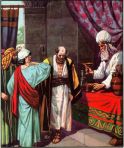
The picture of the Recabites is from http://lavistachurchofchrist.org/Pictures/StandardBibleStoryReadersBook5/images/scan0017.jpg

Fruit and Nuts – Figs and Nabal

Figs

Let us start our discussion of figs by talking about apples. In the Garden of Eden, there were two fruit trees that Adam and Eve did not eat from; according to Wikipedia, it is probable that they “became” apple trees during the Renaissance. I would like to make the case for them being fig trees; after all, what did they sew together to cover their shame, fig leaves. Most of this is a retake of a sermon I heard several years ago that used figs as a metaphor for the church/religion. The preacher made the point that where figs are mentioned just insert the idea of  “religion.”  I will not cover all of the references to figs and I am not sure all of them fit neatly into that box but let’s take a look at a few of them.

Genesis 3:7 Adam and Eve disobey and instead of trying to get back to God they cover themselves in fig leaves and people have been doing that ever since.

The phrase “under his own vine and fig tree” is found in several places in Scripture and can be a symbol of Israel being at peace but both of those plants are symbols for the church. Ex. 1 Kings4: 25, 2 Kings 18:31

Jeremiah 24: 1-10 is a vision where the prophet sees two baskets of figs in front of the Temple one good and one bad. This reminds me of Luke 6:43-46, which is the parable of the trees and the wise and foolish builder; this is where Jesus asks why do you say to Him Lord, Lord and do not do what He says.

John 1: 48 – Philip was under his fig tree and when he was called to come to meet Jesus.

Finally, the story of Jesus cursing the fig tree because it has no fruit and it dies.               Ex. Mark 11

Now in Israel, there is a sycamore-fig, it is not a true fig, but the analogy still works. And my final thought is something that is talked about in Scripture that I did not know; fig trees can bear two crops of figs, the first crop is called breba figs that grow from the old wood. The main crop follows on the ends of the branches- new wood. We can make all kinds of analogies here: natural vs spiritual Israel, former church latter church, new wineskins vs old wineskins, etc.

Please visit this blog to see more about figs.  http://ferrelljenkins.wordpress.com/2008/10/10/zaccheus-climbed-up-into-a-sycamore-tree/  The fig pic is from – http://www.raysfiginfo.com/graphics/sycamore04.jpg

Nabal

Proverbs 18:11 – The wealth of the rich is their fortified city; they imagine it an unscalable wall.             :23 – A poor man pleads for mercy, but a rich man answers harshly. (NIV)

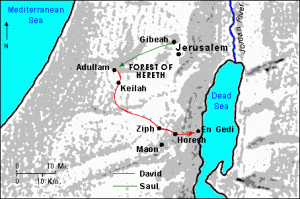
I think these two verses are examples of why I picked Nabal as my first “nut.” But we will get back to him, let us look at 1 Samuel 25 and get some background. Carmel means, “Planted orchard” and is in the area of En Gedi, which is south of Jerusalem (yes there is an Mt. Carmel that is in northern Israel).  Abigail (Nabal’s wife) means “a father’s cause of joy” and after she married David she had his second son, Daniel     (1 Chronicles 3:5).  The Desert of Maon, which means “dwelling”, is in the land of Judea and became a hiding place for David.

Nabal was a descendant of Caleb who was one of the two faithful spies in the book of Numbers; so he was loosely related to David. This leads us to why I think he was a “nut.” In verse 10 when Nabal harshly answers David’s men he knew exactly who David was and what he was capable of doing so verse 10 and 11 is really a high-level insult. David’s request for a gift was for protection that he and his men had given Nabal’s flocks.  So insulting a “warlord” with 600 men when a few sheep would have made him happy is a “nutty” thing to do. Now the problem actually started in verse 9 when the young men “waited.” This word is only translated twice as “wait” many of the times it is used it is “rest” and many of those references are inferring a LONG rest. So as it says in Proverbs 18 Nabal thinks his money is his fortress and so he answers people harshly and made the men wait a long time. (see Judas)

Fortunately for David and all the men around Nabal’s house, Abigail had good judgment. Note – part of the gift was pressed figs.

As I enjoy trying to place Psalms where they may have been written I would put Psalm 109 after verse 35.

Also, the Lord’s use of “tens” in this text is interesting; Nabal was in a coma ten days, which also was the number of men David sent for the gift.

Map of Carmel and Maon from http://home.comcast.net/~davebowser/bible/david/david15.html


Fruit and Nuts – Mark + Almonds

John Mark, the writer of the Gospel of Mark, is our first example of “fruit” from a ministry, that of Barnabas his cousin (Colossians 4:10). Barnabas “the encourager” took him under his wing when he and Paul had a falling out because of Mark (Acts 15:39). We really don’t hear a lot about Barnabas again but Paul tells Timothy to bring Mark along when he comes to see him (2Timothy 4:11). That is a real turn around for Paul and a line of thought is that change in Mark was because of Barnabas. He also helped Peter in his ministry (1 Peter 5:13).

Barnabas gets credit for the “fruit” but let’s look at where the “seeds” got planted. (Warning some of this comes from a very active imagination.)

Jesus himself, I believe, planted the seeds of Mark’s faith, because I think Mark was frequently with the disciples. Many scholars will say that there is a probability that Mark was the young man who “lost” his clothes in the Garden the night Jesus was arrested. Why would he have been with them? The upper room was at his house! Peter went back to Mary’s house (there were several) after the angel let him out of jail (Acts 12:12) this Mary is identified as Mark’s mother.  That would have also put him in the prayer meeting at Pentecost and possibly he was the one carrying the jug that the disciples followed to find the room (Mark 14:13).

Personally, I think that Peter and Andrew were his uncles and James and John were his cousins (Why not?). That would lead to this idea real easy; Mark was the little boy with the five biscuits and the two fish lunch. (I warned you.) I actually wrote a short story along that train of thought; he went along for the boat ride when Jesus needed the rest. But can you imagine getting a little boy’s attention for life with that miracle and what could his mother say when he comes home with twelve baskets of leftovers?

See this site for St. Mark http://www.americancatholic.org/Features/Saints/Saint.aspx?id=1364

Now for the nuts – almonds.

The two stories that always get my attention about almonds are the ones in Jeremiah 1: 11,12 I see a rod of almond; You have seen well, for I am watching over my word to perform it. And Numbers 17:8 where Aaron’s rod produced almonds in the Tent of Meetings.

The almond tree is the first tree to blossom in the spring so it became associated with watchers and the “first one”; the word almond comes from “shaqad” to be alert, sleepless, on the lookout for – hasten, remain, wake, watch. These scriptures are where it is used with these meanings: Watch– Jeremiah 31:28, 44:27, Proverbs 8:34; Wake-Psalm 127:1; Hasten– Jeremiah 1:12.  It is a play on words in Jeremiah 1:12 with the almonds and watching (footnote NIV and Strong’s).

The name Luz (the town that became Bethel) has a reference to almond trees.  This is where Jacob had his dream of the ladder to heaven.

The menorah or lamp had almond-shaped cups for the flames. The Maccabees received a miracle, the sign to continue the rebellion, with this type of lamp. The oil kept burning for a week instead of a day.

Over the years I have used several reference books to gather this material on almonds but this one had several interesting stories with it http://en.wikipedia.org/wiki/Almond

For almond pic http://www.rootsofpeace.org/press/press-2009/2009/11/big-buzz-with-afghan-farmers-1.html

For menorah pic  http://www.judaica-mall.com/16307.htm

Psalm 80

I have been looking at the names that describe God so as I read Psalm 80 its three repeating verses caught my eye. The verses are #3,7 and 19; the verses add a name of God each time it repeats, and part of my study was to look at body parts and it talks about the face of God.

The three names that are added are:

1. God – Elohim means great or mighty one

2. Almighty – Saba focuses on power to conquer or means commander of the army (host)

3. Lord – Yahweh implies a personal covenant relationship with the true God

Different translations handle these verses differently so checking several will be a good study. (I used the NIV.) I did a definition study of the other words in the verse and a loose translation without the names would be:  Physical bring us back O (different names) establish favorable circumstances as a sign of favor so that we can be rescued from earthly enemies.

If you now read the verse adding the definitions for the names, it really adds a new depth to the verse.

I like how Asaph added another name as the Psalm proceeded. Now there are three other sets of names in Psalm 80 the first is “Shepherd of Israel” and then in verses 4 and 14 and these are combinations of Lord, God, and Almighty; if numerology interests you that is six times the names of God are used and a total of twelve individual uses.

Asaph starts the Psalm by calling on the Shepherd of Israel who led Joseph.  I like that title – Shepherd of Israel.  I read several ideas about why he would start off with Joseph and then mention Ephraim, Benjamin and Manasseh so know that you will find many ideas. So here is mine; Joseph is actually the “firstborn heir” which was an important position in a Hebrew family.  Benjamin was his brother by the same mother and Ephraim and Manasseh are his children; that would make them Rachel’s (the “loved wife”) children. Jacob was making Joseph the “ruler” of the family when the brothers got rid of him. One sign of this was the coat of many colors. He actually was the first-born son just not the first-born son, but Reuben lost the birthright of the first-born (Genesis 35:22).

Here are a few other “nuggets” that I found in doing this study.

  1. “Restore” carries the idea of return or repent; it is different from the New Testament “repent” or metanoia. Metanoia is a mental change while shoob or restore usually refers to a physical return.
  2. The word for face is paneh which comes from panah; it means to turn or look. Another word is paniym and it refers to the “face bread” or shewbread that was put into the Tabernacle.  They did not have a physical image of God, but they had the bread. I am not an etymologist, so I do not know if they are related but the Spanish word for bread is pan.
  3. I read in my Bible Glow app; that the psalms in Book 1 (#1-41) more often use Yahweh (the Lord) and Book 2 (#42-72) uses Elohim (God) more often, there is no apparent reason for this grouping.
  4. A little background – this is in the Third Book of Psalms and most of these are attributed to Asaph (means gather or collector). He was a Levite and part of King David’s praise team.

I used my Strong’s Concordance with Vines Dictionary as a reference book. pic of bread from http://en.wikipedia.org/wiki/Challah