Joshua and Caleb – A Thought on Leaders

Joshua, Moses’ aide, the chosen leader to take Israel into the Promised Land is truly an outstanding person.  He does not have many negative things written about him, and the incident with the Gibeonites is the only major problem he has.  He is only one of the two “fighting men” who left Egypt that crossed the Jordan.

Caleb, the other faithful witness, is the other “fighting man” who made it into the Land.  He was a leader in the Tribe of Judah and probably had a great influence on Othniel, the first judge (Judges 3: 7).

Leaders who are called of God are really hard to find.  Many people do hold offices and fill a need but “Generals” are really rare.  We read about these two men but we don’t think about the numbers and percentages associated with them crossing into the Promised Land.  Exodus 12: 37 says there were 600,000 fighting men who left Egypt; that makes Joshua 0.00016% of that number and Joshua and Caleb 0.0003% of the total number of men who walked through the Red Sea.  Moses had picked other leaders to help him judge the tribes so there were people who helped, but the “Generals” really are hard to find.

Joshua and Encouragement

The education, the training, and a mentor who walked with him for 40 years; Joshua had the whole package on his resume.  God had His eye and hand on Joshua for a long time.  God knew that Joshua could do the job He had called him for, but He also knew Joshua needed encouragement.  In Deuteronomy 1:38 and 3: 28 God tells Moses to encourage him.  Moses in 3:21 does encourage Joshua and it continues in 31: 6, 7, and 23 by telling him to be strong and courageous.  This encouraging continues in the Book of Joshua chapter 1; God encourages Joshua and so do the leaders of the tribes of Ruben, Gad, and Manasseh.

Joshua gave what he got in Joshua 10: 25 when he encourages the leaders of the people to be strong and do what God called them to do.

I guess the life lesson here is your leaders need to be encouraged.  They give a lot when they are doing their job so speak into their life and encourage them.

Joshua By the Books

One study technique that I use is to list references from my concordance to get a good look at what I am studying.  Doing this for Joshua gave an interesting twist to this study.  So the first post in this series will be Joshua by the Books of the Bible.

Exodus Chapters 17, 24, 32, and 33  This is where we first meet Joshua and God puts him in the history books:

  • He leads the army against the Amalekites
  • Goes with Moses up the mountain and utters the phrase, “Sounds like war in the camp” when they come back down.
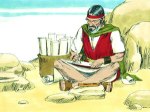
  • He is identified as Moses’ “young aid” that does not leave the first “tent of meeting.” 006-moses-joshua“Young” here may refer to the fact that he is in his twenties and not married.
Numbers Chapter 11, 13, 14, 26, 27, 32, and 34

  • He wants people to be stopped because they are prophesying, his “youth” is recognized again as Moses corrects his attitude.
  • Moses does a name change; it goes from Hoshea (deliverer) to Joshua (Yahweh saves).
  • He is associated with Caleb and exploration of the Land and recognized for their positive attitude and faith.
  • He is credited with having the Spirit and is to be commissioned to lead when Moses dies.
  • Gets orders from Moses, sited as having wholeheartedly followed God
  • He gets the important job of assigning the land once the conquest is over.

Deuteronomy 1, 3, 31, 32, and 34

  • The first three mentions of Joshua are to encourage and commission Joshua as the new leader.
  • Joshua is with Moses while he sings his final song.
  • Chapter 34 is the commissioning with laying on of hands and the imparting of the 005-moses-joshuaSpirit to Joshua.

Joshua  Some of the notable things about Joshua that is in his book is where he was encouraged, Chapter 1, and he then prays for the sun to stand still and encourages his commanders, Chapter 10.  In his farewell speech Joshua (24:15) delivers the great quote, “As for me and my house we will serve the Lord.”  I find that an interesting verse because he has no children listed in the genealogies.  He also left no successor to lead Israel as recorded in Judges.

Judges Chapter 1 and 2

  • Israel is asking God who will lead them since Joshua is dead.
  • Joshua’s age at death is 110, which means he lead them approximately 50 years after the initial conquest.

1 Kings 16:34 tells of the curse that Joshua put on the rebuilding of Jericho.

1 Chronicles 7:27 list his family line in the tribe of Ephraim.

Nehemiah 8:17 refers to the celebration of Booths and compares it to Joshua’s time.

Acts 7:45 Stephen is telling of Moses, Joshua, and the Tabernacle.

Hebrews 4:8 states that Joshua did not give the people rest and that a new Sabbath is yet to come.

In looking at the verses it seems that in the narrative Exodus Joshua was trained, in Numbers he is established in the community, Deuteronomy he is launched as the leader, and in Joshua he does the job that was assigned to him.

Pics belong to Sweet Publishing/FreeBibleimages.org and were found in http://www.freebibleimages.org/illustrations/joshua-challenge/

Work of His Hands

The work of His hands.  cropped-flowers-1.jpg

A comforting idea that is in poems, sermons, and song is that we are “the works of God’s hands.”  Job and David both used this beautiful idea in their writings, but with two different perspectives. We will start with Job.

In Job 10:3 Job is answering one of his tormentors, Bildad, in his third discourse of his book.  Job’s bitterness is evident in this discourse; it is directed at Bildad and God.  (Job 9:33, part of the discourse, is a plea for the work of Jesus as being an arbitrator.)  The end of verse three is still directed at God and says, “While you (God) smile on the schemes of the wicked.(NIV)”  If we look at the original words we find the word “work” with slightly different meanings.  The word work in Job is ygiya it carries the idea of hard toiling/labor.  This fits in with the general tone of how Job is viewing himself and his relationship with God at that moment in his life. It is not pretty and Job is upset.

David uses the phrase in Psalm 138:8.  David uses a different word for work, his is maaseh and it still means work or labor but Vine’s Dictionary says it has to do with farming, artisans working, or the work of praising God.  It has a positive context as compared to ygiya. This fits very well with Psalm 138 and its overall upbeat message.

Even though the general tone of Psalm 138 is positive I can’t help but think it was written at a time when David needed to encourage himself. (ex. After Bathsheba, when he was on the run from Absalom, or when Ziklag was burned.)  It seems he is reminding himself and God of things that he has done and has happened. So the last line of verse eight with the word “abandon” in it puzzled me; it is the reason I think it was written during a time of duress.  It speaks to David’s plea not to be left alone at this time.

“The work of God’s hand.” Two men both referring to themselves as God’s handiwork, but I believe both from a different mindset.

Christmas – Two Questions

Christmas – Two Questions

“How can I be sure of this?  I am an old man and my wife is well along in years.” – Zechariah (Luke 1:18)

“How can this be, since I am­­ a virgin?” – Mary (Luke 1:34)

Two visits from the angel Gabriel, two “fear nots”, two explanations, two questions, and two different human responses are the start of the Christmas story.  The first chapter of Luke introduces us to Zechariah and Mary and how both got news about babies from the angel Gabriel.  Zechariah’s news comes as response from prayer, but you get the idea that it did not show up when he expected it too.  In fact it seems many years late according to Zechariah.  Mary’s news is completely unexpected, a little troubling, but received by a willing heart.

After some struggling with these two stories, some underlining, and looking up some words I am going to try and write this blog and what may seem an unfair situation. It took me a while to understand that Father God had His timetable and His will was carried out for both Zechariah and Mary.

Zechariah and his wife Elizabeth had prayed for a child, God had heard that prayer and was answering it, but not according to human thinking. (Mary was not ready, who knows she may not have even been born when they were praying for a child.)  Zechariah got the news of a lifetime, in the Holy of Holies, from an angel that startled and caused fear in the old man.  His response of unbelief is reflected in his question and probably in body language but it had to be in his heart as well.  So even though he was silenced for nine months Father God still used him and answered the pray. In my thinking Zechariah was treated unfairly until I studied Mary’s part of the story.

Both, Zechariah and Mary’s story are very similar.  Gabriel introduces himself and both Nativity_Scenes002get a “fear not.”  Both are told they will have a baby and are given some explanation, and then both ask their question.  The difference with Mary is that she gladly accepted the news (vs. 38).  The terms that help put light on this was “highly favored” (charitoo) and “favor” (charis).  According to my Strong’s/Vine’s Concordance favor is a gift from the “giver’ of the favor but needs to be received with thanksgiving.  I think it would have been a different story for Zechariah if he had praised and thanked God for the news before he asked his question.

The term charitoo is used only twice in the New Testament here with Mary and then again in Ephesians 1:6.  In Ephesians it is in connection with “us” being adopted as sons so that we can receive “every spiritual blessing.”  I find no mistake that charitoo is in the same verse as the words grace and praise.  Here it is translated as “freely given.”  The concordance adds an interesting note for the Ephesians verse; it says that “grace is a free gift” while “favor may be deserved or gained.”

My personal take away now is there is a big difference between answered prayer and favor.  I hope that I can be like Mary and Elizabeth (vs. 25) and praise God with a thankful heart for the things that show up in my life.

Pic.  http://clipart.christiansunite.com/