Seven Miracles of Jesus Plus One

While studying for my Kingdom series, I kept reading about Jesus “walking through” angry crowds or “concealing” Himself.  Using the parallel function in the Bible Gateway app it was easy to look at several different translations and paraphrases at one time.  I am amazed at how this habit of Jesus is handled in them.  Some could have a possible explanation, while others don’t! I will give the verse/story, the Strong’s Concordance number, and the Greek word with a simple translation. John is the writer who has the most references to Jesus “hiding” Himself.  With that said I will start with the one in Luke. (I am using the NIV.)

  • Luke 4: 30 – #1330 dierchomai – to pass through. Jesus was at Nazareth teaching the morning lesson. (This could also be Matthew 13:53. Luke seems to group things differently, so I will go with Matthew for chronology.  For my study, this starts Jesus’ third block of teaching.). He makes the town’s people mad and they are going to throw Him off the “brow of the hill”.  He “passed through” an angry crowd intent on hurting/killing Him. Really!  They just let Him pass!  Okay, I am not sure what He did, but something powerful quelled/confused the mob.  I find it hard to believe they just “lost” Him on their own.
  • John 7: 10 – #2927 kruptos – secret, hidden. Jesus’ brothers are giving Him a bad time because they do not believe He is the Christ.  So, Jesus goes to the Feast of Tabernacles in secret.  This one does not need a miracle to explain how this happened.  A good hoodie would have worked.  But it is hard to imagine that no one recognized Him until He went to the Temple to teach. There was no one trying to kill or harm Him in this story.
  • John 8: 59 – #2928 krupto – to conceal.  Jesus is at the Feast in John 7.  He is teaching and answering questions.  The crowd does not like His statements about Himself and His relationship to the Father.  They are going to stone Jesus! How do you lose track of someone you are trying to kill?  I just feel that since it was not His time to die Jesus did a miracle and concealed Himself.
  • John 10: 39 – #1831- exerchomai – escape, go out. Jesus is at the Feast of Dedication (Hanukkah).  He is again being questioned by a crowd and they don’t like His answers.  Doing miracles in the Father’s name was not enough proof as to who He was!  So, He escapes!  Again, this could a simple “He outruns them” but that sounds weak, or He punched His way out, no that is weak also.  He was in the Temple, with people everywhere, and was being questioned by what should have been a crowd.  How do you escape that scenario without a miracle? I have a feeling that harming Him was on their minds!
  • John 12: 36 – #2928 – to conceal. This is Monday of Holy Week. Jesus is telling the crowd how He is to die.  A voice came from Heaven to comfort Jesus and challenge the Jews.  His statement in verse 36 surely made them mad!  But He had not shared His last meal with the disciples, so He was not ready to be taken, prisoner.  This could be a natural “hiding” Himself and I would not argue or try to defend a miracle here.

I know this is not one of the traditional “Seven Miracles” and there is no foreshadowing of this type of miracle (That I could think of!).  Really, I think it may be too far out there for many people’s comfort zone. Jesus was not ready to die!  He picked the time and the place – Passover and Jerusalem.  He was in control, not the crowds!  I know that my observations will not change the number of miracles, but if I get a chance to teach it I will add them to the list:-}

These are the Seven Miracles, I copied them from a previous post.  (Click the blue link to see the post.)
·  Turning water into wine in Cana (2:1-11)

·  Healing an official’s son in Capernaum (4:46-54)

·  Healing an invalid at the Pool of Bethesda in Jerusalem (5:1-18)

·  Feeding the 5,000 near the Sea of Galilee (6:5-14)

·  Walking on the water of the Sea of Galilee (6:16-21)

·  Healing a blind man in Jerusalem (9:1-7)

·  Raising dead Lazarus in Bethany (11:1-45)
Pic http://clipart.christiansunite.com/

On His Way to Jerusalem #2 and Heaven

I am borrowing the title of this post from my Easter post and I got that from Luke.  Luke also uses this idea for the third phase/block of Jesus’ ministry by saying He was getting ready to go to Heaven.  (This will not look polished because Word Press does not play nice when you import some things from Word.  This is more of a study than a “telling”.  I am trying to connect where Jesus was with the teachings and actions of others and focus on “kingdom”.)  Jesus’ movements and His teachings are very purposeful in this phase of His ministry as He is preparing the disciples for Easter/Passover and for the Book of Acts/Pentecost.  Matthew and Luke have different events in this time period, I will try to join them but that has proven hard.  One idea that might help join all the events is that the disciples (the Twelve) were not always by Jesus’ side in this time period.  Another fact is the Holy Land is not a huge area, several days of focused walking will get you from Jerusalem to Caesarea Philippi and Tyre and Sidon to the East Bank.   

From Matthew 13: 53 to 28: 20 there are eighteen times/parables that the term “kingdom” is used. (actual number of times it appears is higher, I counted groupings) I will add material from Luke and John when it seems right.  Some of this will be subjective because Luke adds many things not found in Matthew or Mark, John’s focus is just different! 

Matthew 13: 53– His hometown (Nazareth) – rejected as He taught in the synagogue – “prophet without honor” I have wondered if that is why He never went back to Bethlehem!  The mention of what happened to John the Baptist not only signals this is a different section of Jesus’ ministry but clears the stage for things to come.

Matthew 14: 13 – a solitary place – feeds the 5000 and walks on water.  The miracles reflect events of the Exodus and the march to Sinai (days to Pentecost) and Jesus’ authority over nature.

Matthew 14:34 – Gennesaret – Pharisees from Jerusalem asked about the Law (washing hands). Teaching on clean and unclean.

Matthew 15: 21 – the region of Tyre and Sidon.  This is as far west as Jesus traveled, it is also as far north as He went; Caesarea Philippi is about the same latitude north.  Jesus found “great faith” in a woman who the disciples wanted to send away.  She wanted mercy for her daughter’s healing.

Matthew 15: 29Sea of Galilee. Feeds the 4000.

Matthew 15: 39 – vicinity of Magadan, by boat– Pharisees wanted a sign from Heaven.

Matthew 16: 5 – crossed lake.  Yeast of Pharisees and Sadducees.

Matthew 16: 13 – Caesarea Philippi *Kingdom (2) * – Who I am, Peter’s confession, started explaining His suffering at Jerusalem, Peter’s rebuke, denying self 

Matthew 17: 1 – high mountain for Transfiguration.  This could be in Caesarea Philippi or “the mountain” in Galilee.  I vote for Galilee because of Jesus wanting them to go back there during the days of “counting the omer” or waiting on Pentecost.

Luke 10: 1 to 17: 11– My main interest here is that Jesus sends out seventy-two disciples to at least thirty-six towns.  Luke puts many parables/teachings in these chapters that may appear somewhere else in a different Gospels.

Matthew 17: 22 – they came together!  Matthew does not say any more than that!  This is why I put Luke 10 into the list.  Realizing that the disciples (the 12) may not have always been “right there” helped the possibilities and melding of the Gospel accounts.

This section is from the first post and overlaps a little. I will add some from Matthew for #8. 

  1. John 10: 22 has Jesus in Jerusalem at the Feast of Dedication or Hanukkah.  He makes the Jews mad so He “escapes”.
  2. Jesus goes to where John baptized on the east bank of the Jordan. John 10: 40.
  3. Bethany is Jesus’ next destination to raise Lazarus from the dead. John 11: 17
  4. Because of a plot to kill Him, He goes to a village called Ephraim that is in the desert.  John 11: 54 We would call it wilderness – English and Hebrew ideas on this topic are opposites of each other. 
  5. Capernaum– dealing with the Temple tax. Matthew 17: 24
  6. Samaria and Galilee border – healed ten lepers. Luke 17: 11
  7. Crosses the Jordan River to be on the east bank. Matthew 19: 1
  8. Crosses back to the west bank and goes to Jericho.
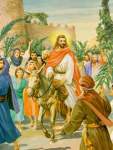
  9. Goes to Bethany/Bethphage and the Mount of Olives for the “Triumphal Entry”. Matthew 21: 1, Luke19: 28

    Jesus on the Donkey

Matthew 18 to 21 – There are seven references to the * kingdom* in this section of Matthew.  Six are by Jesus and one by “the mother of Zebedee’s sons” (James and John).  

Matthew 20: 17 – going up to Jerusalem.  He probably was on the east bank of the Jordan going to Jericho.  This period of time reflects Joshua’s entry into the Land and his Passover (#8).

Matthew 20: 29 – Leaving Jericho going to the Mount of Olives (#9) for His ride into Jerusalem.  Jesus only visited the Temple and then He left for Bethany (Mark 11:11). This is Palm Sunday, I will switch to days of the week so that it will be easier to visualize. 

Monday– To put this is context with Passover, the next four days are when the Passover lamb was separated, “inspected”, and taken care of before it became the main part of the remembrance of what God had done for the people.  I am also going to focus on where Jesus went during these days, not what He taught or said. The links will take you to another post that adds more to the story.  I will extend this section to the Ascension.  Jesus’ movements are scattered throughout the Gospels, so they are not in one place for reference.  Matthew 21: 12 – the Temple and back to Bethany.

Tuesday– Matthew 21: 18, Mark 11: 27 – to the fig tree and the Temple Court where He taught. Matthew has seven references to the *kingdom* on Tuesday; Luke has one.

Wednesday– Matthew 26: 6 – Jesus is in Bethany at the house of Simon the Leper.

Thursday– Matthew 26: 17 the Upper Room, (26: 30) Mt. of Olives/Gethsemane, (26: 57) Caiaphas house.  There is one reference to the *kingdom* during Jesus’ last supper; Luke has three.

Friday– Matthew 27:1 Jesus goes to Pilate, (27:27) Praetorium, (27:33) to Golgotha and the Cross. He was then put in the Tomb.  Luke has three mentions of the Kingdom- one to the Thief and one about Joseph of Arimathea.

Saturday – Jesus went into Hell and got the Keys back and while He was there He preached and set captives free.

Sunday (Easter) Matthew 28 – the Garden Tomb, (Luke 24:13) Emmaus, (Luke 24:36) the first visit to the Upper Room.

One week later – John 20: 24 + 26 – the Upper Room for the second time for Thomas.

To Galilee – To the mountain and the Sea of Tiberias (Galilee).

Mt. of Olives/Area of Bethany – for the Ascension.

I wrote a post called – After the Cloud to envision what may have taken place next and where He went.

pics –  

Kingdom – On His Way to Jerusalem


This part of the study on Jesus’ Kingdom is going to appear to be rough in its style and appearance because it is my study format:)

I am looking at Jesus’ movements loosely after the feeding of the 5000.  I want Matthew to be my reference point but Luke and John add interesting movements and stories that need to be added.  I will try to join them as best as I can.  That means I will start in John about five months before Jesus’ Passion.

  1. John 10: 22 has Jesus in Jerusalem at the Feast of Dedication or Hanukkah.  He makes the Jews mad so He “escapes”.
  2. Jesus goes to where John baptized on the east bank of the Jordan. John 10: 40.
  3. Bethany is Jesus’ next destination to raise Lazarus from the dead. John 11: 17
  4. Because of a plot to kill Him, He goes to a village called Ephraim that is in the desert.  John 11: 54 We would call it wilderness – English and Hebrew ideas on this topic are opposites of each other. 
  5. Capernaum– dealing with the Temple tax. Matthew 17: 24
  6. Samaria and Galilee border – healed ten lepers. Luke 17: 11
  7. Crosses the Jordan River to be on the east bank. Matthew 19: 1
  8. Crosses back to the west bank and goes to Jericho.
  9. Goes to Bethany/Bethphage and the Mount of Olives for the “Triumphal Entry”. Matthew 21: 1, Luke19: 28

From Capernaum to Jerusalem is about eighty miles. I believe all of this walking was for a reason.  Jesus went to the east bank in order to cross the Jordan, like Joshua, “conquer Jericho” and then proceed to Passover.  Yes, it is out of order from what Joshua did but I still see the symbolism in the travels. 

Light and Dark – Jesus in the Tomb

There are several dark to light elements in this story that will be discussed.  Jesus was sealed in a cave in the evening (Mark 15: 42).  On Passover, the women rested but were out while it was dark the next day (John 20:1).  The sun was rising on the first day of the week as they found the empty tomb. I wanted to leave off “of the week” because it was the first day of a new era for mankind.  The light of grace had rolled away an earthly barrier and had come out to start things anew!

It really is not right to say Jesus stayed in a dark tomb for three days.  Saturday of Holy Week is often overlooked in its importance. Jesus did not come out, He went “down” to retrieve the keys that no longer could stay in Hell.  Death had a job to do on the first Passover but Jesus had ended the old, so ownership of the keys was restored to Him.  (Please click on Jesus Preached– it is a poem.  These link with Saturday and Holy Week for previous studies.) The references are Matthew 27: 67, Revelations 1:18, Ephesians 4:8, and 1 Peter 3:19, 4:6. 

Another darkness that became light was the cloud on the minds of all of the followers of Jesus. The dark cloud that had covered the understanding of all the followers of Jesus was replaced with the light of understanding the Scriptures.  This dawn took most of the first day, as the women saw Him first, then Peter, the disciples on the road to Emmaus, and finally the remaining Apostles.  The darkness that started at the cross was replaced with the light of a risen Jesus!

Three– Jesus predicted the three days in the tomb by using Jonah’s stay in the great fish.

End and Start – The First Adam had given up a lot when he ate the fruit in the Garden.  The Second Adam (Jesus) reclaimed the keys to death and Hades.  

Jesus in the darkness coming into the light had been played out many times before.  All of them pointed to this moment.  Creation, the first Passover, God filling the Temple all gave us pictures of what was to come!  He now came from the tomb to start a new picture – Jesus returning for His Bride.  

The next fifty days speak to many things.  Jesus stayed with the disciples for forty days (showing Himself to many).  Then a ten-day period where the disciples prepared themselves and sought the coming of the Spirit.  

The Spirit arriving on Pentecost shares things with Israel meeting God on the Mountain.  A notable part is missing – the darkness.  The Spirit arrives with fire (light) and the sound of a mighty wind.  (Think about the Second Coming of Jesus.)  The Church/Bride has her birthday, and Jews and Gentiles become one new creation.

FURTHER THOUGHT – Reflect on the Book of Revelations by comparing it with the Book of Acts and the time of the Church under the Caesars.

http://www.freebibleimages.org/illustrations/gnpi-101-jesus-resurrection/

Light and Dark- Saul Regaining His Sight


The story of Saul in Acts 9 has two instances of dark and light. Jesus had to end one case of darkness to ready him for the second.  Saul’s first darkness was in his thinking, it bound him in the Law.  Since he was an up-and-coming star in Judaism, it is probable that he had heard Jesus teach and was one of the many messengers sent to trick Jesus. It is also very likely that Saul was part of the council that sent Jesus to the cross.  The light to this darkness is in verse three, it knocked him to the ground.  You have to wonder just what he saw as he talked to Jesus?

Saul/Paul’s second dark and light cycle began when he got up from the ground.  He opened his eyes and “could see nothing”.  That is frightening! (I had that experience due to an eye infection. I just washed my eyes and could see again.) The last thing he saw, for three days, was Jesus in His glory. (TD Jakes has said that he (eyes) may have never recovered from this, but he now had spiritual vision.)  Saul went from spiritual and physical darkness to seeing the Light, or from no light to knowing the Light!

Three– Saul’s three was “three days”.  He did not eat or drink during this time and the answer to his prayers was – Ananias, being filled with the Holy Spirit, and baptism.

End and Start – Here are some of the things that ended and started.

  • Saul -> Paul
  • The Law went to Grace.  Yes, he stilled honored the traditions of his youth but was not bound to them.
  • The hunter became a herald.
  • Knowing the Law was replaced with knowing the Law-giver.

FURTHER THOUGHT– Since you have been saved, what is one thing that Jesus showed you that caused a change in how you lived.

http://www.freebibleimages.org/illustrations/btbm-paul-conversion/