On His Way to Jerusalem #2 and Heaven

I am borrowing the title of this post from my Easter post and I got that from Luke.  Luke also uses this idea for the third phase/block of Jesus’ ministry by saying He was getting ready to go to Heaven.  (This will not look polished because Word Press does not play nice when you import some things from Word.  This is more of a study than a “telling”.  I am trying to connect where Jesus was with the teachings and actions of others and focus on “kingdom”.)  Jesus’ movements and His teachings are very purposeful in this phase of His ministry as He is preparing the disciples for Easter/Passover and for the Book of Acts/Pentecost.  Matthew and Luke have different events in this time period, I will try to join them but that has proven hard.  One idea that might help join all the events is that the disciples (the Twelve) were not always by Jesus’ side in this time period.  Another fact is the Holy Land is not a huge area, several days of focused walking will get you from Jerusalem to Caesarea Philippi and Tyre and Sidon to the East Bank.   

From Matthew 13: 53 to 28: 20 there are eighteen times/parables that the term “kingdom” is used. (actual number of times it appears is higher, I counted groupings) I will add material from Luke and John when it seems right.  Some of this will be subjective because Luke adds many things not found in Matthew or Mark, John’s focus is just different! 

Matthew 13: 53– His hometown (Nazareth) – rejected as He taught in the synagogue – “prophet without honor” I have wondered if that is why He never went back to Bethlehem!  The mention of what happened to John the Baptist not only signals this is a different section of Jesus’ ministry but clears the stage for things to come.

Matthew 14: 13 – a solitary place – feeds the 5000 and walks on water.  The miracles reflect events of the Exodus and the march to Sinai (days to Pentecost) and Jesus’ authority over nature.

Matthew 14:34 – Gennesaret – Pharisees from Jerusalem asked about the Law (washing hands). Teaching on clean and unclean.

Matthew 15: 21 – the region of Tyre and Sidon.  This is as far west as Jesus traveled, it is also as far north as He went; Caesarea Philippi is about the same latitude north.  Jesus found “great faith” in a woman who the disciples wanted to send away.  She wanted mercy for her daughter’s healing.

Matthew 15: 29Sea of Galilee. Feeds the 4000.

Matthew 15: 39 – vicinity of Magadan, by boat– Pharisees wanted a sign from Heaven.

Matthew 16: 5 – crossed lake.  Yeast of Pharisees and Sadducees.

Matthew 16: 13 – Caesarea Philippi *Kingdom (2) * – Who I am, Peter’s confession, started explaining His suffering at Jerusalem, Peter’s rebuke, denying self 

Matthew 17: 1 – high mountain for Transfiguration.  This could be in Caesarea Philippi or “the mountain” in Galilee.  I vote for Galilee because of Jesus wanting them to go back there during the days of “counting the omer” or waiting on Pentecost.

Luke 10: 1 to 17: 11– My main interest here is that Jesus sends out seventy-two disciples to at least thirty-six towns.  Luke puts many parables/teachings in these chapters that may appear somewhere else in a different Gospels.

Matthew 17: 22 – they came together!  Matthew does not say any more than that!  This is why I put Luke 10 into the list.  Realizing that the disciples (the 12) may not have always been “right there” helped the possibilities and melding of the Gospel accounts.

This section is from the first post and overlaps a little. I will add some from Matthew for #8. 

  1. John 10: 22 has Jesus in Jerusalem at the Feast of Dedication or Hanukkah.  He makes the Jews mad so He “escapes”.
  2. Jesus goes to where John baptized on the east bank of the Jordan. John 10: 40.
  3. Bethany is Jesus’ next destination to raise Lazarus from the dead. John 11: 17
  4. Because of a plot to kill Him, He goes to a village called Ephraim that is in the desert.  John 11: 54 We would call it wilderness – English and Hebrew ideas on this topic are opposites of each other. 
  5. Capernaum– dealing with the Temple tax. Matthew 17: 24
  6. Samaria and Galilee border – healed ten lepers. Luke 17: 11
  7. Crosses the Jordan River to be on the east bank. Matthew 19: 1
  8. Crosses back to the west bank and goes to Jericho.
  9. Goes to Bethany/Bethphage and the Mount of Olives for the “Triumphal Entry”. Matthew 21: 1, Luke19: 28
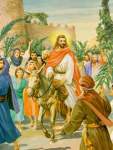
    Jesus on the Donkey

Matthew 18 to 21 – There are seven references to the * kingdom* in this section of Matthew.  Six are by Jesus and one by “the mother of Zebedee’s sons” (James and John).  

Matthew 20: 17 – going up to Jerusalem.  He probably was on the east bank of the Jordan going to Jericho.  This period of time reflects Joshua’s entry into the Land and his Passover (#8).

Matthew 20: 29 – Leaving Jericho going to the Mount of Olives (#9) for His ride into Jerusalem.  Jesus only visited the Temple and then He left for Bethany (Mark 11:11). This is Palm Sunday, I will switch to days of the week so that it will be easier to visualize. 

Monday– To put this is context with Passover, the next four days are when the Passover lamb was separated, “inspected”, and taken care of before it became the main part of the remembrance of what God had done for the people.  I am also going to focus on where Jesus went during these days, not what He taught or said. The links will take you to another post that adds more to the story.  I will extend this section to the Ascension.  Jesus’ movements are scattered throughout the Gospels, so they are not in one place for reference.  Matthew 21: 12 – the Temple and back to Bethany.

Tuesday– Matthew 21: 18, Mark 11: 27 – to the fig tree and the Temple Court where He taught. Matthew has seven references to the *kingdom* on Tuesday; Luke has one.

Wednesday– Matthew 26: 6 – Jesus is in Bethany at the house of Simon the Leper.

Thursday– Matthew 26: 17 the Upper Room, (26: 30) Mt. of Olives/Gethsemane, (26: 57) Caiaphas house.  There is one reference to the *kingdom* during Jesus’ last supper; Luke has three.

Friday– Matthew 27:1 Jesus goes to Pilate, (27:27) Praetorium, (27:33) to Golgotha and the Cross. He was then put in the Tomb.  Luke has three mentions of the Kingdom- one to the Thief and one about Joseph of Arimathea.

Saturday – Jesus went into Hell and got the Keys back and while He was there He preached and set captives free.

Sunday (Easter) Matthew 28 – the Garden Tomb, (Luke 24:13) Emmaus, (Luke 24:36) the first visit to the Upper Room.

One week later – John 20: 24 + 26 – the Upper Room for the second time for Thomas.

To Galilee – To the mountain and the Sea of Tiberias (Galilee).

Mt. of Olives/Area of Bethany – for the Ascension.

I wrote a post called – After the Cloud to envision what may have taken place next and where He went.

pics –  

Kingdom – On His Way to Jerusalem


This part of the study on Jesus’ Kingdom is going to appear to be rough in its style and appearance because it is my study format:)

I am looking at Jesus’ movements loosely after the feeding of the 5000.  I want Matthew to be my reference point but Luke and John add interesting movements and stories that need to be added.  I will try to join them as best as I can.  That means I will start in John about five months before Jesus’ Passion.

  1. John 10: 22 has Jesus in Jerusalem at the Feast of Dedication or Hanukkah.  He makes the Jews mad so He “escapes”.
  2. Jesus goes to where John baptized on the east bank of the Jordan. John 10: 40.
  3. Bethany is Jesus’ next destination to raise Lazarus from the dead. John 11: 17
  4. Because of a plot to kill Him, He goes to a village called Ephraim that is in the desert.  John 11: 54 We would call it wilderness – English and Hebrew ideas on this topic are opposites of each other. 
  5. Capernaum– dealing with the Temple tax. Matthew 17: 24
  6. Samaria and Galilee border – healed ten lepers. Luke 17: 11
  7. Crosses the Jordan River to be on the east bank. Matthew 19: 1
  8. Crosses back to the west bank and goes to Jericho.
  9. Goes to Bethany/Bethphage and the Mount of Olives for the “Triumphal Entry”. Matthew 21: 1, Luke19: 28

From Capernaum to Jerusalem is about eighty miles. I believe all of this walking was for a reason.  Jesus went to the east bank in order to cross the Jordan, like Joshua, “conquer Jericho” and then proceed to Passover.  Yes, it is out of order from what Joshua did but I still see the symbolism in the travels. 

My Study on Jesus’ Kingdom


This study is going to go on for a while!  I hope to use this page to list links to the post as they are written.  Several TV programs on Christian networks prompted my study, especially one show on the Sid Roth program.  As usual, I started with my concordance, dictionaries, and the Bible Gateway app.  I found that Matthew has the most references to the kingdom and Luke is second.  An argument over the terms kingdom of heaven or God had been a big deal.  But since the same stories in different gospels use different terms it hopefully has settled that they are talking about the same thing. 

Much of my study will revolve around the Gospel of Matthew.  Here are my reasons for that decision. 

  • Matthew has the most references/usages of the word kingdom.
  • Matthew was an eye-witness for much of Jesus’ ministry.  So was John and for some of the three years, Mark was there.  The Holy Spirit uses Luke to tell a story from what he had gleaned by talking with other eye-witnesses for a Greek believer; I find story placement in Luke very valuable.  
  • Matthew uses the term kingdom of heaven for his Jewish readers and sprinkles in phrase Kingdom of God at specific times.  The Kingdom of God is used by the other writers, for the most part (it is more of a Greek term).

In reading Matthew and focusing on the word kingdom, I circled the word by using Bible Gateway as an aid, it seemed that there were five sections of teaching on the kingdom. 

  1. The first is from Matthew 3: 2 to 8: 12.  
  2. The second is from 9: 35 to 13: 52. 
  3. The third block of teachings is 13: 53 to Chapter 16.
  4. the fourth block is from the Transfiguration to the beginning of Holy Week (Matthew 17-20).
  5. The fifth block is from the Triumphal Entry to the Ascension.  

The first two blocks of teachings start with messages about John the Baptist and Repent.  The third one begins with Jesus going home (Nazareth) and being rejected by the town.

This third block contains the feeding of the 5000, which is in all four Gospels and covers Holy Week. I will use these two events to frame this third block.  Comparing and injecting teaching/parables and events from the other Gospels that occur during this time is proving interesting. Themes and ideas are repeated but they get more intense with each block.  My next post will be about Joseph of Arimathea (from Luke).  I am starting with the third block because of Holy Week, Passover/Easter, and Pentecost.  I will list and link them from this page. (Note this is missing teachings, thank you for your patience. My thinking changed and I added a fifth block.)

First Block – The First Block of Teaching on Kingdom, Elisha, Elijah, Elijah- Questions/Answers, John the Baptist

Second Block – Matthew 11, Matthew 12 + 13, Juxtaposition of Tell/Don’t Tell,

Third Block

Joseph of Arimathea – Easter 2019 

The Thief – Easter 2019, On His Way to Jerusalem

Fourth Block – Fourth Block of Teaching

On His Way to Heaven, On His way to Jerusalem

The Thief – Easter 2019


Psalm 42: 10 – My bones suffer mortal agony as my foes taunt me, saying to me all day long, “Where is your God?” (NIV)

The fulfillment of this verse is in Mark 15:32 and Matthew 27:44 when Jesus hung on the cross and the Pharisees and the two thieves heaped insults on Him.  John 19: 32 adds to the story of the thieves when their legs were broken so they would die faster.  

Luke 23: 39 – 42 are the verses, about the thieves, that I am interested in for this post!  Here one thief is insulting Jesus and the other is asking to be remembered when Jesus comes into His kingdom.  The thief that switched is the one we will talk about. Why the switch in behavior?  Did Jesus even know his name?  Had the thief seen Jesus before this day?  Had he heard of Jesus before this day?  I will get to these later, first I want to focus on the “threes” Jesus had before the crucifixion and some of the “shadows” that go with this day.

  • Isaac as a type of Jesus.  The story is in Genesis 22.  The fire, the wood, and the burnt offering (sacrifice) are the three elements in this story.  The wood for the fire was on Isaac, this symbolizes the cross.  Abraham, the father of the faithful, had the fire (judgement) and God was going to supply the ram (offering).
  • Nehustan – Numbers 21 is the story of the copper snake that Moses made to save the people if they were bitten by serpents.  Moses lifted it up on a pole (cross).  I think of it hanging between the living and the dead.  Just like Jesus hung between the thief who would live again and the one who went to hell.  2 Kings 18:3 tells of the abuse of the symbol and its destruction.
  • The Transfiguration – 1. Again, I put Jesus at the center (or in-between) of the disciples and Moses (the Law) and Elijah (the prophets).  The Law and the prophets were “dying” and the disciples were about to be saved by grace.  2.If we view this “three” a little differently, Jesus was in-between Moses and Elijah with the disciples looking on.  A thought here is that Moses had died while Elijah had not.  Jesus was between the living and the dead, or the Law was now “finished” and the prophets were still “living”. 

Answers to some questions will come only in heaven.  But it would be probably that the one thief had at least heard of Jesus since His fame was spread around the country.  For sure though the thieves saw everything that occurred from when they left the prison. Jesus’ behavior was different!  He was not yelling and cursing.  People were harassing Him about God and Jesus was not answering them back.  Add in the darkness and the other things Jesus did and all of this made the one thief change his mind/words about Jesus.

That one little request by the thief actually carries a lot of deep truth.  First, he acknowledged the divine nature of Jesus by referring to His Kingdom and that He was going there after death.  Second, the thief saw past the military aspect of a Messiah and realized the Kingdom was not limited to the physical earth.  That is really impressive since he did not have the learning of Joseph of Arimathea and Nicodemus.

Was the redeemed thief on Jesus’ left side or on His right? I will give you two verses and let you form your own opinion – Matthew 25: 33states that the sheep will be on the right hand and the goats on the left on the day of judgment.  Ecclesiastes 10: 2states the heart of the wise goes to the right while the heart of the fool goes to the left.

Pic – http://www.freebibleimages.org/illustrations/tis-jesus-cross/

Joseph of Arimathea – Easter 2019


Reports!  Reports are coming in from Galilee!  Someone is telling the people to repent for the kingdom of God is near.  The Baptist is bad enough but he is by the Jordan.  The messages form Galilee also have stories of healings and large crowds.  

These reports produced two responses in the Council in Jerusalem – Fear and Finally:

Fear– Another crazy rabbi stirring the people!  Another revolt against Rome.  He is not part of the Council, Pharisees, or Sadducees.  God stopped doing miracles hundreds of years ago, this cannot be of God. This rabbi will have to be stopped or there will be trouble!  

Finally– The Baptist preached repentance but he had no miracles.  Many people are being healed just as the Prophets said.  Could the Messiah really have arrived?  Were the Magi after the census correct, our king had been born?  We need to see this rabbi and hear his message.

This is the ocean of emotions that Joseph of Arimathea and Nicodemus found themselves in.  We know very little about these two men and their relationship with Jesus, but their ripple in the water is worth noting.  Luke 23: 50and Mark 15: 43 state that Joseph was waiting for the Kingdom of God.  Matthew 27: 57 and John 19: 38 add to Joseph’s story by identifying him as a member of the ruling council, a secret disciple, and one of the two men who asked for Jesus’ body and prepared it for burial.  Nicodemus, the other man, in the Easter story is only found in John 3, 7: 50, and 19: 39.  He realized that those miracles could only come from God.  Jesus explained the born again experienced to him, Nicodemus sought a proper trial for Jesus, and was a secret disciple.  Well, this is until they asked Pilate for, and prepared Jesus’ body for burial. 

Did Joseph and Nicodemus go on the missions, from the Council, to ask Jesus questions?  Were they part of the 120 in the prayer meeting on the day of Pentecost or were they part of the 3000?  How many miracles did they see Jesus do?  What kind of “Kingdom” was Joseph waiting for?  Since I can not answer any of those questions, I will settle for the statement that “Joseph was waiting for the Kingdom of God”.  Because Joseph choose to identify with a dead Jesus, I hope his view of the “kingdom” was more than a military/civil leader to free Israel from the Romans.  (If a military kingdom was what he hoped for, why bother with a dead man?)  I want to/have to believe that Joseph had heard Jesus teach on the kingdom and had grabbed a vision of Jesus’ kingdom.  

So, Joseph may have understood the parables and the “kingdom of heaven is like a____” statements.  I can even believe that he understood when Nicodemus talk to him about the “born again” experience in John 3 (you know he did).   These two learned and powerful men were certainly the exception rather than the rule in Israel!

http://www.freebibleimages.org/illustrations/jesus-crucified-dies/