Be Still and Know God #2

Psalm 46:10 – Be still, and know that I AM God

“Know” is yada it means knowing by observing and reflecting on things or by experiencing it.

I really did not deal with the knowing part of the verse in the first study, mostly because I did not have an idea of how too. But talking before a church service with my Pray Partner Team, more or less on this subject it gave me some direction.

How do you know God and how do you know God was the two questions that came out of that conversion.  No, they really are not the same question. Let me try again.

Do you know God by studying, praying and or fasting?  Then, how do you know God: Savior, Healer, Teacher, the Big Man upstairs, is He my Lord or your Lord or Someone you visit three times a year?

A problem I had with this question was the people that read their Bible cover to cover every year and have read it in several translations and do a lot of good things and Jesus will still say, “Depart from me for I never knew you (Matthew 25:41).” Brother Darwin helped with this question when he stated a difference between logos and rhema words of God. People can have a logos word by reading and that is all they ever have; then there are people who have had a rhema word and it changes them. Rhema words are those special words that speak to your heart and change you in some way.

Back to yada and my questions of “how do you know God?” If you want an answer, you will have to have both, as an example let me use two of my favorite examples – Peter and Paul.  Peter “grew up” with Jesus, he walked and talked with Him, healed, ministered and listened to Him teach – truly a logos experience. Peter also denied Jesus but because Jesus loved him after the denials he had a rhema experience.  Paul also had logos as a Pharisee but tried to destroy the church until he had his rhema experience (Acts 9). He then spent the rest of his life experiencing Jesus as he ran his race.

Follow Me – The 13th Disciple

Oh! You mean the guy in Acts. No, I mean the ones that were invited and never followed.

But let’s start with the one in Acts 1:20 – 26.  Matthias was the one picked over Joseph/Barsabbas/Justus; both had met certain requirements but God used the roll of the dice to pick him.  Ok, casting lots (rolling dice, modern counterpart), picking a stone from the Urim and Thummim (Numbers 27:21, 1 Samuel 28:6), flipping coins or drawing straws it was still God choosing and the disciples believing that He could direct the “lot.”  Nothing is recorded about him after this brief mention in Acts and the Catholic Encyclopedia has several possible stories of his life and times but nothing of any relibality. If you are triskaidekaphobia he can be the 2nd 12th disciple.

I am talking about a legitimate number 13 like the rich young ruler in Matthew 19:21, Mark 10:17 and Luke 18:18, who got a “come follow me” from Jesus OR the person in Luke 9:59 who had to bury his father first. We don’t even know if the man was dead, probably not because he “would have stinketh by then!” These three stories lead to a discourse about the cost of following Jesus and the promise that if you leave everything you will get that and more back.

Has it cost you something? Did you leave anything behind and not tried to replace it?

The phrase “follow me” carries the idea of choosing to be on a road with someone and going with them.  Paths and ways are another study but there are four things you can do on a road: 1. Stay on it and go with Him. 2. Turn and go the other direction. 3.Just get off. 4. Stand still.   Hot, cold or lukewarm.

I started to rethink this topic after looking at the Man of Gerasenes and his desire to follow Jesus and the Master’s redirecting him stay at home and witness there. Why?

Was he not ready? Had he already paid the price and this was his reward? Was he, because of his experience, in a different place in “the walk” than the twelve and Jesus knew they would not mix?

The picture of St. Matthias is from http://www.catholic-forum.com/saints/stm17001.jpg

The Man of the Gadarenes and Me

The Man of the Gadarenes and Me

by Mark

Among the tombs, lost from those who cared, lost from those who feared.

In the bars hiding from today.

—————————————————————————————–

Clothed in broken chains meant to bind him.

Never good enough, fear of rejection, tired of trying

—————————————————————————————–

Solitary among the dead, like them, only breathing.

Is this all there is?

—————————————————————————————-

You’re too close, the chains would warn.

Join this, try that, buy another beer

—————————————————————————————-

His shrieks and cries were calls of help; anger was heard.

Anger lashing out at those who love you

—————————————————————————————

When he saw the Master, the One that could save, his demons yelled.

I am ok, I was raised in church

————————————————————————————–

Though fear held on, he came to rest at His feet.

Jesus forgive me, thanks for never letting go

————————————————————————————–

Clothed and in his right mind, willing to follow Him anywhere.

Freed, not perfect but ready to try again

————————————————————————————–

His new Master said, “Go tell.”

Write your testimony on the blank lines.

Me and the Man

The man and I have crossed paths several times in my Christian walk.  The first time that I remember is a weekly meeting at a rehab unit in Charity Hospital of New Orleans.  I was the speaker and he was my sermon; I compared what he did to what I had been like before I was saved. I got right to the end of my sermon and had to let someone else give the altar call because I was crying so hard.

We meet again a few years later when a fellow teacher gave morning devotions and she focused on Mark 5:15.  He was “fully clothed and in his right mind” there were multiple points received from that message but it is not uncommon to get that as an answer in the morning if you ask me how I am doing.

I guess all of the fellowship over the years came together when I wrote the poem on the next page of this blog.  It is meant to be a witnessing tool as you write your testimony below ours.  It started as a writing contest entry, not sure it ever made it.

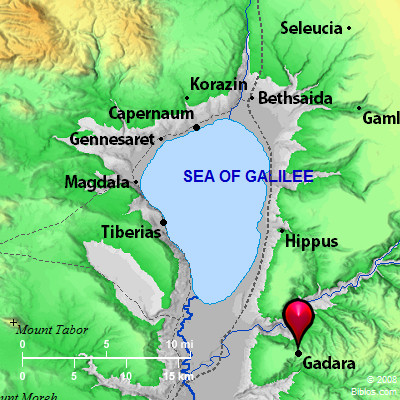
But this is a Bible study blog so if I may, I am going to give a few other things I have seen along the way. I will direct the study from Luke 8: 22 to 9:2 it is similar to Mark 5 and Matthew 8 but I like Luke because he had to “study to show himself approved” because he was “not around” like Matthew and Mark had been. Actually, Bible scholars will tell you that Mark wrote his book first and the other two followed and some argue that all three used a common undiscovered document. By the way, if you Google this topic be ready to be bombarded with all kind of things, the one that I found most amusing was the argument that Mark did not know his geography. Gee, he was alive at the time and had probably visited the region with his uncles when they were fishing. (Gerasenes is too far from the Sea of Galilee.)

The reason I start with Luke 8:22 is the phrase “one day.” It frames this as part of the story and the fact that they got hit with a storm as Jesus was about to do this great work is not surprising.  The thousands of whining demons, pigs near a kosher country and Jesus conversing with Legion I will leave those topics to your own Biblical beliefs and backgrounds; I want to focus on other things.

The people of the Gerasenes or the Decapolis were afraid and asked Jesus to leave which he did. I personally feel the reason that they wanted Him to go was that if He could do that miracle what He must be saying is real and they knew they would have to make a choice and a change.  They were probably not Jewish because it was a Roman area, like Lo Debar it was on the east side of the Jordan and perched on a hillside.  According to Wikipedia, it was a very secure place and one of importance.

Then there is Jesus’ reaction to the man’s request to go with Him; Jesus refused, yet in chapter 9 He sends out the Twelve. Jesus had a plan and it seemed that he could be useful for the Kingdom all on his own.

The map is from http://bibleatlas.org/gadara.htm or Biblos.com  if you have never used this website give it a look it is very interesting and useful.

Be Still and Know God

Waiting, being still what is the difference?

Remember that our modern English words don’t necessary translate nicely with Hebrew words.  Wait and being still are two words/phrases that can have several meanings and depending on your favorite translation of the Bible a verse may read different ways.  Wait can also mean hope so it will help how you view a passage if you look it up in your concordance.  “Being still” also has several meanings so if you find a verse you like check it out and see how it adds to your understanding.

Sometimes the Hebrew word for “still” can also be translated “wait.” That is why the Amplified Bible can be helpful, it will give alternate meanings to words. Anyway here are some different verses and there “be still’s.”

To “Be Still” means to stand one’s ground, confront, to stand before as in: I Samuel 12:16 – Now then, stand still and see this great thing the Lord is about to do before your eyes! (rain at wheat harvest when Israel wanted a king)

Exodus 14:14 – Do not be afraid. Stand firm and you will see the deliverance the Lord will bring you today.

To “Be Still” means to be still, silent, to rest as in: Psalm 4:4 + 5 – In your anger do not sin; when you are on your beds, search your hearts and be silent. Offer right sacrifices and trust in the Lord.

Habakkuk 2:20 – But the Lord is in His holy temple; let all the earth be silent before Him.

Jeremiah 23:18 – 22 Who has listened and heard His word? …. But if they had stood in my council, they would have proclaimed My words to My people and would have turned them from their evil ways and from their evil deeds.

To “Be Still” means to be quiet, hush or come to silence as in: Nehemiah 8: 10 + 11 – Do not grieve for the joy of the Lord is your strength. The Levites calmed all the people, saying, ”Be still for this is a sacred day. Do not grieve.

Zechariah 2:13 – Be still before the Lord, all mankind, because he has roused himself from His holy dwelling.

To “Be Still” means to be feeble, weakened, faint as in: Psalm 46:10 – Be still, and know that I AM God.  “Know” is yada it means knowing by observing and reflecting on things or by experiencing it.

In any of its meanings for me to be still is very hard; I try, sometimes I can do it many times I don’t.  For me anyway this is not meditation or musing over a thought this is just standing/sitting still and quite before God.  If you can really reach a time of being still you may find yourself like Oral Roberts in his book The Ultimate Voice (p. 101), “There was no moving of my physical body, only the wild beating of my heart.” 

All verses are NIV.