Reflections On The Resurrection #3 – Galilee

About Resurrection Day Mark and Matthew record that the angels reminded the women that the Disciples were to return to Galilee and that Jesus would see them there.  Matthew also adds in 28:10 that Jesus Himself told the women to relay that message to His brothers (disciples) and then in verse 16 he records that they meet Jesus at the assigned mountain.  WHY GALILEE?

The urgency with which Jesus and the angels told the women did not seem to be imparted to the disciples.  Those reminders were seemingly ignored as they hid behind locked doors and had dinner.  That has always puzzled me until I realized that they were celebrating the Feast of the Unleavened Bread which according to the Law is exactly what they were supposed to do.  They had not understood that Jesus’ death had fulfilled the Law.

These reminders came with the idea that Jesus had not only predicted His death but had made plans for His resurrection.  He even had named the exact location for this reunion – a particular mountain.

For the disciples Galilee was home, a familiar place where they would have felt safe.  This is where it had all started the feeding of thousands, walking on water, and all of the healings.  However it may represent a pattern of something that Jesus will sometimes do with His ministers before they are about to be sent out on their “Great Commission.”  This pattern is clearly set in the Old Testament and is now being established in the New.  It is going into the wilderness.

Jesus after His baptism went to the wilderness and Paul also spent time in one (Arabia) before he started his work for the Lord.  Old Testament examples would have been the Exodus and Elijah traveling to the mountain.  Another common factor here is the number 40 that is associated with a time of testing.

In the forty days from Easter to the Ascension Jesus met, taught, and fed His disciples.  Even though we do not know the sequence of the events John 21 is at the Sea of Galilee.  I will note here that the Ascension did take place near Bethany (House of Poverty) a short distance from Jerusalem so the disciples spent some of that time traveling out of the “wilderness.”  I have come to think of this as a “restart” and not a redo for the disciples as they had been prepared for their work before the Resurrection had started.

Reflections On The Resurrection #2

In the Resurrection what kind of body will we have? (1 Corinthians 15:35 NIV)

I have read this passage numerous times and never thought about it much until I read Chapter 16 in the C.S. Lewis’ book Miracles.  The Apostle Paul presents a clear argument that the body we now have will be changed when the trumpet sounds  (15: 51).  Lewis adds to Paul’s discourse by talking about Jesus after He came out of the tomb on Easter morning.  Mary and the other women did not recognize Jesus and thought He was a gardener until He called her by name.  The two disciples on the road to Emmaus walked with Him several hours and had their “hearts burning” as He spoke but did not recognize Him until Jesus blessed and broke bread.  The disciples at the Feast of Unleavened Bread meal thought He was a ghost even though He showed them scars and ate something.  Finally, Peter did not recognize Him when He was telling them about the fish until John told him “It is the Lord!” (John 21: 7)  A connection between all of these is that He had a changed physical body but retained His mannerisms: how He said, “Mary”, how He blessed a meal, and physical scars that were completely healed.  The accounts repeatedly tell of Him having a physical body or doing something that required a physical body.  The women held on to His feet, He could break bread, and He ate fish.

The_Resurrection016The earthly body that was sown as “seed” so He could become the “Firstfruit” on Easter was changed; it had a new “splendor.”  He had a “spiritual body” that was an improved version of His old one.  This sort of change is foretold in Daniel 12: 2+3 where Daniel talks about those who will “sleep in the dust” but “will shine like the brightness of the heavens.”

It also seems that He received new abilities with the new body.  He broke the bread in Emmaus and then disappeared (Luke 24: 31) and He “stood among them” twice in a locked room in John 20.  In Philippians 3: 10 – 11 Paul talks about the “power” that comes with the Resurrection.

Jesus physically returning as the Firstfruit and showing Himself to the disciples as foreshadowed in the Feast of Unleavened Bread and the Feast of Weeks let them know that there was a new power waiting for them.  After all, in John 11 Lazarus was raised from the dead as one of the Seven Miracles that were presented to prove Jesus’ divinity but his body was just brought back to life, no change was mentioned.

The Resurrection/new body is tied in with the tree of life from the Garden of Eden the references for this tree are Genesis 3: 22, Proverbs 11: 30, and Revelations 22: 2.  Adam and Eve missed the chance to have this change here on earth because they ate the wrong fruit but Jesus after missing several meals on Friday had a powerful snack before taking away the keys to Death and Hell from Satan and then showing Himself to everyone during the Resurrection.

http://clipart.christiansunite.com/1395484861/Easter_Clipart/The_Resurrection_Clipart/The_Resurrection016.jpg 

Reflections On The Resurrection #1

The Resurrection, Easter Sunday, the day that Jesus came out of the tomb but is that The_Resurrection015really what the Resurrection was to the early church?  C.S. Lewis in the sixteenth chapter of his book Miracles makes the point that the modern church may have that wrong.  Instead of five minutes or an hour or even until sundown the Resurrection is the forty-day period of time up to the Ascension.  Lewis says,  “It is not the action of raising from the dead but the state of having risen.”  This period of time is only lightly covered in the Gospels but has its foretelling in the Feast found in Leviticus 23 and Exodus 23.

Many people witnessed the Resurrection and their testimony on the topic was The_Resurrection014important in the Church.  It started with the women on the morning of the Lord’s Feast of Unleavened Bread and that of “Firstfruits.”  This was also the beginning of the Feast of Weeks, which ends in what we call Pentecost.  So following Paul’s list in 1 Corinthians 15: 5 – 8 and adding in the ones from the Gospels the appearances of Jesus during the Resurrection were:

  • The women (Mary Magdalene)
  • Peter
  • The disciples on the road to Emmaus
  • The Twelve (twice)
  • The five hundred
  • James
  • The other apostles
  • Paul

After the meetings with the Twelve they went to Galilee like Jesus had instructed them and they saw Him there on the mountain.  The story of Peter and the “great catch of the fish” (John 21) took place in Galilee but the Ascension happened near Bethany.  So it seems that the Disciples did a lot of traveling during this forty-day period.

I found that the two appearances to the Twelve in John 20 were based on the Feast of Unleavened Bread.  The first one would have been the start of the Feast and the second visit was the end of the Feast (Leviticus 23: 4 – 8).  The Disciples were observing the Feast and honoring their Jewish beliefs.

Pics from: http://clipart.christiansunite.com/Easter_Clipart/The_Resurrection_Clipart/index3.shtml 

Vision

Vision in the Bible has two means, the first is human sight and the other refers to prophetic messages.  The word chizzayown (Strong’s 2384) is one of the Hebrew words for prophecy especially if it is delivered through dreams.  Just for the record there are other words that are used for messages from God through dreams.  Chizzayown is used nine times in scriptures.  It is used the most in the book of Job but this study started in Isaiah 22 where Jerusalem is referred to the “Valley of Vision.”  Only two of the nine are actually messages (visions) while the others talk about who, what, and how of a vision.

VALLEY OF VISION  Isaiah 22 carries a message of destruction, not because Jerusalem did not prepare their defenses to defend the city but because they did not seek God and repent of their sins.  Instead they threw a party and said, “Let us eat and drink for tomorrow we die (verse 13).”  Once again Jerusalem choose to ignore God even though they had been told the problem and that destruction was coming.

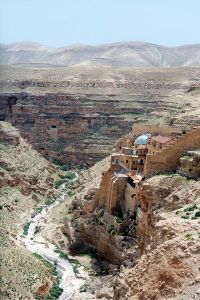
MarsavaThe word here for valley is gahee and its root word means arrogance and pride.  It is a very steep-walled valley and would present a formable challenge to either climb up or down.  Where you are in this kind of valley certainly would influence your thinking about the circumstances you are in.  If you are at the bottom of a gahee the thought of climbing out or up those steep sides would be daunting.  The reverse is true if you happen to be at the top of the valley defending your position; it would be easy against anyone trying to come up the sides but I would not want to have to escape by climbing down those cliff walls.  (See Valleys)

Being called a “Valley of Vision” is an indictment against them because by Mark’s Translation it would be a “Steep Arrogance From Dreaming Up a Prophecy.”

THE TWO VISIONS  Only twice does chizzayown actually relate a vision.  The first time is in 2 Samuel 7, Nathan got the word at night (v.4) and it is referred to as a revelation in verse 17 (NIV).  This word is telling David he will not build the Temple and that his family would endure as rulers of Israel.  The second vision is a satanic vision that was given to Eliphaz in Job 4:17 – 21.  It really dictates the conversion in the rest of the book and is even quoted again by Bildad in Job 25:4 – 6.  Vine’s Dictionary comments that it was just an ordinary dream but I think it is clear that it had a spiritual origin just the wrong spirit.

VISION IN JOB  Even though Eliphaz’s vision dominates the dialogue it is Elihu (33: 14,15) who actually defines and tells us about chizzayown; it is God speaking to man through a vision of the night.  The other two uses are Job telling about terrifying visions (7:14) and Zopher (20:8) talking about the fleeting nature of night visions.

ASHAMED AND A PROMISE   The other times chizzayown is used is in Zechariah 13:4 when prophets will be ashamed of their gift because of the spiritual cleaning the Lord will do.  The last use is a promise in Joel 2:28 that when the Spirit is poured out in the last days that young men will have visions.

Valleys

In Christianese (yes, we have a language) mountains and valleys carry a lot of symbolism.  I have heard sermons where valleys are hard places to be but a mountaintop is a place of freedom.  Then other ministers will tell you that valleys are where you grow and that it is a struggle to go over a mountain.  I suppose in our Christian walk we are always going through valleys and over mountains or in non-Christianese you will have your good times and your hard times.

I was reading Isaiah 22 and Jerusalem was referred to as the “Valley of Vision.”  The picture that is painted in Isaiah 22 is not a nice one and the “Valley of Vision” term is obviously not a compliment.  But it made me wonder about the meaning and types of valleys and visions that were being talked about.

In my Strong’s Concordance, there are five terms for valleys but only four of them are used in Isaiah.  Shephelah (8219) is the one not used and it refers to the Judean hill country.  The other four are emeq (6010) and it is a vale or broad depression,elahvalley-from-azekah-t2 wadi (5158) this has a seasonal stream that flows during the rainy season, gahee (1516) is a gorge with lofty sides, and a biqah (1237) is a wide level valley between mountains.  In Isaiah, the gahee and wadi carry negative things with them while the emeq and biqah are places that are valued or are at least have a positive context.

The Valley of Vision is a gahee and its root word is gevah (1466), which means arrogance or lifting up with pride.  While watching an IMAX movie about Jerusalem they showed a version of this picture and I knew that must be a gahee. Marsava

Imagine standing at the bottom of the gahee looking up, I can see why the root word deals with arrogance and exaltation.  It would take serious skill and desire to climb out of that valley.

Vision in the phrase is chizzayown (2384) and refers to prophesy.  It is used nine times in Scripture and one of those is Joel 2: 28 were young men will see visions.

Other references of valleys in Isaiah:

  • Emeq – 17:5, 22:7, 28:21, 65:10
  • Wadi – 7:19, 57:5
  • Biqah  – 63:14, 41:18
  • Gahee – 22:1 +5, 28:1 + 4, 40:4

So the next time someone starts talking about being in a valley ask them what kind?

gahee – http://en.wikipedia.org/wiki/File:Marsava.jpg ,  the wide valley http://ferrelljenkins.wordpress.com/2008/08/22/the-valley-of-elah-and-the-shephelah/  This blog is excellent and Ferrell Jenkins is an excellent photographer, you should take a moment and check out some of his other blogs.