Joel – Valleys (What they say about the End Times)

Part of the judgment/restoration prophesies in Joel deal with valleys.  The word “valley” occurs five times, but they come from two different Hebrew words: emeq and nachalahNachalah means a narrow valley and is associated with the “winter rains” and the wadi the water flows in. It is used once in Joel.  Emeq is a broad valley or vale, this word is used four times.  The different valleys are part of the metaphors that God uses to speak the truths He wants us to see about Him, so being able to visualize these landforms is important.  (See the post Valleys.)

Given the intensity of Joel’s prophesies my mental image of the valleys has been a rough place with steep sides.  So it did surprise me to find that the valley of Jehoshaphat and the valley of decision were emeq.  Now my mental picture is a place that can hold many people, and you can get into it easily (or out of it easily).

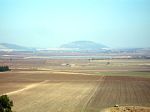
The first two uses (3:2, 12) of emeq are the Valley of Jehoshaphat which means the valley of the Eternal Judge.  In both of these, He is commanding the nations into the valley to be judged.  Several sources will note that the locust in the first part of the book could represent nations or that the nations will be like locust.  There is a valley near Jerusalem that is known by this name.  But given other prophecies and the history of the land, you would think of the valley of Megiddo.220px-jpf-jezreel_valley_and_mount_tabor
Emeq is also used in 3:17 where it is the valley of decision.  Decision in Hebrew is the word charuts.  Again my paradigm did not cover the many uses of this word.  This word is translated gold, diligent, sharp cutting objects, and refers to a wall.  Most of the uses of charuts as “gold” are in the book of Proverbs: 3:14, 8:10 & 19, and 16:16.  In these verses, they are associated with wisdom and knowledge.  When translated “diligent” it is also in Proverbs: 10:4, 12: 24 & 27, 13: 4, 21: 5.  In these verses, it is associated with wealth and valued possessions.  When it is translated as “sharp objects” it refers to threshing or harvesting implements and how the work is being done.  Daniel 9: 25 has it as a wall that will be finished in a time of distress.

All of these different uses challenged what I thought people would be deciding about; I assumed it would be to choose God or not.  Even though I still think this; I now see the reasons they are in the valley choosing.  People will be in the valley choosing between God and money, God and their knowledge, God and destruction (getting cut down), and/or God and their man-made walls/excuses. This is where the type of valley (emeq) becomes important; it will be easy to get into that situation, but it will be just as easy to get out of it.  Joel 3: 14 says “the Lord” will be heard sounding the coming judgment, but that He will be a refugee and stronghold for His people (Israel = those who have struggled with God).

The promises of the last five verses in Joel also center on a valley – Nachalah.  It is called the valley of acacias which is a thorny plant that grows in places where it seldom rains but when it does it is a flash flood.  The promise is that this rough place will become a blessing by a continual flow of water (Holy Spirit) from the throne of God.
https://en.wikipedia.org/wiki/Tel_Megiddo

The Number Seventeen in the Bible

Seventeen as a number is used sixteen times in the KJV; six of those are associated with the numerical list of people, two have a positive inflection, and eight have a negative association.  Five of the negative associations are connected with rulers of the land.  The seventeenth letter of the Jewish alphabet also has a connection with a leader of Israel.

Peh or Fey is the seventeenth letter of the Jewish alphabet.  In the Hebrew numbering system, it is the number 80.  Peh is associated with the mouth and the power of speech.  This reminds us of the power of our words for both good and bad.  Moses is the leader that ties these thoughts together.  According to some teachings he was 80 years old when he was given a “new mouth” to speak with. (He stuttered.)

The two positive references are Genesis 47:28 and Jeremiah 32:9. These show God’s provisions and mercy for believers.  Jacob lived in Egypt and was taken care of by Joseph for 17 years before he died, he never thought he would see the day.  Jeremiah paid 17 units of money for a field while Jerusalem was being attacked; it was to show the people that there would be a positive end to the situation.

The first two mentions of 17 are the starting and stopping of Noah’s Flood (Genesis 7 + 8).  This is when God was cleansing His world from the evil that was running rampant.  Using the lunar calendar (30 days to a month) they are 150 days apart.  Joseph Prince in his devotional book (July 25) states that the seventh day of the seventh month became the day Jesus rose from the dead during the Feast of Firstfruits. The next use of 17 is Genesis 37:2, it is the age of Joseph when he spoke out against his brothers; they plotted evil against him (this did turn out for good).  He was a prisoner for thirteen years before he became ruler of Egypt.

The other five references to 17 all involve kings/rulers and are either how long they have reigned or connected to when they began.  The rulers are Rehoboam, Ahaziah, Jehoahaz, Ahaz (Pekah is the reference).  They are in the Kings Timeline post.

http://www.hebrew4christians.com/Grammar/Unit_One/Aleph-Bet/Pey/pey.html

http://www.walkingkabbalah.com/hebrew-alphabet-letter-meanings/

Samuel – Saul’s Servant

The unsung hero in the story of Samuel and Saul is the servant.  I am pretty sure I have never heard a sermon about his role in the crowning of Saul as king.  He is never named and only referred to as a servant (na ar).  He had a “God part” to do and did it well.  He is easily compared to Ananias (Acts 9) in the story of Saul the Apostle.  He did the job that needed to be done and was never heard of again.  Na ar is mentioned nine times before Saul’s signs and only once after them.

In the Strong’s/Vines Concordance the first definition listed is probably not the description of this servant.  I think he would have been younger than Saul but not a boy.  He was certainly trusted and displayed knowledge of his physical surroundings.  He was also spiritually aware because he encouraged Saul to “see the prophet” when he was ready to go home.  He had brought his own money, and was willing to use it to resolve the “donkey problem.”  He was obedient and loyal to Saul and followed Saul’s leading when the uncle asked about Samuel.

He was honored at the sacrifice because he got to eat with Saul in the main room.  But he was not allowed to witness the actual pouring of the oil.  He would have seen the results of the anointing because the oil would have been all over Saul’s head.  He observed/witnessed the three signs and I cannot believe Saul was not talking about them as they went.

God used an unnamed servant to affect the history of Israel; sometimes we have to do things “just because.”  It turned out well for him.  Who knows maybe he was Ziba the servant in 2 Samuel 9 who did play a part in the life of lead and the story of Lo Debar.

Samuel and the Priest

One aspect of the story of Samuel that has always made me curious was the Levitical priest.  Samuel may have been “adopted” by Eli, but he was from the wrong Tribe.  He assumed the role of prophet and clearly was a judge (leader of Israel), but he could not be a priest.  Eli and his sons died on the same day, so that left his grandsons.  They would have needed to be trained.  I had written in another post that Samuel may have done this, but I had not counted on the other part of the family that had gone very quiet.

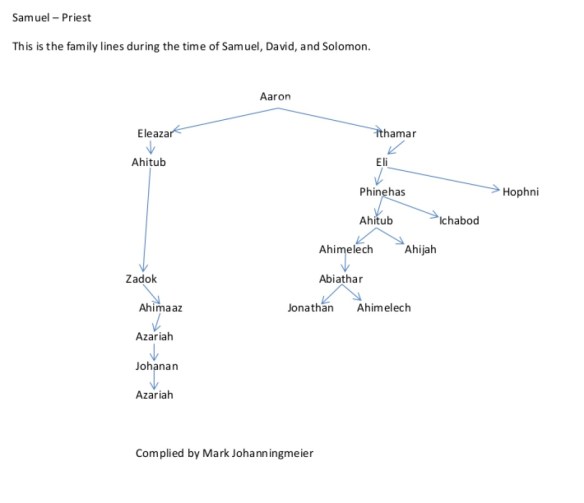
Aaron had four sons during the Exodus.  The first two died because they did not have proper respect for God.  That left Eleazar and Ithamar.  Eli was a descendant of Ithamar.  Eleazer’s side of the family had “disappeared” for some reason.

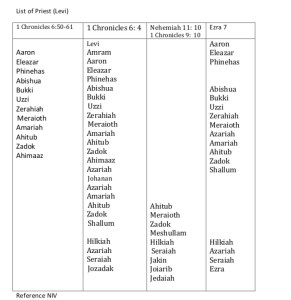
Eli’s side of the family was removed from serving as a priest by Solomon.  The two graphics show the list and the family tree of Aaron’s sons.  I used the NIV and various concordances to make the list.  The websites will help with further study.

samuel-list-of-priest

.

samuel-list-of-priest-2

https://en.wikipedia.org/wiki/List_of_High_Priests_of_Israel#/media/File:Kohanim.jpg

https://en.wikipedia.org/wiki/High_Priest_of_Israel

https://en.wikipedia.org/wiki/List_of_High_Priests_of_Israel

Samuel – Saul, and the Signs

Background

Saul’s anointing in 1 Samuel 10 follows a pattern that can be seen in the lives of other leaders.  There is a calling followed by a physical anointing/visitation, that is confirmed by “signs” with the person doing the job they have been called to do.  The reason I say “a pattern” is that every step may not be recorded in Biblical text or at least a matter of discussion between friends.  God also can individualize the pattern to fit the person and situation.  I can see this pattern in the lives of Moses, David, Samuel, and others.

Like an onion, this story has several layers that can be viewed, but all of them are presented as one solid story.  Josephus and Matthew Henry were used in this study and they exposed layers in this story that I had not noticed.

I have said before the anointing of Saul was a “faith-building situation” for the old prophet Samuel.  Samuel’s “building” part started the day before Saul arrived in his town.  (NOTE: Many of the places in chapters 9 and 10 are unknown.  It would be fun to be able to follow Saul’s exact footsteps but that is not a reality.)  If this was Samuel’s hometown, this took place in Ramah.  Most maps put this in southern Benjamin near Jerusalem.  So for the Lord to say, “I am sending you a Benjamite” could be viewed as vague.  Samuel took this information and reserved a “royal” portion of the meat; he also knew about the donkeys.

I think these “words” were also given for building faith in Saul, in order to prepare for the anointing the next day. How specific the “words” were is a reflection of God trying to build up Saul, who may have been a little weak in his understanding of God.  I say this because of his need to “reward” the prophet for his time, the timing of when he calls for a fast, and his need to do the work of Samuel with respect to the offerings.

After the physical oil was poured on Saul, he was told that three very specific things would happen: at Rachel’s tomb he would get news of the donkeys, he was required to take bread, and that he would join in the activities of a group of prophets.  I wonder if 10:8 was not a fourth thing that needed to be done.  Verse 7 and 9 talk about his heart being changed before the trip to Gilgal could take place, and some resources put this reference to another time.  Gilgal was where Joshua circumcised the men before the conquest of the land could begin.  The “seven days” may represent the work/rest cycle (Genesis and the Law) before the new time in Israel’s history was to begin.

First Sign – verse 2  This sign has several interesting layers.  Saul being a Benjamite and starting at Rachel’s tomb begins the symbolism.  Benjamin was the thirteenth child of Jacob/Israel and the second child of Rachel.  The only child of Jacob born in Canaan and this tomb was the starting place of the Tribe of Benjamin.  Zelzah may mean “a cover for his bright spot”, and its exact location is unknown, the text is also rendered “south border.”   There is a traditional Rachel’s tomb near Jerusalem.  This was Saul’s “pull back” to “present problems.”  The men confirm Samuel’s word that the donkeys were found, but that Kish was worried about him.  Saul and the servant may have been gone for a while because it would seem they went north, came in a large arc to the south covering a lot of territory.  Family is the theme that unifies the first sign. This includes past and present.

Second Sign – verse 3 and 4  Saul and his servant were moving toward home.  The next place they were going was the “great tree of Tabor.”  Tabor means brokenness; this shadows Jesus on the cross. Here he would meet three men going to the House (Bethel) of God.  What they are carrying (young goats, bread, and wine) indicates these would be an offering.  Saul was to accept part of their offering; this is stated in such a way as to suggest he might have refused it.  Again there could be several things here that God is working on.  First, it was an immediate provision for them to finish their journey.  Second, pride could have been a factor; in taking the offering it was doing a work in him.  Also, it would seem that God was willing to share His offering with them.  The theme here is a personal work done in Saul.   

Third Sign – 5 to 7 The two wanders move now to Gibeah of God.  Gibeah and several variations refer to “hill.”  Here at Gibeah Saul is to meet prophets and join in the prophesying. Samuel tells him that he will be changed as he prophesies because of the Spirit of the Lord.  He is now ready (supposedly) to act as king.  There is still some narrative before he is introduced to the people in verse 24.  The sign’s theme is spiritual change.

Observations – 1.  The Philistine outpost on or near the Hill of God should disturb us.  They let God’s people worship and did not try to stop them, but they were still in charge and keeping an eye on them.

  1. People noticed the change. Saul’s uncle was curious.  Both Josephus and Matthew Henry comment on this and Saul’s incomplete answer; they feel that if he had told what happened, jealous and ill feelings would have started in the family.
  2. Saul did continue to prophesy. 1 Samuel 18: 10

4. His hiding in the baggage could be seen as him going back to the “old Saul.”