
Josiah’s Generation, His Legacy, and The Day

Josiah’s actions of cleansing the Land and the Temple, his Passover celebration, the legacy of prophetic ministries from his reign, and their relationship to “The Day” talked about by earlier prophets are acts of major significance.  This “breath of fresh air” in the family of David was God’s attempt to let Judah repent and put off the cleansing of the Land that had to come.

His importance was announced many years before his arrival in 1 Kings 13:2. This was a time of spiritual darkness when Jeroboam had divided Israel and was replacing Jehovah with man-made images.  An unnamed prophet came out of Judah, and prophesied the birth of Josiah and the destruction of Jeroboam’s altar; this story is finished in 2 Kings 23: 15 – 17.

Josiah’s shining light comes between two really dark chapters in the history of God’s people.  Manasseh and Amon took evil and ignoring God to the lowest point for Judah.  Then Josiah’s sons and grandsons ignored the reforms he made, inviting destruction of the Day for Jerusalem.  Jeremiah endured this abuse and had Burach chronicle it, Ezekiel and Daniel were also witnesses of this unfaithfulness of Judah and Israel, only they were in Babylon.

Imagine the voices trying to speak into his life at eight years old when he became king.  At sixteen he personally starts seeking God.  The amazing thing about this is that he had no scripture to refer to, I wonder if he knew of the prophecy during Jeroboam’s reign.  At twenty he started purging the Land, some areas were not in Judah.  After cleansing the Land, he turns to the Temple and orders it cleaned and restored; then the Law is given to him, and he realizes how far from God they have been.  This in turn forces him to find Huldah that leads him to celebrate Passover.

Points of a Josiah Generation

  • Josiah sought God. This in itself is not a grand idea, but the term “of his father David” clarifies exactly Who he sought.  It was not the current version or idea of God, but the God that helped David through the trials and hardship he endured, the God that showed Himself faithful.
  • Josiah physically removed and destroyed things that were offensive to God and hindered the mindset of Judah. In 2 Chronicles 34, the list of things that he destroyed was impressive.  I am certain that there was crumbling and opposition to this work; they were probably expensive and many of the people had grown up with these altars, images, and the “religious” activities that were associated with them.  WARNING: He took care of what he was responsible for!  He did not go into Moab, Edom, or Ammon trying to clean them up, he took care of what God had given the people of Israel.
  • In 2 Chronicles 34: 8 he knows there is another level that he has to go to. He turns to the “church.”  Things inside his worship house had been neglected and were broken.  An important point here is Josiah empowered the people to do the repairs and many/most were worshipers (vs. 12).  Verse 9 tells where the funds came from, the descendants of Judah and Rachel are listed by name, but other Tribes/people also gave!  The named tribes are the chosen first-born (Judah) and the heirs of the “loved wife” (Joseph and Benjamin).  Jesus has the people and the resources to fuel the revival that will happen before the “Day” arrives.
  • All of this leads to the “Book” once again being allowed to direct the people of God. PROVEN prophets of the Lord once again are consulted and the Lord speaks through them.
  • Josiah’s Passover symbolizes the revival that many are expecting to occur, but it came after a considerable amount of effort and actions.

SPOILER ALERT – Once Josiah was gone things came undone very quickly!  The offspring of the revival ignored God and twenty-two and a half years later Jerusalem was in ruins and the Land was getting to rest!
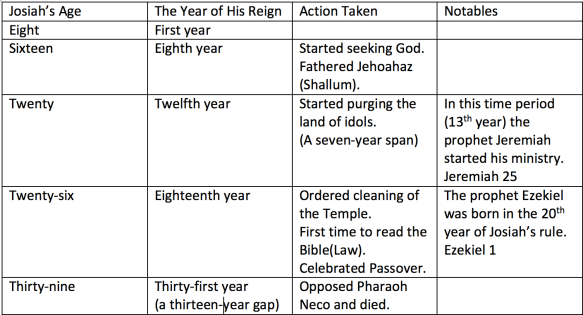

A Josiah Generation from His Numbers

In the post – Josiah by His Numbers I listed Josiah’s life and the numbers that are given in Scripture.  The numbers are found in both 2 Kings and 2 Chronicles, God repeated Himself, so you know they are important.  There is much written on numbers, there occurrences, uses, and meanings on the internet, be careful as some sites don’t always glorify Jesus.

  • Seven is a number showing completion, it also carries covenant context. Josiah took seven years to clean the idols and other pagan influences of Judah and Israel.  it probably took that long because the people and leaders seemed pretty comfortable with idolatry and keeping the Lord as a figurehead.
  • Eight – Eight is referred to the number of new beginnings, I have often felt this is because of Genesis and the days of creation. In Josiah’s life, eight signals a “new” of something that had or should have been going on. His “eights” are the beginning of his reign and him starting to seek God. The “seeking God” is impressive because he had no copy of the Law, it was given to him ten years later (also the number of Commandments).
  • Twelve (apostles) is associated with leadership. His twelfth years as a ruler is when he started taking control and clearing out pagan worship.
  • Thirteen (see my post of 13) is the start of something new. Not recycling or restarting, but brand new.  Jeremiah started his ministry in the 13th year of Josiah’s reign, and they celebrated the Passover (implied) until Josiah died.
  • Sixteen – In my post on sixteen, it seems that it was associated with the “eye of God” keeping watch. Josiah starting to seek God at sixteen fits that thought well, God was keeping his eye on him.
  • Eighteen is a number with a lot associated it with (See Eighteen in the Bible), but it representing fullness makes the most sense to me. In Josiah’s life, it was the eighteenth year when his campaign to up Judah came to its “fullness” with the finding of the Law and Passover celebrated properly.
  • Twenty –Josiah’s waited until the age of twenty to start his battle against pagan influences.  This corresponds with two themes of twenty in the Bible.  Jacob waited/served twenty years to get his wives, children, and flocks.  Young men entered military service at twenty.

Josiah By His Numbers

I like 2 Chronicles 34 + 35 for Josiah’s life story, 2 Kings 22 is the other reference about his life.  They are basically the same but they were written for different audiences.

I have done several posts about numbers, so I will refer to them.  The numbers do highlight the prophetic nature of Josiah’s life.

Josiah’s Children

Josiah’s heirs are the last kings of Israel before the Exile. They are integral parts of the story that lead to the judgment of Jerusalem and then its rebuilding. They are mentioned in several books including 2 Kings, 1 + 2 Chronicles, Jeremiah, and time stamps put them in Daniel, Esther, and Ezekiel. There is an interesting 3 months/11-year cycle that is mentioned (twice) with these men concerning their times as rulers.

Johanan/Jehoahaz – When Josiah died the people made Jehoahaz king. He lasted three months when Pharaoh Neco came in and took him to Egypt where he died. 1 Chronicles 3:15 states he was Josiah’s firstborn. 

Eliakim/ Jehoiakim – Pharaoh was in charge of Israel, again! In reality, Israel was once again “slaves” of Egypt.  Neco showed his power by removing the king of “the people” and putting in one of his choosing.  In another show of power, Neco changes the king’s name. Eliakim (God establishes) was changed to Jehoiakim (Yahweh lifts up or establishes). He rules 11 years.

Jehoiachin/Shallum – Jehoiachin means “Yahweh supports” and it shows.  His rule started when he was eighteen and it lasted three months.  He was taken to Babylon and stayed in prison until he was fifty-five years old. This fulfills Jeremiah 22:11. The reason he is so important, he is the grandfather of Zerubbabel. Kings and Chronicles don’t give much about him, so read Jeremiah 22:24 – 30.  Then temper this with Haggai 2:23.

A signet ring lost and then restored.  Jeremiah 23 then talks about The Branch and this theme is repeated in Zechariah 3:8 (which is in the time frame of Haggai).  Jeremiah 24 completes the Lord’s thoughts about him and the other exiles.  If you only read Jeremiah 22 it is easy to get the impression that God “hates” Jehoiachin; actually, God did him a favor by bringing them out of Jerusalem. 

Zedekiah/Mattaniah  – Jeremiah tells Zedekiah’s story, he is mention frequently starting in the 21st chapter until the end of the book. (be careful there are other Zedekiah’s mentioned) He is the embodiment of the spiritual attitude of Judah at that time; at times he is seeking God, sometimes protecting Jeremiah, and then ready to give him to up to be abused.

His reign as king mirrors his spiritual life.  He accepts Babylon, he rejects Babylon and tries to come under Egypt; he just makes bad decisions.  So, he lasted eleven years and came to a bad end.  He had to watch his family die, and then his eyes were blinded.

Shallum | The amazing name Shallum: meaning and etymology

The family stories/trees are in 2 Kings; 2 Chronicles 36; 1 Chronicles 3:15-16; Jeremiah 22:11-30, 24:1-10, 25:1-3, 52:1-11 and 31-34; and Matthew 1:11-12.  

2 Kings 23 – 25

  1. Jehoahaz 23 yrs. old, ruled 3 months the people put him as ruler went to Egypt and did not return;
  2. Jehoiakim/Eliakim 25 yrs old, ruled 11 yrs;
  3. Jehoiachin son of Jehoiakim 18 yrs old, ruled three months, went to Babylon with his mother, lived out his life there (Jer. 52, 2 Kgs. 25:27);
  4. Mattaniah/Zedekiah he was Jehoiachin uncle (Josiah’s son) he was 21 yrs old and ruled 11 years. Do the math he was 9/10 yrs old when Josiah died or Jehoiakim was 4 when he birthed him.

2 Chronicles 36 These are changes from 2 Kings

  1. Jehoahaz/Joahaz;
  2. Jehoiakim;
  3. Jehoiachin – NIV footnote, some manuscripts have eight yrs old;
  4. Zedekiah – NIV footnote Hebrew may indicate brother.

1 Chronicles 3:15-16

1599 Geneva Bible – 15 And of the sons of Josiah, the [a]eldest was [b]Johanan, the second Jehoiakim, the third Zedekiah, and the fourth Shallum.

16 And the sons of Jehoiakim were Jeconiah his son, and Zedekiah his son.

  1. 1 Chronicles 3:15 So called because he was preferred to the dignity royal before his brother Jehoiakim which was the elder.
  2. 1 Chronicles 3:15 Or, Jehoahaz, 2 Kings 23:30.


NIV 1 Chronicles 3:16 Hebrew Jeconiah, a variant of Jehoiachin; also in verse 17

These are from BibleGateway, which is a big help.

Baruch, Jeremiah’s scribe, is the traditional writer/compiler/editor of the Books of Kings. Ezra the priest/scribe is noted for the same thing with the Books of Chronicles. They did not make it easy for our western minds and sense of order. I have heard rigid rules about the oldest male child/first-born, and who gets listed first in a family tree. Yet there are examples where those things are changed. Josiah’s heirs (children) seem to be an example of not fitting into “the norm”.

Jeremiah 21:1 – 22:9 Is against Zedekiah.

Jeremiah 22:10-30 – Verse 10 seems to be an introduction and 11 is about Shallum who will never return or see Jerusalem again; if this is Jehoiachin he was “just” exiled. Is 11-17 an introduction to Jehoiakim in verse 18, he had 11 years to build his palace? (Cedar probably came from Lebanon. David and Solomon had a “Palace of Lebanon” cedar.) Verse 24 talks about Jehoiachin who went to Babylon with his mother and never came back, but his heirs became governors in Judah. Mary’s line is through Nathan another son of Bathsheba, fulfilling the promise to David. The text goes to the prophecy about Jesus, the righteous Branch, Jeremiah 23.

Jeremiah 24:1-10 – Jehoiachin (he ruled three months) and the exiles are the good basket of figs and Zedekiah and those in Jerusalem are the bad figs.

Jeremiah 25:1-3 is a timestamp with Jehoiakim as a reference point for twenty-three years. Remember he ruled 11 years.

Jeremiah 52:1-11 Zedekiah died in Babylon at 31 years of age; he ruled 11 years.

Jeremiah 52:31-34 Jehoiachin is released from prison and lives a “good” life under Evil-Merodach.

Matthew 1:11-12 11 And Josias begat Jechonias and his brethren, about the time they were carried away to Babylon:

12 And after they were brought to Babylon, Jechonias begat Salathiel (KJV). Jechonias is Jehoiachin.

Age order seems to be: Eliakim/ Jehoiakim, Johanan/Jehoahaz, Jehoiachin/Shallum, Zedekiah/Mattaniah 

In my opinion the order of importance is the reverse of 1 Chronicles 3: Jehoiachin/Shallum, Zedekiah/Mattaniah, Eliakim/ Jehoiakim, Johanan/Jehoahaz 

Answer to RZ

Thanks for the question. If you reread the post, you will see I changed it. (So, to the other readers RZ statement may be strange, but it was a great question.) I did account for all four names and in doing so I realized I goofed. In Jeremiah I saw a footnote (NIV) and they identified Jehoahaz and Shallum as being the same person. That should be challenged, it makes more sense that the prophecy refers to Jehoiachin who goes on to produce offspring to continue the royal line of Solomon. Jeremiah 52 talks about his release. 1 Chronicles 3:16 (NIV) has the term successors. Another note that is hard for me at times is the Hebrew word for male family member, it can be translated brother or uncle.

Thanks for the catch and I hope I fixed it.

Mark    

The Number Eighteen in The Bible

The study of the number eighteen in the Bible has proven to be more than I expected!  There are many thoughts about this number, most are very surprising. I feel that eighteen compares with thirteen when it comes to alternate and veiled meanings. Some Jews view it as a very lucky number, while Nazis use it to commemorate Hitler; there are many other opinions held about this number.

When things are studied in the Bible the first use of the word is often important and lends a shadow to the use of the word from then on.  Many times, I feel that is very cut and dry when it comes to the meaning(s) of the word.  Eighteen is one of those words.  The first two times eighteen is used is in Judges and both of these verses deal with the length of time that a foreign king oppressed the Children of Israel.  Many sources will tell you that eighteen is the number of bondage in the Bible. That is a limited scope of the number; as I reflected on Judges 3:14, 10:8 and Luke 13:11 and 16, I could see this as the length of time that they were held in bondage, but it is also when they were set free from the bondage. So, to start this study I will start with an example of eighteen that shows another side of the word.

Solomon’s Pillars

When Solomon built the first Temple he commissioned two pillars to adorn the front entrance.  The first reference to these huge bronze structures is in 1 Chronicles 27:9; this does not talk about the pillars but the bronze that would have made its way into them, eighteen thousand talents given by the leaders of the people.  1 Kings 7:15 is the description of these two pillars when they were made.  The final reference to these pillars is found in Jeremiah 52:21 when they were taken apart and looted by the Babylonians.

Between these two references, we get an impressive amount of information about these two eighteen cubit high guardians of the Temple.  Solomon even named them, the one to the south was Jakin (he establishes), the other one on the north side was Boaz (in him is strength).  Imagine the events and history that took place around them and the impression that they had on the worshippers that attended the Temple.

These “eighteen” references to the pillars do not deal with bondage but with the idea of the components of the words that make-up eighteen.  Eight is “more” than the perfect of seven and the “teen” part refers to ten which in part is related to “tithe.” (See Ten in the Bible.)  Strong’s/Vines paints the idea of “plumpness” or beyond enough that is God’s.

Meaning of Eighteen

Jews may hold eighteen as a lucky number; the reason is the numerical value of the two words that make up eighteen: chet and yod, these two together spell the word chai or life http://www.myjewishlearning.com/article/judaism-numbers/

Josiah’s Eighteenth Year

2 Kings 22: 3 + 23: 23 and 2 Chronicles 34 + 35

Josiah was the last king to do right in the ways of God before Jerusalem was exiled.  His father and son did not follow God.  He came to the throne at eight years of age (children will rule over you) but set his heart on God.  Hilkiah, a forefather of Jeremiah, was the High Priest.  Josiah’s eighteenth year of reigning was busy because he had ordered the Temple cleaned and when it was purified he ordered Passover to be celebrated. This is another example of God’s fullness and the people being freed to worship and follow God. I don’t do this very often but “Josiah’s Generation” is the type and shadow for the last great revival before the end of this age comes.

Time Markers or God Sending a Message

Nebuchadnezzar’s Eighteenth Year

Jeremiah records two things that happened during Nebuchadnezzar’s eighteenth year.  The first one is in Jeremiah 32:1 where God instructs Jeremiah to buy a field, as a sign that life would return to normal. Verse 26 starts the rest of the story; God tells Jeremiah that He has every intention to destroy Jerusalem and it will happen.  The second event is found in 52: 29, this is the number of people that were carried into exile that year; this follows the story of the destruction of the Temple and the pillars.  Nebuchadnezzar was God’s appointed instrument to free the land from the people so it could have its Sabbath rest.

The End of Bondage

Many studies helps/websites declare that eighteen = bondage, I will say it again, it seems to me that it signals the end of bondage.  Judges 3:14 and 10: 8 both tell a story of Israel messing up and being in bondage until eighteen years have passed when God appoints a Judge to free them.  Luke 13: 11 is the story of Jesus healing the woman on the Sabbath, to show the Pharisees that their thinking had the people bound.  Verse 4 also mentions eighteen people who died when a tower collapsed on them, just because they died that way did not make them sinners.  It seems by the text that people were passing judgment about these people because of the way that they died. (It is bad luck to be superstitious.)

David

2 Samuel 8.13 and 1 Chronicles 18.12 tell the story of David/his army defeating 18,000 Edomites.  A strange note in Samuel said he became famous after this victory even though the preceding twelve verses tell of much larger and very powerful enemies that fell to David. It would be a hard push to make a lot of this just because it has an eighteen in the verse.  But Edom was an enemy and it seems that there was some level of freedom associated with the victory. A more notable thing happened after this, David renewed his interest in Jonathan and found Mephibosheth at Lo Debar.

Benjamin and Israel

This story at the end of Judges (20: 25 and 44) is a tale that lets you know the Bible is real.  It does not show-off victories but shortcomings.  It’s eighteen “connection” is the 18,000 warriors that fell on both sides; the totals for the war were lopsided and more than just 18,000.  It would seem God had had enough, and the message to the nation was that neither side was right.  This “purging” seems to have brought about a revival and soul-searching in Israel.  This story is important in the life of King Saul and his acceptance in Israel.

Time Markers????

There are three “eighteens” that appear to be time markers for the beginning of kings starting their reigns: Abijah in 1 Kings15.1 and 2 Chronicles 13:1; Jehoiachin in 2 Kings 24.8 and 2 Chronicles 36: 9; 3.1; Joram in 2 Kings 3: 1. Honestly, it took me several “does this have any meaning” sessions before I got this.  With Abijah and Joram it was not about them but the “other” king they interacted with.  Abijah defeated Jeroboam, the man who broke up the twelve tribes into two kingdoms and started serious sins in “his” ten tribes.  Joram got Jehoshaphat to go with him to fight Moab; it was a lesson for Jehoshaphat and Elisha.  Jehoiachin started ruling at eighteen and he was born when his father was eighteen years old.  The best I can give you in each of these stories is that a “fullness” in God’s timetable had occurred and a lesson was taught or something ended.

The other “eighteens” are just a number position of a person in a list and that King Rehoboam had that many wives, which may lend to a “plumpness or fullness” or that the man was a glutton.

God put and uses numbers to help teach truths!  Sorry, I just cannot associate them as “lucky, blessed, or cursed.”  Worship Jesus, not numbers!  Again, I will say the number eighteen is complex in its uses and associations; freedom from bondage, bondage, or a “fullness” occurring.  There many other “eighteens” that people have found in the Bible.  I think most of them will fit into one of these associations.

See the study on the Number Nineteen in the Bible