Reflections On The Resurrection #2

In the Resurrection what kind of body will we have? (1 Corinthians 15:35 NIV)

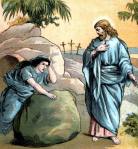
I have read this passage numerous times and never thought about it much until I read Chapter 16 in the C.S. Lewis’ book Miracles.  The Apostle Paul presents a clear argument that the body we now have will be changed when the trumpet sounds  (15: 51).  Lewis adds to Paul’s discourse by talking about Jesus after He came out of the tomb on Easter morning.  Mary and the other women did not recognize Jesus and thought He was a gardener until He called her by name.  The two disciples on the road to Emmaus walked with Him several hours and had their “hearts burning” as He spoke but did not recognize Him until Jesus blessed and broke bread.  The disciples at the Feast of Unleavened Bread meal thought He was a ghost even though He showed them scars and ate something.  Finally, Peter did not recognize Him when He was telling them about the fish until John told him “It is the Lord!” (John 21: 7)  A connection between all of these is that He had a changed physical body but retained His mannerisms: how He said, “Mary”, how He blessed a meal, and physical scars that were completely healed.  The accounts repeatedly tell of Him having a physical body or doing something that required a physical body.  The women held on to His feet, He could break bread, and He ate fish.

The_Resurrection016The earthly body that was sown as “seed” so He could become the “Firstfruit” on Easter was changed; it had a new “splendor.”  He had a “spiritual body” that was an improved version of His old one.  This sort of change is foretold in Daniel 12: 2+3 where Daniel talks about those who will “sleep in the dust” but “will shine like the brightness of the heavens.”

It also seems that He received new abilities with the new body.  He broke the bread in Emmaus and then disappeared (Luke 24: 31) and He “stood among them” twice in a locked room in John 20.  In Philippians 3: 10 – 11 Paul talks about the “power” that comes with the Resurrection.

Jesus physically returning as the Firstfruit and showing Himself to the disciples as foreshadowed in the Feast of Unleavened Bread and the Feast of Weeks let them know that there was a new power waiting for them.  After all, in John 11 Lazarus was raised from the dead as one of the Seven Miracles that were presented to prove Jesus’ divinity but his body was just brought back to life, no change was mentioned.

The Resurrection/new body is tied in with the tree of life from the Garden of Eden the references for this tree are Genesis 3: 22, Proverbs 11: 30, and Revelations 22: 2.  Adam and Eve missed the chance to have this change here on earth because they ate the wrong fruit but Jesus after missing several meals on Friday had a powerful snack before taking away the keys to Death and Hell from Satan and then showing Himself to everyone during the Resurrection.
http://clipart.christiansunite.com/1395484861/Easter_Clipart/The_Resurrection_Clipart/The_Resurrection016.jpg 

Reflections On The Resurrection #1

The Resurrection, Easter Sunday, the day that Jesus came out of the tomb but is that The_Resurrection015really what the Resurrection was to the early church?  C.S. Lewis in the sixteenth chapter of his book Miracles makes the point that the modern church may have that wrong.  Instead of five minutes or an hour or even until sundown the Resurrection is the forty-day period of time up to the Ascension.  Lewis says,  “It is not the action of raising from the dead but the state of having risen.”  This period of time is only lightly covered in the Gospels but has its foretelling in the Feast found in Leviticus 23 and Exodus 23.

Many people witnessed the Resurrection and their testimony on the topic was The_Resurrection014important in the Church.  It started with the women on the morning of the Lord’s Feast of Unleavened Bread and that of “Firstfruits.”  This was also the beginning of the Feast of Weeks, which ends in what we call Pentecost.  So following Paul’s list in 1 Corinthians 15: 5 – 8 and adding in the ones from the Gospels the appearances of Jesus during the Resurrection were:

  • The women (Mary Magdalene)
  • Peter
  • The disciples on the road to Emmaus
  • The Twelve (twice)
  • The five hundred
  • James
  • The other apostles
  • Paul

After the meetings with the Twelve they went to Galilee like Jesus had instructed them and they saw Him there on the mountain.  The story of Peter and the “great catch of the fish” (John 21) took place in Galilee but the Ascension happened near Bethany.  So it seems that the Disciples did a lot of traveling during this forty-day period.

I found that the two appearances to the Twelve in John 20 were based on the Feast of Unleavened Bread.  The first one would have been the start of the Feast and the second visit was the end of the Feast (Leviticus 23: 4 – 8).  The Disciples were observing the Feast and honoring their Jewish beliefs.

Pics from: http://clipart.christiansunite.com/Easter_Clipart/The_Resurrection_Clipart/index3.shtml 

Jesus Returned

The_Resurrection016

I know it sounds simple but unless Jesus had returned and showed Himself to people, Palm Sunday through Good Friday would have made no sense at all.  According to Matthew Jesus had been preparing the disciples for His returning after His death by telling them to meet at a certain mountain in Galilee.  Jesus however knew His disciples and without a little pushing they would not go to that mountain.  They seem to hunker down in the upper room and probably would have stayed there confused instead of going back to Galilee.  Mary’s encounter in the garden with the added instructions, “Go back to Galilee” was a faith and obedience builder.  When they did not leave he met the disciples on the road to Emmaus and finally had to show Himself.  I think He wanted them to leave Jerusalem and go to friendly territory to make them move.  According to Matthew even with all of the visits there were still doubters when they did go to Galilee.

Easter saw several groups “returning” from various places.  Mary Magdalene and the group of women seem to have gone to the tomb several times before she/they saw Jesus.  The disciples even though it was dark returned from Emmaus to tell the Eleven (Ten – no Thomas) that they had seen Jesus.

Jesus’ concern for the disciples had Him return to them even before returning to the Father.  John 20:17 is the phrase, “ I am returning to my Father and my God.”  I have heard several explanations as to why this had to happen but I think our sin that Jesus took on Himself and separated Him from the Father and that had to be corrected.

I guess I wish someone would have chronicled all of the next forty days but some things are just not for us to know.  The bits and pieces we have make them sound amazing and that the Disciples did move around quite a bit from Jerusalem to Galilee and back again.

Matthew 28:1-15, Mark 16: 1-14, Luke 24:1-49, John 20:1-23

http://clipart.christiansunite.com/1395484861/Easter_Clipart/The_Resurrection_Clipart/The_Resurrection016.jpg 

Jesus Preached

Raising_Lazarus001

They sealed the tomb as best they could.

He was not there He had an appointment to keep.

Descended to preach, they had to hear.

Ascended to fill the heavens to bring us to God.

Matthew 27:62 – 66, Ephesians 4: 7-10, 1 Peter 3:19

See Saturday of Holy Week

Jesus Asked for a Drink

Friday of Holy Week has Jesus tried before Pilate, the Roman governor, beaten and sent to Herod, king of Galilee, made to carry His cross through the streets of Jerusalem Crux fish 2and finally nailed to that cross for all to see.  Jesus said very little during this time period, which is part of the type and shadow He fulfilled as the sacrificial lamb.  He spoke to Pilate, women in the street, Mary His mother and John, and asked God a question but for the most part He said little and did not defend His actions when accused.

The_Crucifixion025John 19:28 records one time He spoke and said, “I am thirsty.”  Since He has lost a lot of blood by this time it naturally makes sense that He would be thirsty.  Those three words have caused a lot of thought on my part this week.  Would a man who has resigned himself to die be asking for fluid?  Is this a sign of struggling to stay alive?  The Romans had vinegar there not to ease the suffering of those on the cross but to prolong it.

Verse twenty-eight answers some of my questions.  Jesus knew “all was completed” but that Scripture had to be fulfilled He asked for the drink.  The drink and how it was offered to Him are part of what needed to be fulfilled.  In Matthew 27:34 He was first offered wine and gall (a pain killer) but He refused to drink that.  Remember during communion He said He would not drink wine again until He was with them in Heaven.  The NIV says wine vinegar but vinegar has become a different drink because of the continued fermenting action.  In John it was offered to Him on a hyssop stalk.  Hyssop in the Old Testament deals with cleansing and has several places where this is mentioned. (A new Bible study in the making.)  So this fits in with the “types” being Crucifix from Misson Espiritu in Goliad,TXfulfilled.

My own curiosity drove this experiment.  It seems that hyssop stalks are about two feet long and if the soldier was about five foot eight inches tall that would have put Jesus’ head about eight feet in the air (about standard room height).  We always tend to make our crosses really big, I was just curious.

Think about the power in the statement “knowing that all was now completed.”  The disciples were picked and trained, parables had been taught, miracles and healings had been accomplished, and every type and shadow and prophecy had been fulfilled.  The last thing left to do on this Friday was to ask for a drink and leave.

Matthew 27: 17 – 75, Mark 15:1- 47, Luke 22:66 -23:56, John 18:28 – 19:42

http://clipart.christiansunite.com/1395398461/Easter_Clipart/The_Crucifixion_Clipart/The_Crucifixion025.jpg