Reflections On The Resurrection #1

The Resurrection, Easter Sunday, the day that Jesus came out of the tomb but is that The_Resurrection015really what the Resurrection was to the early church?  C.S. Lewis in the sixteenth chapter of his book Miracles makes the point that the modern church may have that wrong.  Instead of five minutes or an hour or even until sundown the Resurrection is the forty-day period of time up to the Ascension.  Lewis says,  “It is not the action of raising from the dead but the state of having risen.”  This period of time is only lightly covered in the Gospels but has its foretelling in the Feast found in Leviticus 23 and Exodus 23.
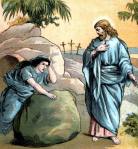
Many people witnessed the Resurrection and their testimony on the topic was The_Resurrection014important in the Church.  It started with the women on the morning of the Lord’s Feast of Unleavened Bread and that of “Firstfruits.”  This was also the beginning of the Feast of Weeks, which ends in what we call Pentecost.  So following Paul’s list in 1 Corinthians 15: 5 – 8 and adding in the ones from the Gospels the appearances of Jesus during the Resurrection were:

  • The women (Mary Magdalene)
  • Peter
  • The disciples on the road to Emmaus
  • The Twelve (twice)
  • The five hundred
  • James
  • The other apostles
  • Paul

After the meetings with the Twelve they went to Galilee like Jesus had instructed them and they saw Him there on the mountain.  The story of Peter and the “great catch of the fish” (John 21) took place in Galilee but the Ascension happened near Bethany.  So it seems that the Disciples did a lot of traveling during this forty-day period.

I found that the two appearances to the Twelve in John 20 were based on the Feast of Unleavened Bread.  The first one would have been the start of the Feast and the second visit was the end of the Feast (Leviticus 23: 4 – 8).  The Disciples were observing the Feast and honoring their Jewish beliefs.

Pics from: http://clipart.christiansunite.com/Easter_Clipart/The_Resurrection_Clipart/index3.shtml 

Jesus Returned

The_Resurrection016

I know it sounds simple but unless Jesus had returned and showed Himself to people, Palm Sunday through Good Friday would have made no sense at all.  According to Matthew Jesus had been preparing the disciples for His returning after His death by telling them to meet at a certain mountain in Galilee.  Jesus however knew His disciples and without a little pushing they would not go to that mountain.  They seem to hunker down in the upper room and probably would have stayed there confused instead of going back to Galilee.  Mary’s encounter in the garden with the added instructions, “Go back to Galilee” was a faith and obedience builder.  When they did not leave he met the disciples on the road to Emmaus and finally had to show Himself.  I think He wanted them to leave Jerusalem and go to friendly territory to make them move.  According to Matthew even with all of the visits there were still doubters when they did go to Galilee.

Easter saw several groups “returning” from various places.  Mary Magdalene and the group of women seem to have gone to the tomb several times before she/they saw Jesus.  The disciples even though it was dark returned from Emmaus to tell the Eleven (Ten – no Thomas) that they had seen Jesus.

Jesus’ concern for the disciples had Him return to them even before returning to the Father.  John 20:17 is the phrase, “ I am returning to my Father and my God.”  I have heard several explanations as to why this had to happen but I think our sin that Jesus took on Himself and separated Him from the Father and that had to be corrected.

I guess I wish someone would have chronicled all of the next forty days but some things are just not for us to know.  The bits and pieces we have make them sound amazing and that the Disciples did move around quite a bit from Jerusalem to Galilee and back again.

Matthew 28:1-15, Mark 16: 1-14, Luke 24:1-49, John 20:1-23

http://clipart.christiansunite.com/1395484861/Easter_Clipart/The_Resurrection_Clipart/The_Resurrection016.jpg 

Jesus Asked for a Drink

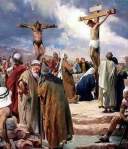
Friday of Holy Week has Jesus tried before Pilate, the Roman governor, beaten and sent to Herod, king of Galilee, made to carry His cross through the streets of Jerusalem Crux fish 2and finally nailed to that cross for all to see.  Jesus said very little during this time period, which is part of the type and shadow He fulfilled as the sacrificial lamb.  He spoke to Pilate, women in the street, Mary His mother and John, and asked God a question but for the most part He said little and did not defend His actions when accused.

The_Crucifixion025John 19:28 records one time He spoke and said, “I am thirsty.”  Since He has lost a lot of blood by this time it naturally makes sense that He would be thirsty.  Those three words have caused a lot of thought on my part this week.  Would a man who has resigned himself to die be asking for fluid?  Is this a sign of struggling to stay alive?  The Romans had vinegar there not to ease the suffering of those on the cross but to prolong it.

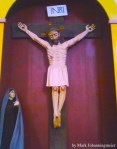
Verse twenty-eight answers some of my questions.  Jesus knew “all was completed” but that Scripture had to be fulfilled He asked for the drink.  The drink and how it was offered to Him are part of what needed to be fulfilled.  In Matthew 27:34 He was first offered wine and gall (a pain killer) but He refused to drink that.  Remember during communion He said He would not drink wine again until He was with them in Heaven.  The NIV says wine vinegar but vinegar has become a different drink because of the continued fermenting action.  In John it was offered to Him on a hyssop stalk.  Hyssop in the Old Testament deals with cleansing and has several places where this is mentioned. (A new Bible study in the making.)  So this fits in with the “types” being Crucifix from Misson Espiritu in Goliad,TXfulfilled.

My own curiosity drove this experiment.  It seems that hyssop stalks are about two feet long and if the soldier was about five foot eight inches tall that would have put Jesus’ head about eight feet in the air (about standard room height).  We always tend to make our crosses really big, I was just curious.

Think about the power in the statement “knowing that all was now completed.”  The disciples were picked and trained, parables had been taught, miracles and healings had been accomplished, and every type and shadow and prophecy had been fulfilled.  The last thing left to do on this Friday was to ask for a drink and leave.

Matthew 27: 17 – 75, Mark 15:1- 47, Luke 22:66 -23:56, John 18:28 – 19:42

http://clipart.christiansunite.com/1395398461/Easter_Clipart/The_Crucifixion_Clipart/The_Crucifixion025.jpg

Jesus Eagerly Desired

Luke 22:15 is the only Gospel account that records the statement, “I have eagerly desired to eat this Passover with you before I suffer.”(NIV)  Luke, the only Gospel writer, who was not present for this meal gives us some very important details, like which disciples went and found the room (Peter and John) and comments of the sharing of the communion. (If all of the accounts had been exactly the same that would be a problem but variations would point that they are remembering it as they saw it/ were told about it.)

Communion005This was not the first Passover meal He had had with them but He included before “I suffer.”  I feel the disciples thought that the suffering, betraying, and death were in the distance future instead of that evening and the next day.  This few hours were very important for them and the direction Jesus wanted them to go.  If you put all of the accounts together it forms a serious block of teaching and Christian doctrine.  (Please note that Judas was allowed to stay through the foot washing and communion; I feel it sealed the guilt that would over take him the next day.)  Five chapters in the Book of John are centered on this meal and they contain marvelous prayers and teaching.

Jesus knew what He was about to face in the coming hours but the meal and what it represented was that important.  He “eagerly desired” the company of His friends and those few moments of fellowship when they would truly realize that He had come from God.  This love and joy on His part is in spite of the fact that they were about to leave Him alone to religious hatred and Roman cruelty.

See Holy Week – Thursday

Matthew 26:17-75, Mark 14:12-72, Luke 22: 7- 65, John 13:1 -18:27

http://clipart.christiansunite.com/1395312061/Communion_Clipart/Communion005.jpg

Jesus Received Something Beautiful

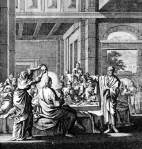
Wednesday of Holy Week finds Jesus having a meal with Simon the Leper.  There are three main characters in this story: Jesus, Judas, and a woman.  The woman, according to Matthew and Mark, opens a container of very expensive perfume and Annointing_Jesus002pours it on Jesus’ head.  Even though it does not say it I can image Judas starting the complaining about the cost of perfume and getting really mad when Jesus puts a stop to the chatter ( that is in John 12).  This anointing may have been the key to Judas betraying Jesus.

Jesus’ reaction is amazing, not only does He let the woman pour oil on His head/body but also defends the action.  He allowed her to minister to Him in this rather extraordinary way.  He knew that she had received a revelation that He was about to die and that He needed to be anointed.  Notice there was no reaction about His statement that He was about to die.  Jesus put this act of obedience in a very important position so it will be told when the Gospel is preached.  She did three notable things: she got a revelation, acted on it, and she gave a tremendously valuable monetary gift.

There are two other references to Jesus being anointed: Luke 7:36 – 39 and John 12:1- 8.  John’s telling is still probably this story even though chapter 12 starts with “six days before Passover.”  I would tend to blame modern man’s need to put punctuation into Greek text; if this is not an oversight maybe Jesus was anointed twice during the week, once before the ride into Jerusalem and then before His trials, both would have been fitting.  Luke has a different story about Jesus being anointed and given that he did a lot of research before writing his gospel I would tend to think that there was at least two different occasions that Jesus is anointed.  The main similarity is the name Simon but that was a common name, plus would a Pharisee risked having Him to dinner while everyone was looking for a way to kill Jesus?

Imagine now that Jesus and His clothes have been anointed on Wednesday what Thursday and Friday must have been like.  Judas sitting next to Jesus at the Passover meal still smelling the perfume and being angry, the mob and the chief priest had to smell Him while they are going through the arrest and trial, Pilate smelling the perfume while he is questioning Jesus, and the soldiers trying to beat the fragrance off Him so they can crucify Him.

Matthew 26:3-16, Mark 14:1-11, Luke 22:1-6

See Holy Week 2013 – Wednesday

http://clipart.christiansunite.com/1395139261/Pictures_of_Jesus_Clipart/Annointing_Jesus_Clipart/Annointing_Jesus002.jpg