
Christmas Characters – Mary

As I read the Christmas story looking at Mary the thing that most impressed me about her was that she served Elizabeth for three months.  However they were related, it was important for Mary to share this time with her friend and relative. (I do wonder if part of the reason for this visit was not to strengthen her faith for what lay ahead of her.)mary-and-elizabeth

The Cost

This trip came at a cost.  It was the first of four times that she would go between Nazareth and the land of Judah in nine months.  It is approximately eighty to ninety miles and she probably did the first two on foot; that would have been about a week’s worth of walking.  The journey took her through many of the historical sites of Israel and through Jerusalem.  Just walking would have been hard enough, even though she was young, but there were also the chemical changes going on inside her.  Another cost was her reputation!  She left Nazareth not showing that she was pregnant and came back with a three-month baby bump, you know tongues were wagging.   Joseph considered divorce.  Being stoned to death was a possibility. Just a little pressure for saying YES to God.

Mary and Gabriel

Mary was greatly troubled.  I don’t really blame her.  Suddenly there is a man in your room and he is happily greeting you saying you are highly favored of the Lord.  “Greatly troubled” is diatarasso it is used once in the New Testament and gives the idea she was very upset. When “greeting” is used elsewhere in Luke it is aspasmos which is just the concept of saying hello.   It seems that the entire conversation may not have been recorded but it would seem likely that Gabriel introduced himself as he did with Zechariah.

I have tried to connect Zachariah’s service with the birth of Jesus in the Post – The Day of Atonement, Passover, and Epiphany.  The results are not what I expected about the birth time of Jesus.  The legend/history is better than I thought.

Mary had heard the Scriptures, she knew like every other virgin of the family of David that she was a candidate to carry the Messiah.  Now it was happening to HER!  Luke 3:31 cropped-jesus-2.jpgputs her in a branch of the family that came through Nathan and the only connection to the “kingly line” was with Zerubbabel and Shealtiel.  The greeting sounded like the one given to Gideon (Judges 6:12), who also had family trouble because he accepted the task he was given.
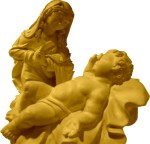
Pondering

Mary was a reflective person who considered her place in history by what God had given her to do.  In Luke 2: 19 she is “treasuring all of these happenings and pondering them.”  She would have been the only source of these happenings for Luke and Matthew.

Her song of praise in 1:46 showed a lot of thought and awareness of Scripture and the events of her time.  I think the week-long walk may have helped the composing of her song.

http://www.freebibleimages.org/illustrations/

Christmas Characters – Elizabeth

Elizabeth is a special person who does not get the recognition she deserves.  She is a model of a godly woman.  She loved God, and was faithful to her husband, relatives, and friends; she was learned and responsive to the Holy Spirit.  Zechariah being a priest had to marry a “descendant of Aaron” (Leviticus 21: 14).  Like Hannah (Samuel’s mother) and Sarai, she endured the “disgrace” of not having children; like Hannah, she must have spent time praying about this situation.

Imagine the day Zachariah finally got home from his required time at the Temple.  Her husband could not speak (and possibly not hear).  Had he written down the story?  Did he have to write it out in front of her?  How many times did she poke, stick, and scared him to test his condition?  That we don’t know, but her response to God was simply, YES, and THANK YOU.

I have tried to connect Zachariah’s service with the birth of Jesus in the Post – The Day of Atonement, Passover, and Epiphany.  The results are not what I expected about the birth time of Jesus.  The legend/history is better than I thought.

Her going into seclusion for five months was actually good for her and the baby.  A legend about John was he did not move until Mary greeted Elizabeth in Luke 1: 41. But we do know she was filled with the Holy Spirit and prophesied.  Her word to Mary was directed at settling her anxious thoughts by confirming the angel’s word.  Her strength, knowledge, and courage showed up eight days after the baby came.  She still had a husband that was notmary-and-elizabeth talking, a baby demanding her time, and a house full of people who were about to cut her son.  On top of that, they were arguing with her about the name of her son.  Something I came to notice during this study, she did all of this and she was the only person that did not have a visit from Gabriel.  Zechariah, Mary, Joseph, and the shepherds all got an angelic visit.  God knew Elizabeth and knew that she would go on the word of her husband and her faith in Him.

This fact is still interesting – a descendant of Aaron had a relative from the house of Judah.  They were close enough that Elizabeth welcomed her and let her stay for about three months.  The family ties were solid enough that Gabriel used Elizabeth to build faith in Mary.

pic – http://www.freebibleimages.org/illustrations/

Christmas Characters – Zechariah

Zechariah, the father of John the Baptist, has two scenes in the first chapter of Luke but is still important in the life and mission of Jesus.  The good doctor Luke begins the Christmas story with him.  Not just as the father of John but as a time reference.  He is performing the priestly duties of the division of Abijah during the time of Herod.  We really are not sure when this was but Theophilus could have figured it out.

David in 1 Chronicles 24 assigned the two priestly families months when they would serve at the Tabernacle.  (For a small discussion of the families go to Samuel – Priest.)  These assignments would have held until the destruction of the Temple and Jerusalem by the Babylonians.   This concept is applied again by Nehemiah when he was governor (12:17).  Abijah is one of the four names that are in both lists.

There are some loose comparisons between Zechariah and Abraham, but the notable difference is that he did not believe the news about a child being born.  Just for fun I reviewed the writings of the Prophet Zechariah and found a few light comparisons; mostly that the prophet also had angelic visits.  Zechariah’s (father of John) prophesy in Luke 1: 67 – 79 does carry some of the themes in the Book of Zechariah.

The fear Zechariah had while burning the incense (Exodus 30) possibly came from the incense_stickthought that he had done something wrong and was not worthy to be performing that duty. This fear started with the death of Nadab and Abihu in Leviticus 10 and Korah’s rebellion in Numbers 16.  I have read in a variety of places that the priest would have a rope tied to his ankle just in case he messed up and was struck down behind the curtain.

His reaction to Gabriel’s heavenly message was just one of unbelief, not a happy surprise; he challenged the reality that it would happen.  There could be many reasons for Gabriel stopping Zechariah from speaking, but stopping the spread of his doubt seems the best.  Also, his total silence for nine months adds to the importance of his real inclusion in this story, the birth of John.  The other three Gospels include John and his mission, but it is interesting that the only non-Jewish writer included the miracles and signs associated with his birth.

I have tried to connect Zachariah’s service with the birth of Jesus in the Post – The Day of Atonement, Passover, and Epiphany.  The results are not what I expected about the birth time of Jesus.  The legend/history is better than I thought.

Nine months of silence and a visit from Mary prepared Zachariah for his final scene in birth-of-johnLuke when he confirmed the angelic message by naming his child John.  He joined the small group of people who are recorded in the pre-Pentecost time as having been filled with the Holy Spirit.  It is worthy to note that his prophesy started with the news of Jesus and then went to his son John.  That part of his utterance carries the words of Gabriel and Malachi 3:1.

Besides fathering John, Zachariah was the link to the priesthood informing them that something great was about to happen!  They choose not to accept!

http://www.freebibleimages.org/illustrations/

https://en.wikipedia.org/wiki/Incense

Joel – The Land

If asked, before this study, I would have said the key feature in the Book of Joel is the locust; now I would say it is “the land” or “His land.”  The reason for the locust came was to distress the people and clean the land. Sometimes our English translations don’t do the Hebrew text justice.  Joel used specific words when he talked about valleys and mountains that change the mental pictures of his prophecy.  He does the same thing when he is writing about land or ground; most of the time the word is erets, but twice the word adamah is used.

David states in Psalm 24:1 “the earth is the Lord’s and everything that is in it.”  Joel is writing to the “elders” and “the all” that live in THE LAND.  In 1:6 and 3:2 Yahweh refers to this piece of real estate as “My land” and Joel in 2:18 calls it “His land.”  The word is erets and refers to earth or by extension all of the earth is His because He made it.  But that little sliver of land we call Israel is very special to Him.  It is no mistake that he led Abram there and promised it to his yet unborn children.  New Jerusalem will be placed there and some Bible teachers will make the argument that is where the Garden of Eden (2:3) was.  Those locusts were sent to strip the fields and pastures and so cover the mountains and valleys in order “to clean” it off.  This, in turn, produced the anguish/repentance that was needed.  The army of locust/army of people will be judged for what they do in Israel.

Adamah the word for ground/earth is used in 1:10 and 2:21, and it refers to red or productive ground and is the ground that Adam came from.  This term is important because it is a promise for us; when we are obedient the ground is productive, but rebellion will hinder that productiveness.  1:10 is dealing with the rebellion/loss of production and 2:21 is when Judah is promised blessings again.

The razing of the land talked about in Joel sounds like the destruction that the Roman army brought when they destroyed Jerusalem in 70 A.D.

God is the Master Gardener; He is letting us use His earth we need to take care of it as best we can.

Joel – Mountains

To do a post on valleys and not one on mountains does not seem right.  The Hebrew word har (mountain) is used six times in Joel.  A word for hill is used once in 3:18, but depending on the translation you may read “hill” even though it is the word Har. (Got to love translators and their work.)

Three times in Joel Har is used with the word Zion or holy (2: 1, 32; 3: 17).  The other three times the NIV adds an “s” making them plural, so to me, that makes them all the other mountains in Israel.  Mountains in Israel and other places are often sacred places.  Strong’s Concordance states they are often associated with deities and serve as symbols of strength.  Israel did have problems with using mountains as worships sites for other gods throughout its history.  If you read this thought (what we think as strong or wrong gods) into the verse when you read 2: 2, 5, and 3: 18 it transforms the verses into statements of God’s greatness and blessings over and above the gods that would war against Him and his people.

In 3:18 it is the mountains and hills that are giving the wine and milk.  These are the “areas” above the valleys where I would normally think of when it comes to food production.  I will let you draw your own conclusions here but it should give you another look into the greatness of our God.

Reference – Strong’s/Vine’s Concordance