Terah and His Granddaughters the Mothers of Israel

Terah, the little-known figure in Genesis 11 is the grandfather of Israel.  His granddaughters are the “mothers of Israel” and his grandsons are the “fathers of Israel”.  To clear the air at the start of the post, families intermarried 4,000 years ago.  Genetically that would not work well now.  The gene pool seems to have been corrupted along with society as we have moved away from the Garden.  I am not trying to do genetics in this post because I am not qualified, but I will note some of the non-Terah additions.   

Terah, it seems, had several wives, none of them are named.  We know that Abram and Sarai were half-siblings, but Nahor, Terah’s second son, married the daughter (Milcah) of his third son – Haran.  I guess you lose sight of the fact that this is still tracing the family line back to Noah and then to Seth and Adam.  Flip that forward you have the family line of those who first “called on the name of the Lord” (Genesis 4:26 NIV).  

Rebekah, Terah’s great-granddaughter, married her cousin Isaac, and his great, great, granddaughter’s Leah and Rachel married their cousin Jacob.  Milcah was Terah’s granddaughter, her son Bethuel fathered Laban and Rebekah.  Laban was with Bethuel when Abraham’s servant was handing out things to get Isaac a wife – Rebekah.  Besides Leah and Rachel Laban had sons (Genesis 31:1).  We have no idea who the mother of Laban was or who his wife was.  Haran had another son, Iscah, but nothing is said about him.

Names – Strong’s Concordance has no meaning associated with Terah.  Nahor is the name of Terah’s father and second son, it may mean snoring.  Bethuel, who is not mentioned in Genesis 29:5, may mean “destroyed of God”.  Laban may mean brick or white.  I like names and their meanings but you may have to do more than a quick search to form an opinion before you make it part of the story.

The Other Mothers of Israel

Leah and Rachel account for nine tribes in Israel. Laban gave his daughters maidservants – Leah was given Zilpah and Rachel received Bilhah.  The two servants had four sons for Jacob.  We know nothing of these two girls and a safe guess is they came from the Haran area.  This should complicate the family bloodline a bit but they are still “children” of Abraham.

The Wives of Jacob’s Sons  

Isaac and Jacob were both “encouraged” to go back to the family in Padan Haran to find brides.  The servant who was entrusted with the task was not to take Isaac back there.  Rebekah was “upset” with the women around them and not too happy that Esau had found his wives from the Canaanites. (I believe that Esau in Genesis 28:8+9 took a bride from Ishmael in an attempt to please his father. A wife from within the family.)  Jacob probably knew he would not be welcomed by Laban if he was looking for wives for his sons.  So, where did the girls come from?  Joseph’s wife was an Egyptian; they had Manasseh and Ephraim.  Judah married Shua and had children by Tamar (Jesus’ grandmother), they were both Canaanites. The easy answer to the wives is Canaanites, or “Jacob’s servants” he acquired in Haran, or women from Shechem.  If we are thinking genetics, the family line has spread out again and the line of Terah was not added in for the twelve sons to form their families.  Once the family population was greater they could go back to marrying cousins.

Part of the Law was not to intermarry with the people/nations around them.  Ruth is a worthy inclusion, she is a granddaughter of Lot through his son Moab.  All three of Terah’s sons added to the bloodline of the Hebrew nation and more specifically, Judah

Terah 

This is definitely a “what if”!  Terah in Genesis 11:31 seems to be the first one going to Canaan.  When he left Ur, he traveled northwest to skirt the desert.  He made it to Haran (the town with the name of his dead son) and stayed and died there.  Nahor and Milcah are not mentioned in Genesis 11:31, 32.  Were they already in Haran, which is why Terah never left?  Don’t know! They may have followed after Terah and Abram.  

The stated reason for leaving Ur was to go to Canaan.  Was Terah following the voice of God?  Did he just stop following the leading and stayed in Haran?  Was he just going with Abram who was really the one called?  Would the whole family (Terah, Nahor, Lot, and Abram) going and being in Canaan changed the major points of history?   

The Really BIG What If

Were these direct descendants of Seth going to Canaan to meet Melchizedek?  We are not told of any other meetings between Abraham and Melchizedek other than Genesis 14.  I just find it hard to believe they did not meet.  And the ten percent Abraham gave was a lot of possessions to someone you did not know.  Yes, the region of Moriah could have been the land controlled by the King of Salem, but that was after Abraham’s victory (Genesis 22).

Oh!

We can see what Canaan did to Lot.  Laban would have been really bad.  Well, Sodom would have been burned up by his time, but I don’t think Laban would have done well there.  Israel had enough problems with Moab, Ben-Ammi, Esau, and Ishmael, the family infighting would have gone to another level.

Abraham not wanting Isaac to go back to Haran could have been for two reasons. Frist, Haran was not a nice place.  Second, Abraham knew that Isaac’s blessings would only be found in Canaan, the place where there was a priest like Melchizedek.  Genesis 15: 7+8 confirms the calling and the possession of the land.
Kings and Prophets of Judah

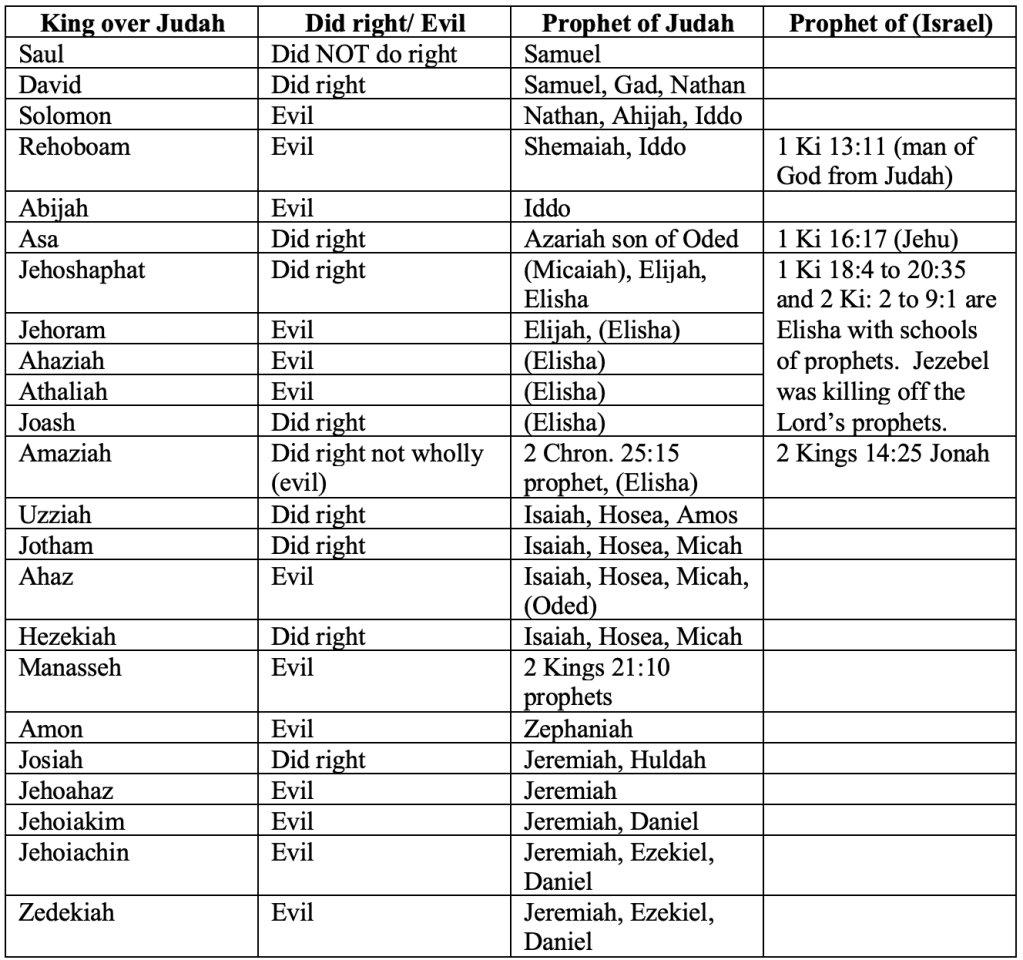
Kings and Prophets of Judah and Israel is a study help.  I believe the prophets are paired with the king(s) they served with, there may be some over-lapping that I did not catch. 

Logos – Truth

Truth, the word, as part of the logos of John’s Gospel (KJV) is used by John, himself, questioned by Pilate, and given by Jesus.  In my Strong’s/Vines Concordance it is G #225 – Aletheia (truth) it signifies the reality lying at the basis of an appearance, the manifested, veritable essence of a matter. G #230 or “of a truth” (truly) is used by the disciples at the feeding of the five thousand when the leftovers were picked up (6:14), and the Jew’s at the Feast of Tabernacles (7:40).  

In the 2011 version of the NIV, John uses the word truth in forty-two verses, in his Gospel he used it in twenty-three verses, and in nineteen verses in 1,2, and 3 John.  The word truth is not used in Revelations.  This is in contrast to Matthew who uses it once in his Gospel. (Different translations will differ in the total number of uses.  These numbers are for the base word truth, so truthful, etc. is included.  True does come into play in some translations.) The New Testament uses truth 102 times, while the Old Testament has thirty-five uses of the word.

John using the word truth more than the other writers of the Bible makes sense because John is showing us that Jesus is the Christ and God’s Son.  There have been seven outstanding miracles highlighted in John.  This is a shame because more miracles are documented in the Gospel of John (See Plus One and +++).  The total number is not given because Jesus healed large numbers of people at various times in that Gospel. Truth is used a large number of times to highlight John’s purpose in declaring Jesus as the Son of God.

So, is truth a capstone, something to always be reaching for, or is it a foundation stone, something that you are built on and has always has held you up?  One will always have you looking and never finding your answer.  The other one you can rest on knowing it is there. If you go looking for it, it may still be hard to find, you may have to dig a bit, but you know it has always held you up.

Friday of Holy Week had Jesus being questioned by a man in John 18: 28-40.  These two men had very different views on what truth was.  Pilate’s question (vs 38), “What is truth” shows that he viewed it as a capstone, something that he was unable to reach or know.  Jesus’ statement in verse 37 has Him resting on His foundation so that He can testify to the truth even in His moment of trouble.

That precious “morning moment” when I woke up and those two choices played around in my mind made me realize I needed to choose one.  In fact, it has shown me that there are other foundation stones that I keep putting in the wrong place.  God’s love, grace, and the power of the Holy Spirit are a few things that I have put high into the air, to reach for, instead of realizing that they are what has always held me up as a Christian.

If truth has always been out of your reach, make the Logos of God your foundation by praying the pray in “Following Jesus” at the top of this post, or learn to rest on Jesus if you have prayed that prayer.

Lost Tribes of Israel??????????

Are there ten tribes of Israel lost?  I guess it depends on how you look at it.  The Naked Archeologist did a movie and explored the topic, it was interesting.  Back to the question – are the ten tribes of Israel lost?  I don’t know where they are but Father God never lost them, He knows where they are.  2 Kings 17:7-23 tells the reasons why God put them out of His presence.  Verse 23 states that at the time of the writing of Kings they were still in exile.

This was an interesting way for Assyria (and Babylon) to control a conquered nation. The “winners” would just make the population pack up their stuff and move them far away.  2 Kings 17:24 tells the story of who was brought in to take Israel’s place.  They became known as the Samaritans in New Testament.  But was everyone taken?  Babylon in conquering Judah never seemed to take everyone (Jeremiah 52:28).  2 Kings 17:6, 18:11 tells us where they (Samaria) were taken and 1 Chronicles 5:26 adds that the east bank tribes were also taken to the same place – the Habor River.

Okay, the reason for this thought and post is what tribes were the Twelve disciples from?  It would make sense that the Twelve are from those who returned from Babylon and that should have been the tribes of Judah, Benjamin, and Levi.  We do not know and are not told; the topic is never brought up in the Gospels.  In the Gospels and Revelations, it seems like the Twelve will be judging the Tribes.  Ezekiel divided the land around the New Temple/Jerusalem for the twelve tribes. Now, let us look and see what tribes are talked about after 2 Kings 17:23.

2 Chronicles 30 is the story of Hezekiah’s Passover, in verses 10, 11, and 18 other tribes are sent the message and invited to come to celebrate in Jerusalem.  Actually, the proclamation went from “Dan to Beersheba”, or from the top to the bottom, or from north to the south of the country.  That phrase is a code for all of Israel.  Beersheba is at the bottom (south) of Judah near the land of Edom and Dan is in the north (See Judges).  (To add to the drama 2 Kings 23:8 and Amos 8:14 talk about “a god” that was worshiped in Beersheba.) People from Ephraim, Manasseh, Asher, Zebulun, and Issachar responded to the call and came to the Passover. Not all of the people were sent to the Habor River by the Assyrians, or some came back!

The one tribe that really makes me think is Simeon. Genesis 49:7 states that Levi and Simeon will be scattered in Israel.  Levi is easy to see, they were given towns in Israel because of their work with the Tabernacle and Temple.  The land Simeon received was inside Judah to the south of Jerusalem.  But Jeroboam got ten of the twelve tribes in 1 Kings 11:31. Did Simeon move out? 

The New Testament has Anna from the tribe of Asher talking to Mary and Joseph at the Temple.  Paul is very proud to be from the tribe of Benjamin in Romans 11.  And Jesus was from the tribe of Judah and there were priests in the Temple from Levi.  So, several tribes are mentioned after the exile of the northern tribes.

I will still go with the idea that the tribes of Israel are not lost, the Father knows exactly where they are.  As children of Abraham, they will come to Him when the time is right.

My take away. God’s people are everywhere some just still need to be found.

Was David a Priest?

Yes, David was a priest in the order or “in the way” of Melchizedek.  No, he was not a priest after the order of Aaron or anything to do with the Tabernacle or Ark.  David had a heart for God so he did many good works.  Near the end of his life (1 Chronicles 22 -26), David made plans for the Temple and helped to organize the Levites and Priest.  At times in his life, David did things that might border on priestly rights and duties and we will look at all (or many) of these.  This topic cannot be discussed without Psalm 110 being brought into the conversation, so it will be.

I will start with the NO answer.  David could not work in the Tabernacle or with the Ark simply because he was not a son of Aaron or Levi. (Levities 8 + 9) David did do some questionable things that could be mistaken as priestly duties and rights.  But even these actions need to be viewed in the light of some other leaders.

  1. King Saul – 1 Samuel 13 is the story of Saul offering a sacrifice.  Verse 9 has Saul ordering “someone” to bring the offering to him.  The context of the story makes it sound like he did the cutting and sprinkling of the blood.  Verse 13 has Samuel telling Saul his kingdom and lineage will not last.  (Saul’s line could have ruled “for all time”.)  He actually “lost the kingdom” in 1 Samuel 15.
  2. Jeroboam – 1 Kings 11,12, and 13.  11:6 explains that Solomon had not followed God or His commands and that the nation of Israel would be divided.  Jeroboam also had a promise of a lasting kingdom if he did right (vs. 39).  12:31 (NIV) Jeroboam built shrines on high places and appointed priests from all sorts of people, even though they were not Levites.  13:33 +34 repeats his disobedience and the outcomes.
  3. King Uzziah – 2 Chronicles 26: 18,19,21.  Uzziah was a grandson of David who actually had done well until he gave into his pride.  He went into the Temple and was offering incense.  The real Priest confronted him.  He broke out with leprosy and lived separately until he died.

Please set these examples and all of the other “kings” of Israel next to Deuteronomy 17: 14-20.  These verses were the Lord’s rules for the kings who would reign over His people.  Verse 18 states that he is to make a copy (his own) of the Law and read it every day.  If David had done this it is a good bet that Solomon did not, because he broke the rules in verses 14 -17 very well.  In Jeremiah, King Josiah held a Passover because the Book of the Law was found during a Temple cleaning and he had never seen or read it before. Makes you wonder what the priest was working from?

If my three examples were judged for making sacrifices, burning incense, and allowing non-Levitical priests.  It would stand to reason if David had done these types of things he also would have been held guilty.  He had his problems but acting as a Priest in the order of Aaron was not one of them.

WELL HE DID –

  1. Eat the Bread of Presence (1 Samuel 21:1-9).  Yes, this was after he lied and deceived Ahimelech the priest, and thought about killing Doeg. I will give this one up as God’s grace and mercy and not David’s right behavior. A point of interest here is that Ahimelech’s questions to David were about legal purity and not a family origin.
  2. Wear a linen ephod. 2 Samuel 6: 12 – 23 and 1 Chronicles 15:27 has David along with the Levites wearing linen ephods as they moved the Ark of God to Jerusalem.  An ephod is a piece of clothing.  Yes, ephods are frequently associated with “priest”.  In the case of the tribe of Dan stealing one and the “house priest” it belonged to, it may seem that the robe was also worshiped.  Even if David was trying to “blend” in at the start of the parade by the end he may have taken off the ephod and was dancing around in his underwear.  A priest of the order of Aaron could not have done that, but one from the order of Melchizedek could have.  Sorry, David wearing an ephod, to me, is more like everyone trying to dress like the pastor.
  3. Move the Ark to Jerusalem.  This is David acting more like Melchizedek than Aaron.  The Tabernacle of Moses was still in use in Gibeon (2 Chronicle 1:3).  This Tabernacle of David or Tent of David has more to do with him wanting the blessing of God than him doing priestly functions.  The Tabernacle of David is a type of how to worship by grace away from the rules of the Law. 1 Chronicles 16:1-7 has David putting the priest and Levites in charge of a 24-hour praise session around the Ark.  Verse 37 – 40 has the priestly families split into two groups and doing duty in two locations – Jerusalem and Gibeon.  
  4. Build his own altar.  In 1 Chronicles 21: 18 – 30 and 2 Samuel 24: 18 – 25 David was ordered to build an altar by the prophet Gad.  He had to do this to stop a plague that his actions had started (counting the people).  This altar became the area where the Temple of Solomon was built.  David had people with him so I will suggest that he did not build the altar or kill the animals, which had to be done by a priest.
  5. Arranged the priest and Levities into divisions.  He also ordered that provisions be made and collected to build the Temple, that the leaders of the people were to help Solomon, and he changed the duties of the Levites because they were not going to be carrying the Ark and the Tabernacle around (1 Chronicles 22+ 23).  Chapter 24: 3 states that the heads of the priestly families were there with him.  He was not making these decisions by or for himself, but as a king who wanted Jehovah served and glorified.
  6. Write Psalm 110.    Some scholars will state a slightly different view on that – did he write it, was it written in his style, or was it written about him?  To me, because it is so prophetic, David wrote it and I just don’t feel he is the object of the conversation.  Matthew 22:43-45, Mark 12:36+37, Luke 20:42-44, and Acts 2:25 + 34 deal with verse one and the question of how David can call his son Lord and Messiah.  If you rewrite verse one as it should be, it would say – “Jehovah says to my Adonay”. Adonay has several meanings – God, ruler, husband, or someone in authority, that is an earthly authority.  (Check the lettering to see the difference in the word Lord.)   I am not sure that David would have talked about himself as a priest in the order of Melchizedek (vs 4), that is very boastful. If he did he would have had all of his clothes on!

Yes, David was a priest but of the order of Melchizedek. (<- That link is to Melchizedek in Hebrews, which I hope explains him at a deeper level)  Melchizedek is an interesting character, he is mentioned in three books of the Christian Bible but volumes have been said about him.  He is first mentioned in Genesis 14:18 as the “priest of God Most High” who shares a meal with and then blesses Abraham and is given an offering.  Psalm 110 adds to Melchizedek’s persona by bringing in the concept of eternal priesthood and adding the word “order”.  The Hebrew word dibrah (#1700 Strong’s) left me confused so I went to several translations for clarity.  The KJV and NIV use the word “order” while others use “like” or “in the same way”.  The Book of Hebrews (Chapter 7 discusses Melchizedek’s history) really adds to Melchizedek’s resume when he and Jesus are compared to each other. (More will be written later as this ballooned out of this study in ways I did not expect.). But back to the question of was David a priest.  Hebrew 7:12 states that a change of the priesthood and a change of the Law must go hand-in-hand, and verse 14 dispels David as a priest under the Law of Moses because he was of the tribe of Judah. So, David was a priest but not in the order of Aaron because the Law did not change and he was from the wrong tribe.

It took a while to piece together the thoughts on righteous kingship and priest. Moses gave me an example of that type of leadership.  There is no doubt of Moses’ calling and his authority but the plagues and other miracles were before the Law was given. Moses’s work before Aaron and his sons were selected, should show that he was working as Melchizedek did, a “king/priest of righteousness”.   Exodus 19:6 (which is before the giving of the Law) says all of Israel was to be a kingdom of priests and a holy nation. The episode with the golden calf changed what could have happened.  When God gave the Law the priesthood was given to Aaron.  The priesthood of “all of Israel” in the “order of Melchizedek” went to the family of Aaron, not the entire nation.  David would fit into the order of Melchizedek because he was the king of Jerusalem and righteous, having a heart for God.

This thought is found again in Revelation 1:6 – we are kings (kingdom) and priests unto God.  Different translations use kings or kingdoms but it is in line with Exodus 19:6. I have seen several of these “plan A/plan B” or “what if” things recently.  God had a big plan but stubborn hearts temporally changed the first plan to a second plan.  God’s plan A is not dead but on hold until we accept God’s plan, which is what Jesus gave us at the cross.

So, the bold things David did, he did as a king/priest in the “order” of Melchizedek.  Some of his actions would not have fit under the Law of Moses and the priesthood of Aaron. 

Imagine – Sweet Publishing/FreeBibleimages.org